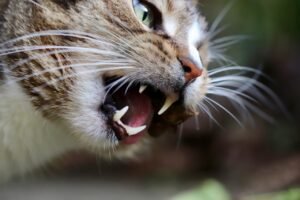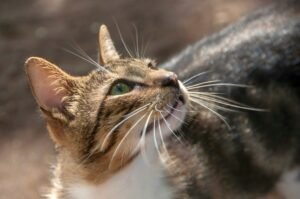

A cat’s nose may look like a small part of its face, but it plays a surprisingly important role in how your cat experiences the world. Cats have an exceptionally sensitive sense of smell, and when they are exploring something up close, scent can provide information that their eyes cannot.
This becomes especially important at the very beginning of a kitten’s life. Newborn kittens are born with their eyes closed, yet within their first days, they can use their sense of smell to navigate toward their mother and find a nipple to nurse. For such a tiny animal, the nose is more than a way to smell—it is one of the first tools a kitten has for finding its way through the world.
As cats grow, they continue to rely heavily on scent to understand their surroundings. They use their noses to evaluate food, detect other animals, recognize familiar places, pick up scent marks left by other cats, and detect chemical signals that are completely beyond our own sense of smell.
Inside the nose, a specialized system of tissues and nerve cells detects odor molecules in the air, while other scent-related structures help cats process chemical signals and communicate through scent and pheromones. Together, these systems give cats a remarkably sensitive sense of smell that helps them figure out what is familiar, what is new, what is interesting, and what may be worth avoiding.
So how does a cat’s nose actually work, and what makes it so much more sensitive than our own?
Why Is a Cat’s Nose So Sensitive?
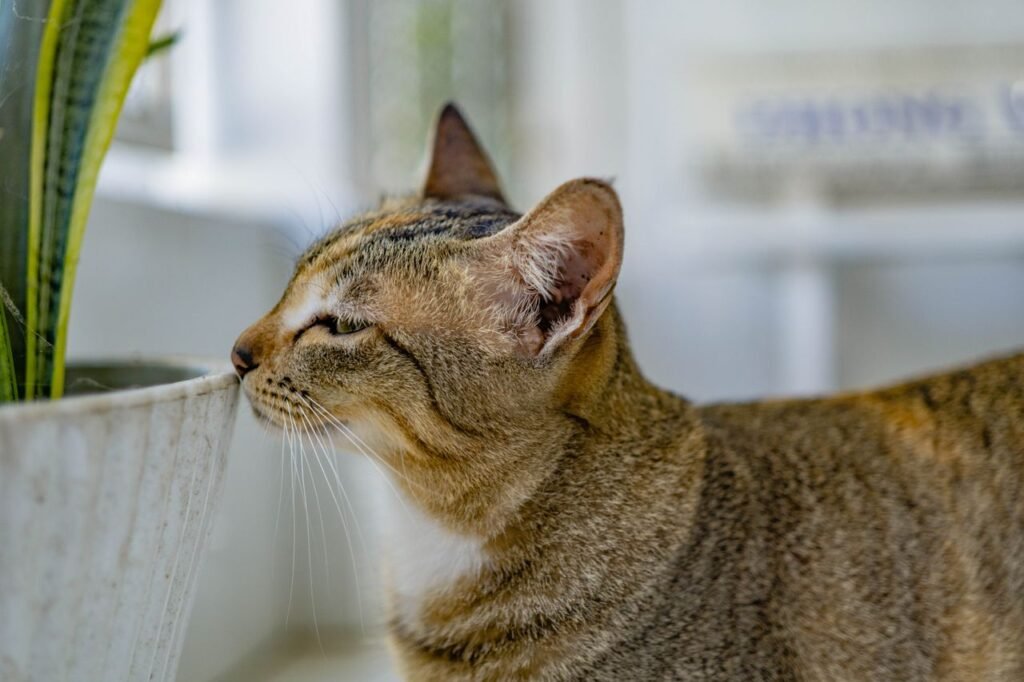
Before looking at the individual parts of a cat’s nose, it helps to understand just how sensitive the feline sense of smell can be.
A cat’s sense of smell is often estimated to be 10,000 to 100,000 times more sensitive than a human’s, although this number should not be interpreted as meaning that every smell seems 10,000 or 100,000 times stronger to a cat.
Instead, it refers to the much lower concentration of certain odor molecules that a cat may be able to detect.
In other words, a cat may notice a scent when the concentration of an odor in the air is far below the level that a human can detect.
Cats also have a much larger area of olfactory epithelium than humans. This specialized tissue contains the receptor cells that detect odor molecules and begin the process of turning them into signals the brain can interpret.
| Animal | Approximate Olfactory Epithelium Area |
|---|---|
| Humans | 2–4 cm² |
| Cats | About 20 cm² |
| Dogs | About 150 cm² |
Dogs still have a considerable advantage in terms of the overall size of their olfactory epithelium, which is one reason they generally outperform cats in scent tracking and searching. But a cat’s nose is still extraordinarily sensitive compared with ours.
And the sensitivity of the feline nose does not come from one feature alone. The shape of the nasal passages, the moist surface of the nose, the olfactory epithelium, the olfactory bulb, and the vomeronasal organ all contribute to the way cats detect and interpret chemical information.
This brings us to the anatomy itself.
Cat Nose Anatomy: What Is a Cat’s Nose Made Of?
A cat’s nose is more than the small, usually moist surface that we see at the end of the muzzle. Beneath that surface is a much more complicated system of openings, passages, sensory tissue, and nerves.
External Nostrils
A cat’s external nostrils, or nares, are the openings through which air enters the nasal cavity.
Unlike human nostrils, a cat’s nostrils have small lateral openings or slits along their sides. Small muscles around the nose and upper lip can also change the shape of the nostrils slightly as the cat breathes.
These features help control the movement of air into the nasal passages and may allow cats to sample scents from slightly different directions.
The Philtrum
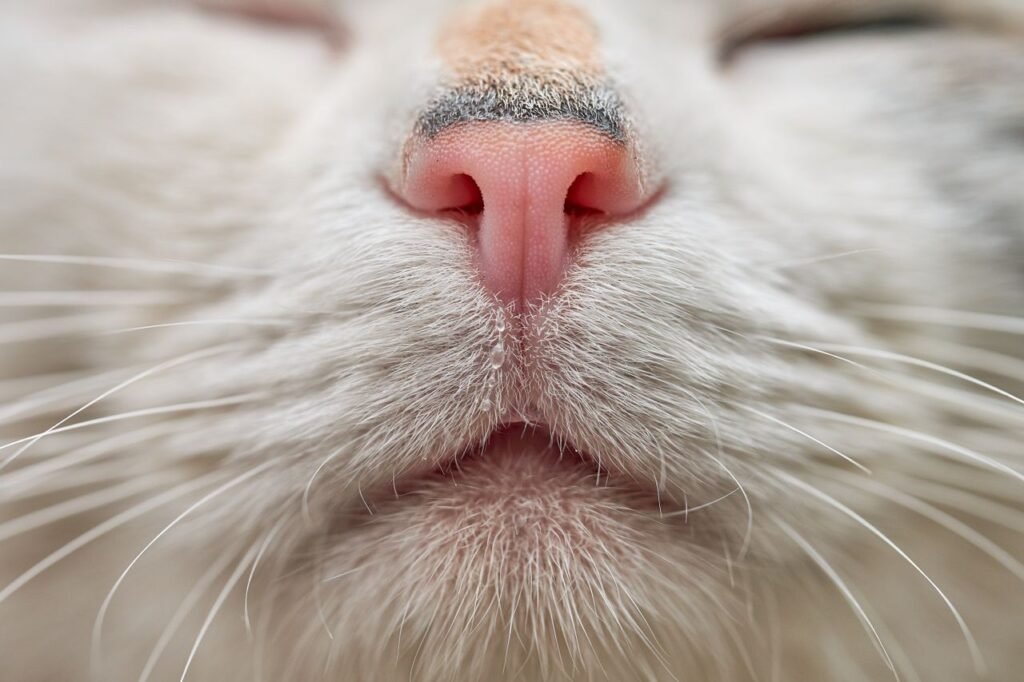
The philtrum is the narrow groove that runs from the center of the nose toward the upper lip.
The area is normally moist, and that moisture may help retain odor molecules on the surface of the nose.
Although the philtrum is easy to overlook, it is one of the distinctive features of a cat’s facial anatomy.
The Nose Leather
The textured, hairless surface at the end of a cat’s nose is commonly called the nose leather or rhinarium.
Its surface is covered with tiny grooves and ridges and is normally kept moist by secretions from the nasal area and tears that drain through the tear ducts. Moisture can help capture particles and molecules from the surrounding air.
The pattern of these grooves also varies from cat to cat. These individual patterns are often called nose prints, and while they have been explored as a possible method of identifying individual cats, they are not commonly used for identification in the way human fingerprints are.
The nose leather can also vary in color depending on a cat’s genetics and pigmentation. Cat nose colors can range from black and pink to brown, gray, or mottled patterns, and some cats may develop changes in pigmentation as they age.
The Nasal Cavity
Behind the external nostrils is the nasal cavity, where much of the important work of the feline sense of smell takes place.
As air moves through the nasal passages, odor molecules are carried deeper into the nose, where they come into contact with specialized sensory tissue.
The Olfactory Epithelium
The olfactory epithelium is a specialized layer of tissue containing millions of sensory receptor cells.
These receptors respond to different chemical compounds in the air. When they are activated, they generate signals that travel through the olfactory nerves toward the brain.
This is where simply breathing in a smell becomes the perception of a smell.
The Olfactory Bulb
The olfactory bulb is a structure in the brain that receives and processes signals coming from the olfactory receptors.
In cats, the olfactory bulb contains tens of millions of cells involved in processing smell information, helping the brain distinguish between different chemical signals.
So the feline sense of smell is not simply a function of the nose—it is a nose-to-brain system.
A Cat’s Nose Does More Than Smell Things
For cats, smell is about much more than finding something to eat.
Dogs are well known for using scent to follow trails and locate targets, but cats typically rely more heavily on vision and hearing when hunting. That does not make smell less important; instead, cats often use scent in a different way, particularly when they are evaluating their surroundings and interacting with other animals.
A cat may use smell to decide whether food is familiar or appealing, distinguish a familiar place from an unfamiliar one, detect another animal that has passed through an area, recognize scent marks within its territory, detect pheromones, and gather chemical information about other cats.
This is one reason cats can become so interested in seemingly ordinary objects after something has changed around them. A new piece of furniture, a bag brought home from somewhere else, or even another animal that has recently entered the house can introduce a whole new collection of scents for a cat to investigate.
*Helping a New Cat Adjust to a New Home: A Step-by-Step Guide
Food provides another good example. Some cats are reluctant to eat food immediately after it comes out of the refrigerator but show more interest once it warms up. One possible explanation is that colder food releases fewer volatile odor compounds, which can make its aroma less noticeable and potentially less appealing to a cat.
For an animal that relies heavily on scent information, even a small change in odor can make a difference.
Do Cats Have a Better Sense of Smell Than Dogs?
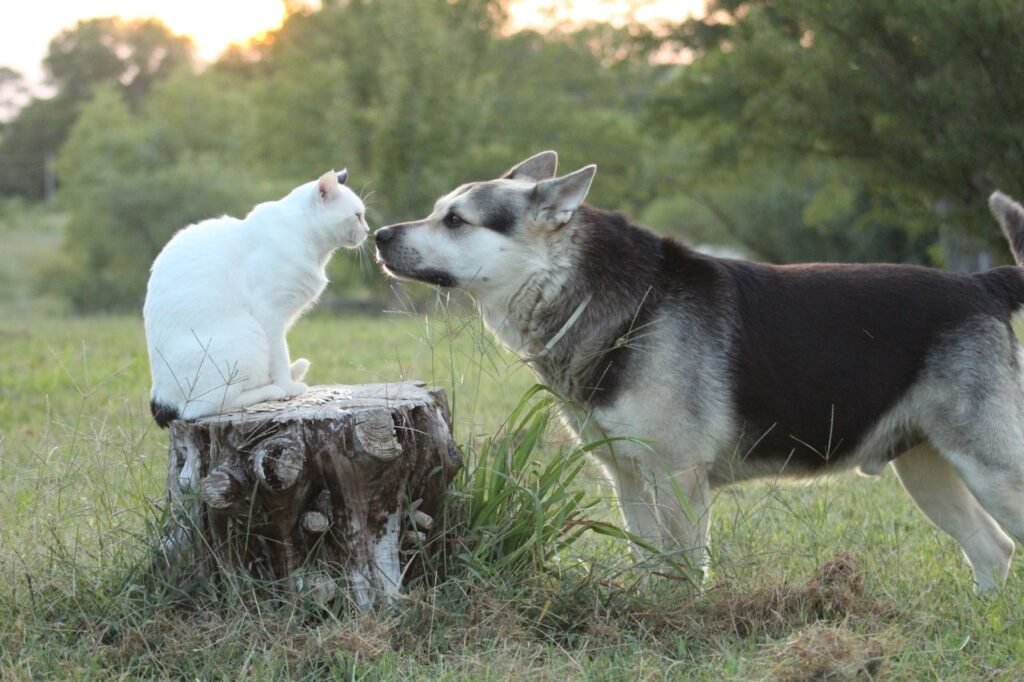
Usually not.
When the overall ability to detect and track odors is compared, dogs generally have the advantage. Cats have about 20 square centimeters of olfactory epithelium, while dogs may have around 150 square centimeters, giving dogs a much larger area of tissue devoted to detecting odors.
That larger olfactory surface is one reason dogs are generally better suited to tasks such as scent tracking and searching for a specific odor over a distance.
But that does not mean a cat’s nose is anything less than impressive.
Cats have a highly sensitive olfactory system, and the internal structure of their nasal cavity appears to be particularly well suited to processing odor molecules.
Rather than simply moving air in and out for breathing, the nasal cavity can shape airflow in ways that help deliver odor molecules to the sensory tissue deeper inside the nose.
The researchers compared the combination of feline nasal airflow and the layered structure of the olfactory epithelium to a highly efficient molecular detection system.
So the simplest answer is this:
Dogs generally have the stronger sense of smell, especially when it comes to tracking and locating odors, but cats still have an exceptionally sensitive sense of smell and a nasal system that is remarkably well adapted for analyzing scent.
How Do Cats Use Their Noses to Communicate?
For a cat, a scent can mean much more than simply, “What is that?”
It can also carry information that amounts to:
“Who has been here?”
“Is this my territory?”
“Do I know this animal?”
“Does this place smell familiar?”
Cats have scent-producing glands in several areas of the body, including the sides of the forehead, around the mouth, beneath the chin, along the tail and tail base, on the paw pads, and around the anal region.
When a cat rubs its face, body, or tail against furniture, a wall, a doorway, or even your legs, it may be leaving some of its own scent behind.
This behavior is associated with territory marking, familiarity, social communication, and environmental comfort. To us, the furniture may look and smell exactly the same after a cat rubs against it, but to the cat, that familiar scent can be an important part of what makes the environment feel recognizable and safe.
Cats can also gather information from the scents other animals leave behind, which is why sniffing is such an important part of their interactions with one another.
What Is Jacobson’s Organ in Cats?
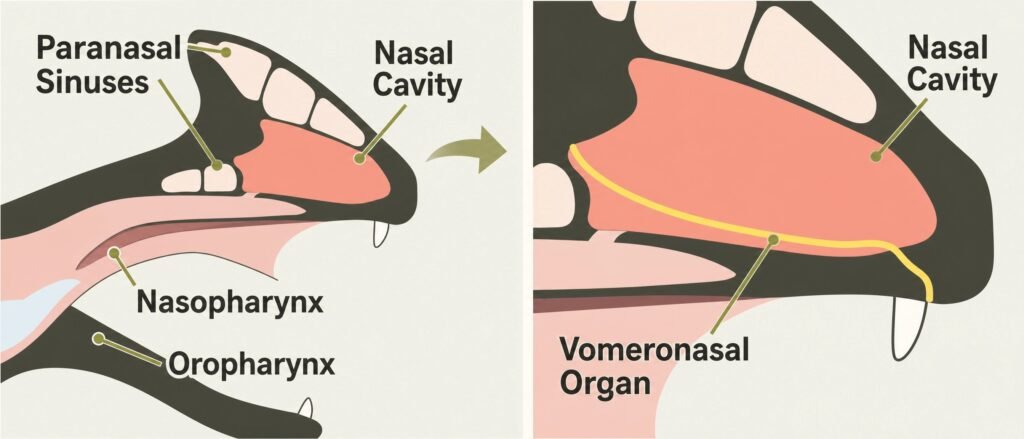
Jacobson’s organ, formally known as the vomeronasal organ, is a specialized sensory structure located near the roof of a cat’s mouth.
Unlike the main olfactory system, which handles ordinary smells, the vomeronasal organ is specialized for detecting certain chemical signals, including some compounds involved in animal communication and pheromones.
Humans have a highly reduced vomeronasal organ, while cats retain a functional vomeronasal system.
This gives cats another way to process chemical information beyond what they detect through their ordinary sense of smell.
And there is a very recognizable behavior associated with this system.
Why Does My Cat Open Its Mouth After Smelling Something?
If your cat ever sniffs something and then suddenly opens its mouth, raises its upper lip, and stares into space with a strangely serious expression, it is probably not making a face because the smell is unpleasant.
It may be showing the Flehmen response.
During this behavior, a cat changes the position of its mouth and lips in a way that helps direct certain chemical signals toward the vomeronasal organ, allowing the cat to examine them more closely.
The result can look almost comical to us, but for the cat, it is essentially another way of analyzing information in its environment.
The Flehmen response is not unique to cats. Horses, lions, and several other mammals display similar behavior when investigating certain scents or chemical signals.
Are Cat Noses and Turtle Noses Homologous Structures?
This is a surprisingly interesting question in comparative anatomy.
The short answer is that cat and turtle noses share a deep evolutionary foundation as parts of the vertebrate head and respiratory system, but it would be misleading to describe the entire cat nose and turtle nose as simply the same homologous structure.
Cats and turtles are both vertebrates, so they inherited the basic vertebrate body plan from distant common ancestors. Their nasal systems developed from that shared evolutionary foundation, but their lineages diverged a very long time ago, and their noses have since evolved in very different directions.
Cats are mammals, while turtles are reptiles, and their skulls, respiratory systems, lifestyles, and sensory needs are quite different. As a result, their nasal cavities have developed distinct structures and adaptations. Comparative anatomical studies show that turtle nasal cavities themselves can vary substantially among species, with different internal structures associated with different ecological adaptations.
Cats have a highly developed olfactory system that includes a relatively large olfactory epithelium and a functional vomeronasal organ. Turtles also have nostrils and olfactory tissues, but their nasal anatomy is organized differently and reflects their own evolutionary history and lifestyle.
So there are two different questions to separate here.
What Are Homologous Structures?
Homologous structures are anatomical features that can be traced back to a shared ancestral structure, even when they have changed considerably in shape or function over evolutionary time.
The forelimbs of cats, humans, bats, and whales are a classic example: they look and function differently, but their underlying skeletal pattern reflects common ancestry.
What Are Analogous Structures?
Analogous structures are features that evolved independently in different groups because they perform similar functions or solve similar biological problems.
Their similarity comes from similar selective pressures rather than from inheriting the same structure directly from a common ancestor.
So, if the question is:
“Are a cat’s nose and a turtle’s nose exactly the same anatomical structure?”
No.
If the question is:
“Do they share an evolutionary foundation?”
Yes.
The most accurate way to think about them is that both are vertebrate nasal systems built from an ancient shared body plan, but they have been extensively modified along separate evolutionary paths.
Common Questions About Cat Noses
Yes. Cats have a much more sensitive sense of smell than humans and possess a larger area of olfactory epithelium as well as a highly developed olfactory system.
Usually not. Dogs generally have the advantage when it comes to detecting, tracking, and locating scents, but cats still have a remarkably sensitive sense of smell and a specialized nasal system for processing chemical information.
Sniffing is one of the main ways cats investigate their surroundings. Your cat may be checking food, unfamiliar objects, other animals, or scent marks left in its territory.
The area around the tail base and anus contains scent-producing glands that can provide chemical information about an individual cat. Sniffing this area allows cats to gather information about one another that humans cannot perceive.
A brief nose-to-nose greeting is often a relatively peaceful form of social interaction. Cats can use scent to recognize one another and gather information about the other cat.
Every cat has its own pattern of fine grooves on the nose, so nose prints can show individual variation and have been explored as a possible identification method. However, they are not currently used as a standard identification system in the way fingerprints are for humans.