
Why Do Cats Have Tails?
If you have ever watched a cat walk along the top of a fence, balance on a narrow railing, or make a surprisingly graceful jump from one piece of furniture to another, you may have wondered how they make it look so easy.
A cat’s tail may look like little more than a fluffy accessory, but it is actually a useful and highly expressive part of the body. It helps cats adjust their posture as they move, communicate with other cats and people, sense what is happening around them, and even conserve warmth when they curl up to sleep.
So, why do cats have tails? What does a cat’s tail actually do? And how do cats without tails get around?
To answer those questions, it helps to start with what a cat’s tail is made of.
What Is a Cat’s Tail Made Of?
A cat’s tail is essentially an extension of the spine.
Inside it are a series of small bones called caudal vertebrae. These vertebrae are connected by joints and supported by muscles, ligaments, nerves, and blood vessels, giving the tail both strength and flexibility. The vertebrae are generally larger near the base of the tail and become smaller toward the tip.
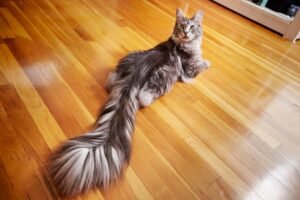
That structure allows a cat to move its tail in remarkably precise ways. A cat can hold its tail upright, let it droop, sweep it from side to side, curl it around another cat or a person’s leg, or make small movements that are easy to miss.
The tail can also become dramatically larger when the fur stands on end. This is the familiar “bottlebrush” tail you may see when a cat is frightened or highly aroused.
What Does a Cat’s Tail Do?
A cat’s tail has several important functions, and they overlap rather than working independently.
It Helps Cats Maintain Balance

One of the best-known functions of a cat’s tail is helping with balance and body control.
Think of the tail as a movable counterweight. When a cat is walking along a narrow surface or making a quick adjustment during movement, shifting the tail can help change the position of the body and keep the hips aligned.
A 1998 study published in Behavioural Brain Research looked specifically at how cats use their tails while crossing a narrow beam. When the beam suddenly moved sideways, the cats quickly moved their tails in the opposite direction. This tail movement helped realign their hips and reduced the likelihood of losing their balance.
That does not mean the tail is a cat’s only balance system. Cats also rely on their inner ear, vision, proprioception, flexible spine, muscles, and joints to control their position in space.
The tail is better thought of as one part of a much larger balance-and-movement system.
It Helps Cats Communicate

If you live with a cat, you have probably already learned that the tail can say quite a lot without making a sound.
A cat’s tail position and movement can provide clues about its mood and intentions.
For example:
- Tail held upright: Often associated with confidence, friendliness, or a social greeting.
- Tail tucked close to the body: May indicate fear, anxiety, or stress.
- Tail puffed up: Usually signals that the cat is frightened, startled, or highly aroused.
- Tail rapidly swishing or thrashing: Can indicate irritation, agitation, or emotional arousal.
- Tail wrapped around a person or another cat: Often occurs during friendly social interaction.
But there is an important catch: a cat’s tail should never be interpreted on its own.
Ears, eyes, whiskers, facial expression, body position, and the surrounding situation all provide additional information. A rapidly moving tail, for example, does not have one universal meaning in every situation.
Learning to read the whole cat rather than just the tail will give you a much more accurate picture of what your cat is trying to communicate.
To learn more, see: Cat Tail Language: What Your Cat’s Tail Is Telling You
It Can Help Conserve Warmth

Have you ever seen your cat curl into a tight little ball with its tail wrapped around its body or face?
There is a practical reason for that cozy-looking position.
Cats can use their tails as an additional layer of insulation when they curl up, helping cover parts of the body that are exposed to cooler air. A thick, fluffy tail can work much like a small blanket, especially when the cat is resting.
This does not mean cats rely on their tails as their primary method of temperature regulation. Their fur, body position, grooming behavior, and other physiological mechanisms all play roles in maintaining body temperature.
Still, a fluffy tail wrapped around the body is a useful little bit of natural insulation.
It Plays a Role in Scent Marking
Cats have scent glands in several parts of their bodies, including areas around the face and along the tail. When a cat rubs against furniture, another animal, or even your legs, it can leave behind familiar scents as part of normal feline social communication.
So when your cat wraps its tail around your leg, it isn’t necessarily “claiming” you. It may simply be greeting you, reinforcing a familiar scent, or engaging in friendly social contact.
What Is Stud Tail?
The tail also has some specialized oil glands, particularly near its base. When these glands become overactive, a condition known as stud tail, or tail gland hyperplasia, can develop.
Stud tail is most commonly seen in intact male cats, although any cat can develop the condition. It can cause greasy fur, hair loss, scaling, darkened skin, blackheads, or inflammation around the base of the tail.
If you notice persistent greasiness, hair loss, crusting, swelling, or other changes around your cat’s tail, it is worth having your veterinarian take a look rather than assuming it is simply a grooming issue.
Can Cats Live Without a Tail?
This is where things get interesting.
If a cat’s tail is useful for balance, communication, sensory information, and other functions, can a cat without a full-length tail still live normally?
Yes, many can.
Cats born with naturally short tails or no visible tail can still move, climb, jump, play, and communicate. They simply rely more heavily on the other systems involved in movement and balance.

Some cats are born with naturally short tails, including Manx cats and several bobtail breeds. Their tail length can vary considerably, and the absence of a full-length tail does not automatically mean that a cat will have difficulty getting around.
However, there is an important distinction between being born with a naturally short tail and losing a tail because of an injury.
What Happens When a Cat Loses Its Tail?
A serious tail injury can be much more complicated than simply losing the visible part of the tail.
Because the tail is an extension of the spine and contains nerves, injuries near its base can sometimes affect the nerves involved in tail movement and, in more severe cases, functions such as urination and defecation.
The important point is not that every cat with a tail injury will develop bladder or bowel problems. Rather, a severe tail-pull injury can involve nerves near the base of the tail, so it should be treated as a potentially significant injury.
This is also why a cat that has been hit by a car, had its tail caught or pulled, or suffered a serious injury around the tail should be examined by a veterinarian, even if the tail itself does not look badly damaged.
What About Cats Born Without Tails?
Some cats naturally have very short tails, while others may appear completely tailless.
The Manx is one of the best-known examples. Other cats, including certain bobtail breeds, may also have naturally shortened tails.
Many of these cats live active, normal lives. But genetics can matter.
In some tailless cats, particularly those with severe forms of the Manx mutation, changes associated with tail length can also affect the lower spine and nervous system. Depending on the individual cat, this can lead to problems involving movement, sensation, or bladder and bowel function.
So it would be misleading to say that tailless cats simply “grow stronger back legs” to compensate for their missing tails. Some cats adapt extremely well, but the biology behind naturally short or absent tails is more complicated than simple physical compensation.