

We all know that a cat’s tail does a lot more than look cute. It helps cats keep their balance, sense what is happening around them, stay warm, and communicate with other cats and people.
A cat’s tail is also remarkably flexible. With muscles, vertebrae, nerves, and other structures working together, cats can move their tails in surprisingly precise ways. Those movements have become an important part of feline body language, giving cats another way to communicate without making a sound.
But there’s an important catch: cat tail language is not a simple dictionary where one movement always has one meaning.
A raised tail can signal a friendly approach, while a puffed-up tail can indicate fear or a defensive response. A rapidly swishing tail may mean irritation in one situation and intense focus during play in another.
Here are some common examples of cat tail language—and the reasons behind them.
Cat Tail Positions and What They Mean

This chart gives you a quick look at some of the most common tail positions and movements you may see in cats. But remember: these signals are only part of the picture.
To really understand cat tail language, you need to look at the tail together with the cat’s ears, eyes, posture, facial expression, and the situation itself.
Let’s take a closer look at what some of these tail movements may be telling you.
Tail Held Straight Up While Walking Toward You

One of the easiest cat tail signals to recognize is the upright tail.
When a cat walks toward you with its tail held high—especially when it then rubs against your legs—it is generally a friendly, non-threatening approach. Cats commonly use this posture when greeting familiar cats or people.
But why do cats raise their tails when approaching someone?
One possible clue comes from kitten behavior. Very young kittens raise their tails during interactions with their mother, including when their mother grooms them around the rear end. This is part of normal early-life care, when kittens are completely dependent on their mother.
That does not necessarily mean an adult cat is literally “returning to kittenhood” when it greets you. Rather, some of the social signals cats develop early in life remain part of their communication repertoire as adults.
When a house cat approaches a person with its tail held high and then rubs against them, the behavior is therefore better understood as a friendly social approach than as a simple sign of happiness. The cat may also be seeking attention, social contact, or—very often—a meal.
In other words, if your cat walks toward you with its tail straight up, it may be saying something along the lines of:
“Hi. I’m comfortable with you. What are we doing?”
And sometimes the answer is simply, “Where’s dinner?”
Why Does a Cat’s Tail Puff Up?
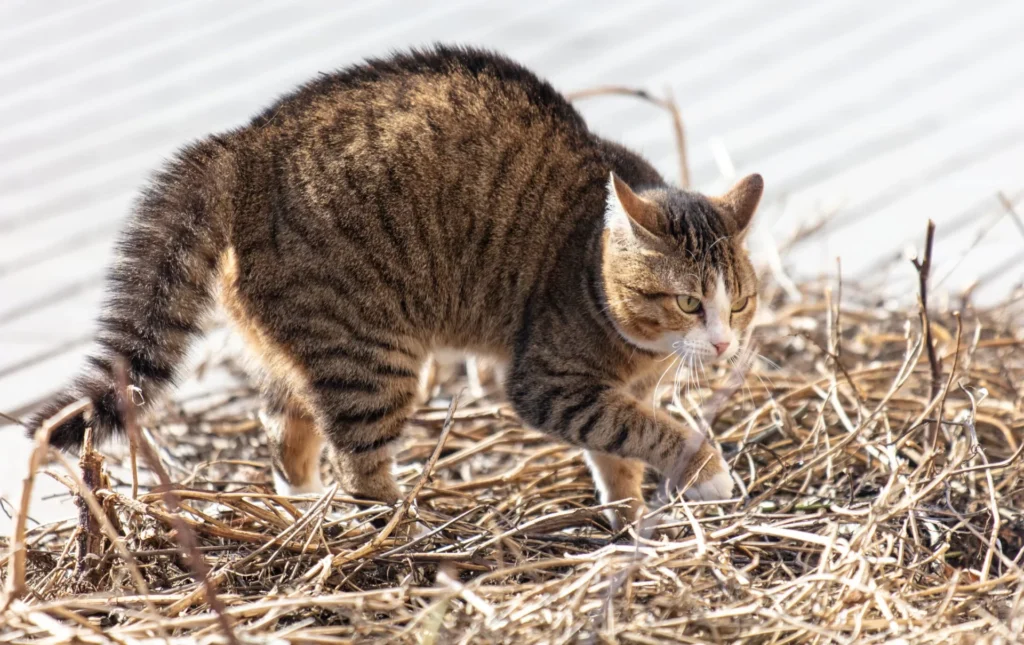
A puffed-up tail is one of the most dramatic signals in cat body language.
When a cat’s tail suddenly becomes much larger and fluffier, the cat is usually experiencing a high level of arousal. Fear, surprise, and feeling threatened are common triggers, although the behavior can also occur alongside defensive aggression.
The reason behind the dramatic transformation is surprisingly simple: looking bigger can make a threatening situation look a little less threatening.
When a cat arches its back, raises its fur, and puffs up its tail, its entire silhouette becomes larger. To another animal, the cat may suddenly look like a much bigger and more formidable opponent.
This response is known as piloerection. It happens when tiny muscles attached to the hair follicles, called arrector pili muscles, contract and make the hairs stand up.
If that sounds familiar, it should. Humans have a similar physiological response when we get “goosebumps.”
So a “bottle-brush” tail does not necessarily mean:
“My cat is angry.”
A better interpretation is:
“Something has caused my cat’s arousal level to rise sharply, and it may be feeling threatened.”
That distinction matters, because a frightened cat may look aggressive when it is actually trying to protect itself.
Why Do Cats Tuck Their Tails?

A cat that tucks its tail close to or underneath its body is doing almost the opposite of a cat with a puffed-up tail.
Instead of trying to look bigger, the cat may be making itself appear smaller and less noticeable.
A tucked tail can occur when a cat feels frightened, anxious, insecure, or wants to avoid confrontation. You might see this when a cat encounters an unfamiliar animal or object, feels threatened by another cat, or finds itself in an unfamiliar environment.
Rather than thinking of the posture as simply “giving up,” it is more accurate to see it as part of a strategy for reducing conflict and signaling that the cat is not looking for a fight.
For example, a cat may tuck its tail when:
- It is frightened by an unfamiliar object or animal.
- It feels threatened by a stronger or more assertive cat.
- It has lost control of a confrontation and is trying to disengage.
- It is in an unfamiliar or stressful environment.
This is where the familiar expression “running with your tail between your legs” comes from. The phrase captures the visual impression of an animal trying to appear smaller and avoid further confrontation.
Again, context matters. A cat may also curl its tail around its body simply because it is comfortable, cold, or settling down to rest. The tail position becomes much more meaningful when it appears alongside other signs of fear or tension, such as crouching, flattened ears, wide eyes, or a tense body.
Why Does My Cat Flick or Swish Its Tail?
If your cat starts making quick, repeated movements with its tail, especially from the base, it is worth paying attention.
A rapid flicking or lashing tail can occur when a cat is irritated, frustrated, overstimulated, or highly aroused. For example, you may notice it when you have been petting your cat for a little too long or when a child is handling the cat in a way it does not enjoy.
But there is an important difference between tail movement and emotional meaning.
Cats do not wag their tails in quite the same way dogs do. A cat that rapidly swishes or lashes its tail is not necessarily “angry,” and tail movement does not always indicate a negative emotion. Cats may also move their tails while playing, stalking prey, or concentrating intensely on something.
The speed, direction, intensity, and the rest of the cat’s body language all matter.
For example:
- Slow side-to-side movement while watching a toy: intense focus or preparation to pounce.
- Fast, forceful tail lashing while being petted: possible irritation or overstimulation.
- Rapid tail movement while facing another animal: possible high arousal or defensive tension.
So instead of thinking, “My cat is wagging its tail, so it must be upset,” look at the whole situation.
A Curious Example: Qoobo
There is even a fun example of how humans interpret these subtle tail movements.
In 2019, the Japanese company Yukai Engineering introduced Qoobo, a cushion-like companion robot with a tail that gently moves when the cushion is stroked. It is an interesting example of how a simple tail movement can be used to create the feeling of interacting with a pet.
Why Does My Cat Flick Its Tail When I Call Its Name?
Sometimes the funniest cat-tail behavior is also the smallest.
You call your cat’s name.
Your cat does not look at you.
It does not get up.
It does not come over.
Instead, the tip of its tail moves two or three times.
If cats could talk, you might imagine the response as:
“I heard you. I’m just not coming.”
It is a funny way to describe a behavior many cat owners recognize, but the actual meaning is probably more complicated than a simple feline version of “no.”
Research has shown that cats can distinguish their own names from other words. In other words, your cat may not simply be reacting to the sound coming from somewhere in the room; it can learn to recognize the particular sound pattern associated with its name.
That does not mean every tiny tail flick after hearing its name has a specific, scientifically established meaning. The response may depend on what the cat is doing, how interested it is in the environment, and whether it has any reason to get up.
Sometimes the cat may simply have noticed you.
And sometimes, well…
It heard you. It just has other plans.