
A cat’s tail plays a vital role in its daily life. Cats are known for their incredible agility, and their tails play an important role in maintaining balance and coordinating movement. This article explores the anatomy of a cat’s tail, including its structure, muscles, movement, and common tail types. You can also learn more about overall feline anatomy in this detailed guide: cat anatomy guide.
Cat Tail Structure and How It Works
Generally, a cat’s tail is made up of 18 to 23 caudal vertebrae (the bones that support the tail), four large muscles responsible for moving the tail back and forth and side to side, and eight smaller muscles that control the tail’s fine movements.
However, tail anatomy varies considerably among breeds. For example, some breeds have very long tails, while others, like the Manx cat, have almost no tail at all. The Japanese Bobtail, known for its short tail, also has a tail anatomy that differs from that of most domestic cats.
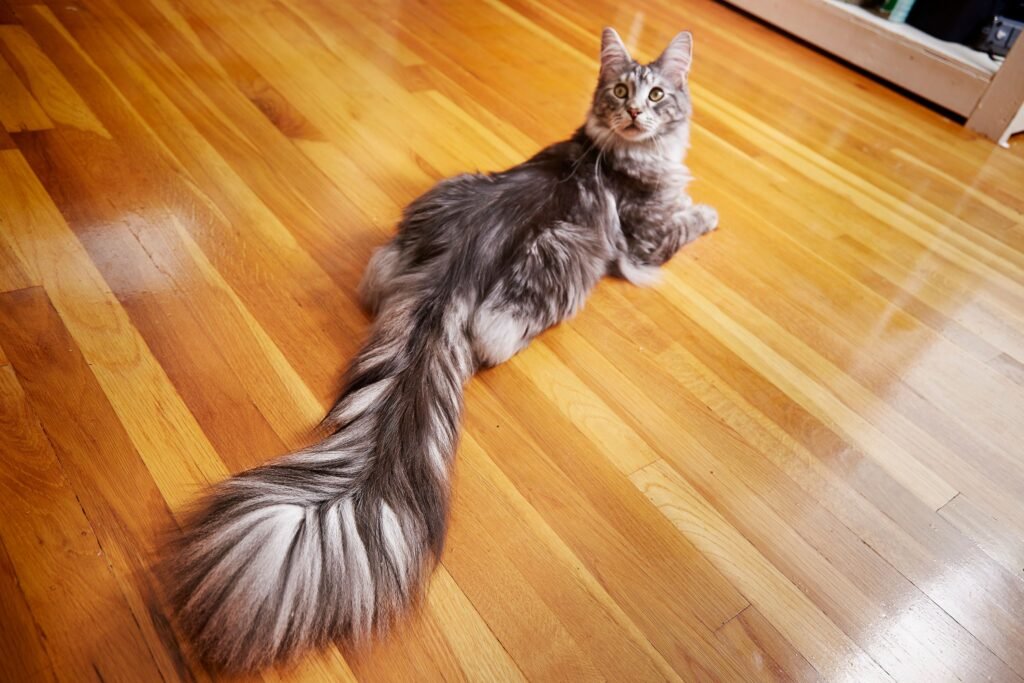
Interestingly, the Maine Coon cat named Cygnus from Michigan, USA, holds the Guinness World Record for the longest cat tail, measuring 44.66 centimeters (about 17.5 inches). Despite having such a long tail, it can still move just the tip of its tail with great precision, demonstrating remarkable control.
Below is a cross-sectional anatomical diagram of a typical cat’s tail, along with the muscle groups and their primary functions (Source: Wada, 1994).
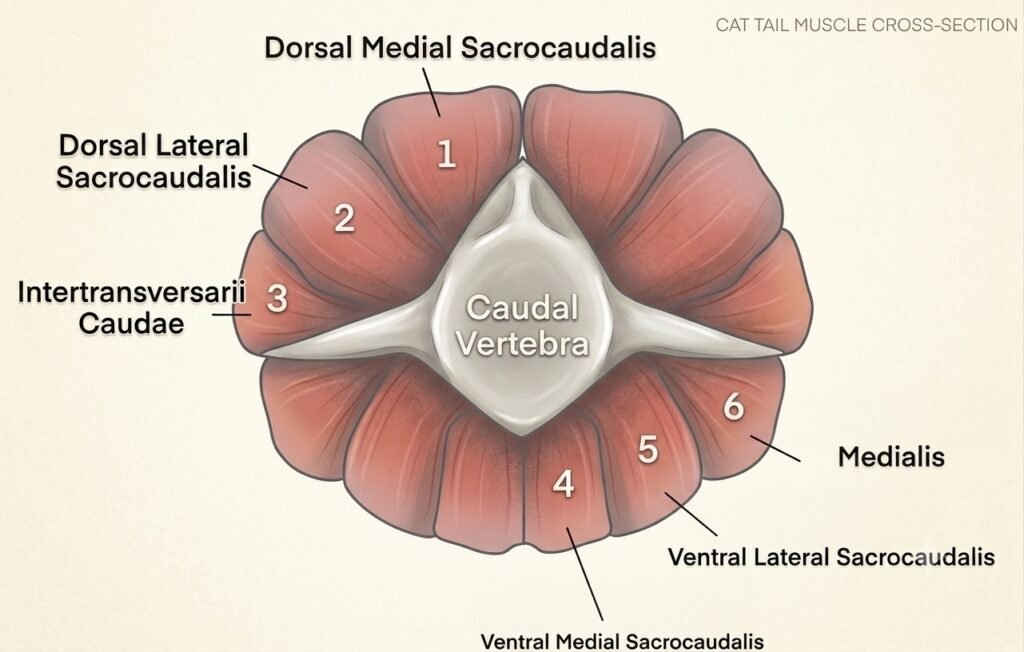
Medial Dorsal Sacrocaudal Muscle: Why Your Cat’s Tail Stands Tall
The medial dorsal sacrocaudal muscle is located on the upper (dorsal) side of the tail, with “medial” indicating its position closer to the body’s midline.
Function
When the muscles on both the left and right sides contract simultaneously, the tail lifts upward (toward the cat’s back). This is the main muscle group cats use when they hold their tails high. If only the left or right side contracts, the tail will lift diagonally upwards in that direction.
Lateral Dorsal Sacrocaudal Muscle
The lateral dorsal sacrocaudal muscle is situated between the medial dorsal sacrocaudal muscle and the lateral coccygeal muscle. It primarily plays a supporting role. If one of the adjacent muscle groups is injured, it can help compensate for some of the lost function.
Function
Working in conjunction with the medial dorsal sacrocaudal muscle, it helps move the tail diagonally upwards. When paired with the lateral coccygeal muscle, it assists in side-to-side tail movements.
Lateral Coccygeal Muscle: The Secret Behind Wags and Twitches
The lateral coccygeal muscle is a group of small muscles attached to each caudal vertebra.
Function
When a cat rapidly wags its tail from side to side, this muscle group is primarily responsible. It can also contract locally to create subtle wavy or twitching movements in the tail. For instance, when a mother cat gently wags the tip of her tail when interacting with her kittens, this precise control is achieved by these muscles.
Medial Ventral Sacrocaudal Muscle: Why Cats Tuck Their Tails
The medial ventral sacrocaudal muscle is located on the underside (ventral) of the tail, with “medial” again indicating its position closer to the body’s midline.
Function
When both the left and right sides contract simultaneously, the tail is pressed downwards and tucked towards the abdomen. This muscle group is primarily at work when a cat feels scared, submissive, or highly stressed, and tucks its tail between its legs.
Lateral Ventral Sacrocaudal Muscle
The lateral ventral sacrocaudal muscle is located between the medial ventral sacrocaudal muscle and the medial coccygeal muscle. It also serves as a supporting muscle, helping to maintain normal tail movement if other muscles are damaged.
Function
When working with the medial ventral sacrocaudal muscle, the tail moves diagonally downwards. When paired with the medial coccygeal muscle, it allows for side-to-side tail movements.
Medial Coccygeal Muscle
The medial coccygeal muscle is located medially to the lateral coccygeal muscle, closer to the body’s midline.
Function
It typically works with the lateral coccygeal muscle above it to move the tail from side to side. When an owner gently pats or strokes a cat’s tail base, and the cat moves its tail gently from side to side, these muscles are at work. This muscle group also plays a role when cats curl their tails around their bodies while sleeping or gently bend their tails.
Together, these muscles allow the tail to move with remarkable precision, much like the baton of an orchestra conductor.
This refined movement capability primarily relies on the long tendons extending from the medial dorsal sacrocaudal and lateral dorsal sacrocaudal muscles, along with a group of motor nerves called Coccygeal Nerves.
The coccygeal nerves arise from the caudal spinal nerves and extend throughout the tail.
- Upward nerve branches control the muscles and skin on the dorsal (upper) side of the tail.
- Downward nerve branches control the muscles and skin on the ventral (lower) side of the tail.
Why You Should Never Pull a Cat’s Tail
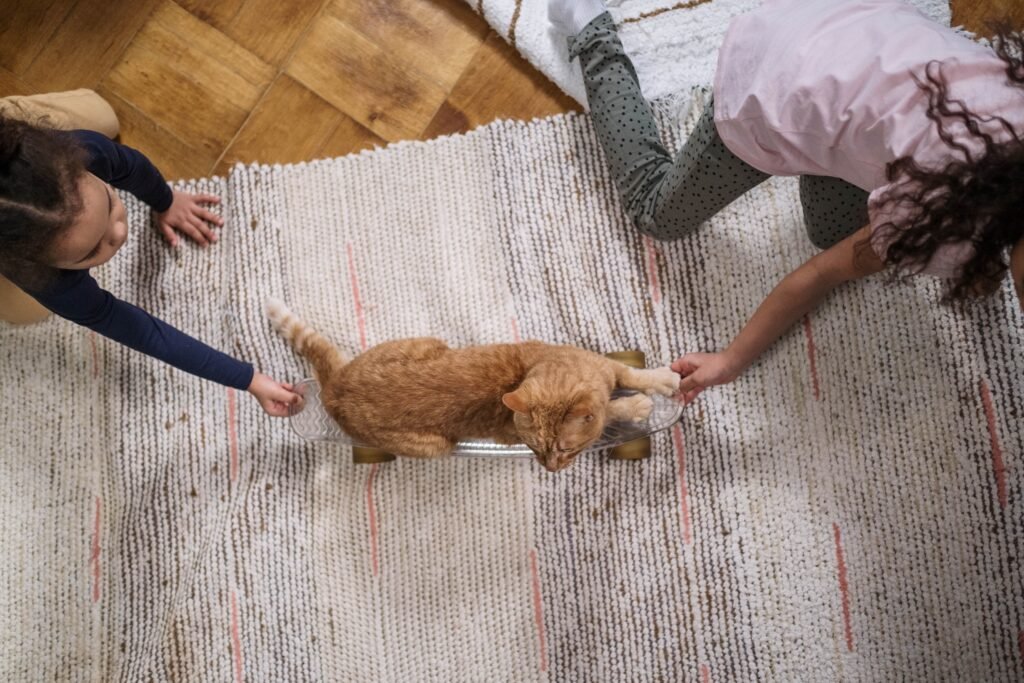
Many people have heard the saying: “Never pull a cat’s tail.”
This is because the coccygeal nerves, near the pelvis, are connected to several other crucial nerves: the pelvic nerve, pudendal nerve, and hypogastric nerve.
If a cat’s tail is severely pulled, not only can the coccygeal nerves be damaged, but the force can also be transmitted to these nerves that control the pelvis and urinary system, leading to a range of serious problems, such as:
- Difficulty urinating or urinary incontinence
- Difficulty defecating or fecal incontinence
- Weakness in the hind limbs or difficulty walking
- Other neurological deficits
This type of nerve damage caused by pulling the tail is known as a Tail Pull Injury, also medically referred to as a Sacrocaudal Injury.
For this reason, whether you’re playing, picking up your cat, or trying to stop it from running away, never control your cat by pulling its tail. Doing so can cause irreversible nerve damage.
*For a detailed look at how these tail structures assist with balance and communication, read our full breakdown on why cats have tails.
8 Common Cat Tail Types
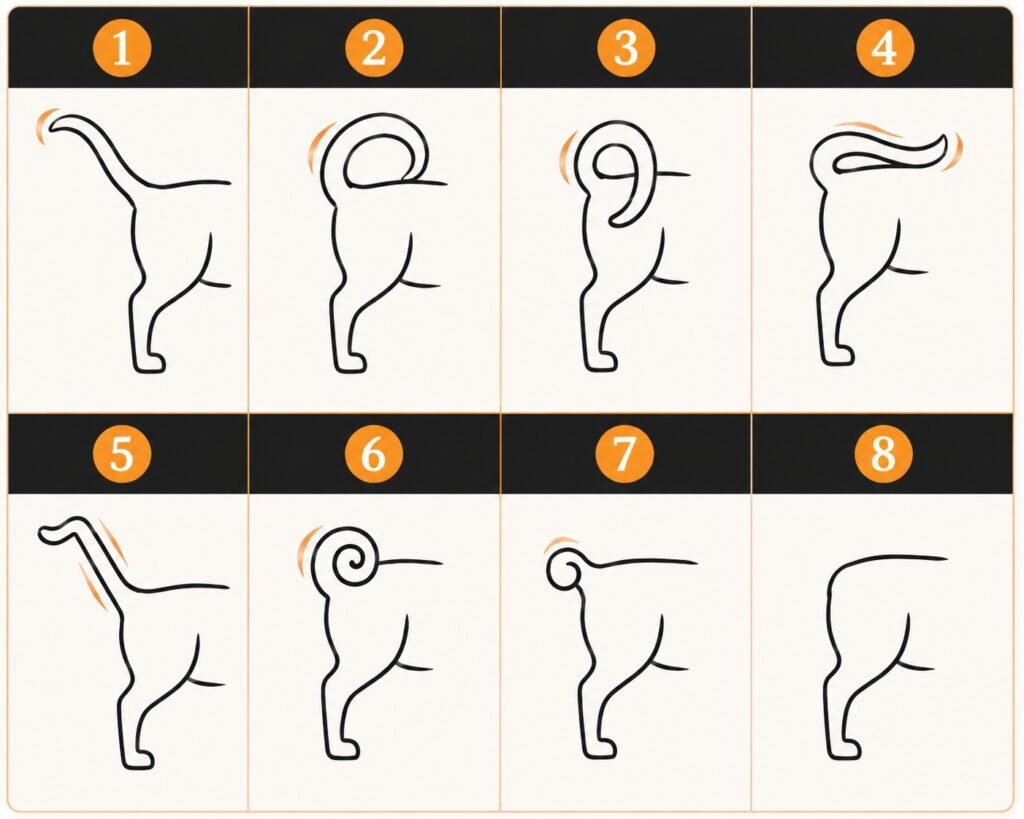
Cat tails vary widely in length, shape, and flexibility. Some differences are simply breed characteristics, while others are the result of naturally occurring genetic mutations. Below are the eight most common cat tail types.
However, the same mutation that produces the tailless appearance can also increase the risk of spinal defects and kitten mortality. For this reason, responsible breeding practices are strongly recommended, and extreme short-tail or tailless traits should not be selectively bred irresponsibly.
1: Full Tail
This is the most common tail type found in domestic cats.
2: Aerial Curled Tail
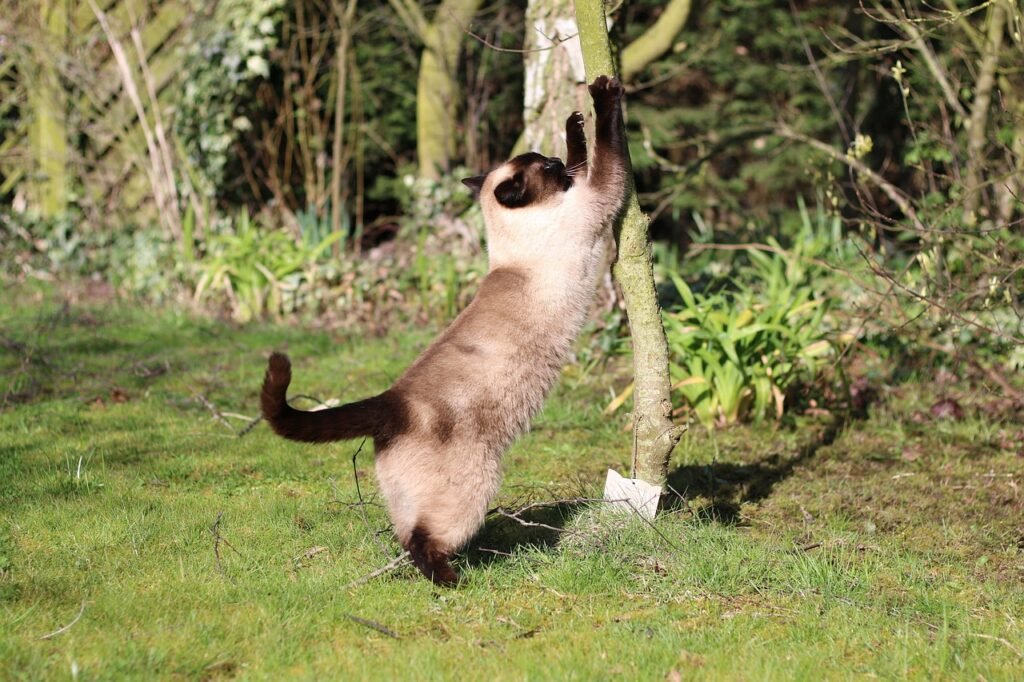
An Aerial Curled Tail describes a tail that naturally forms an upward loop while being carried above the body.
3: Flank Curled Tail
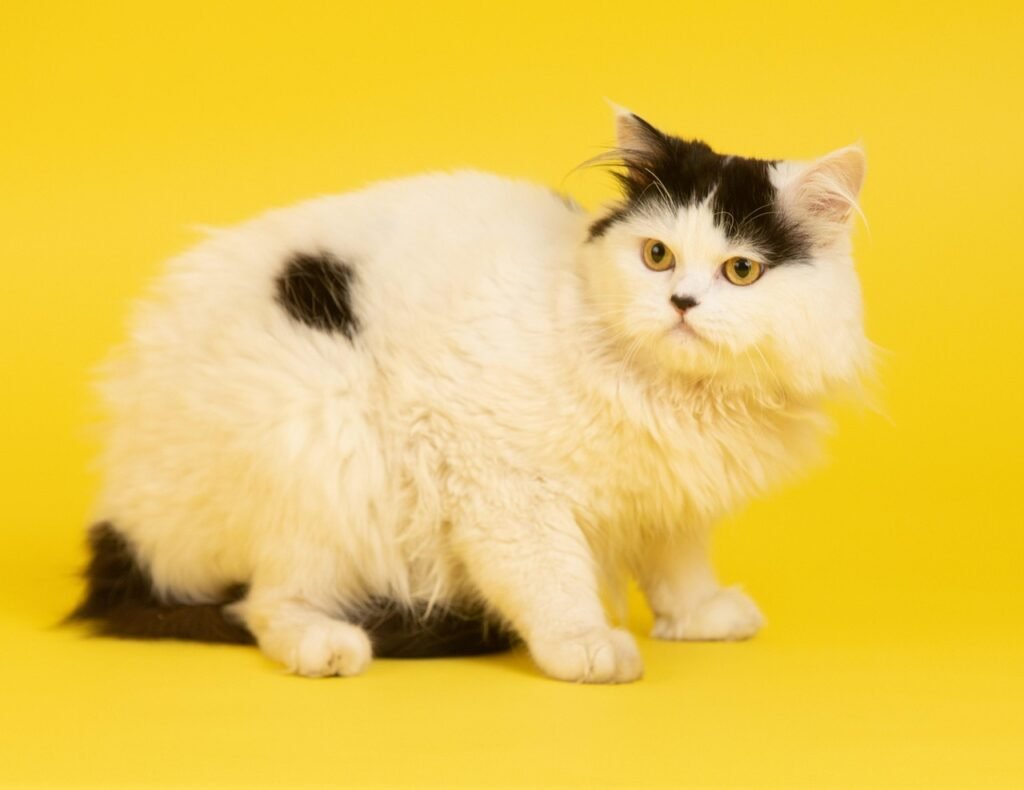
A Flank Curled Tail refers to a curled tail that naturally rests against the cat’s flank.
4: Flat-to-Back Tail
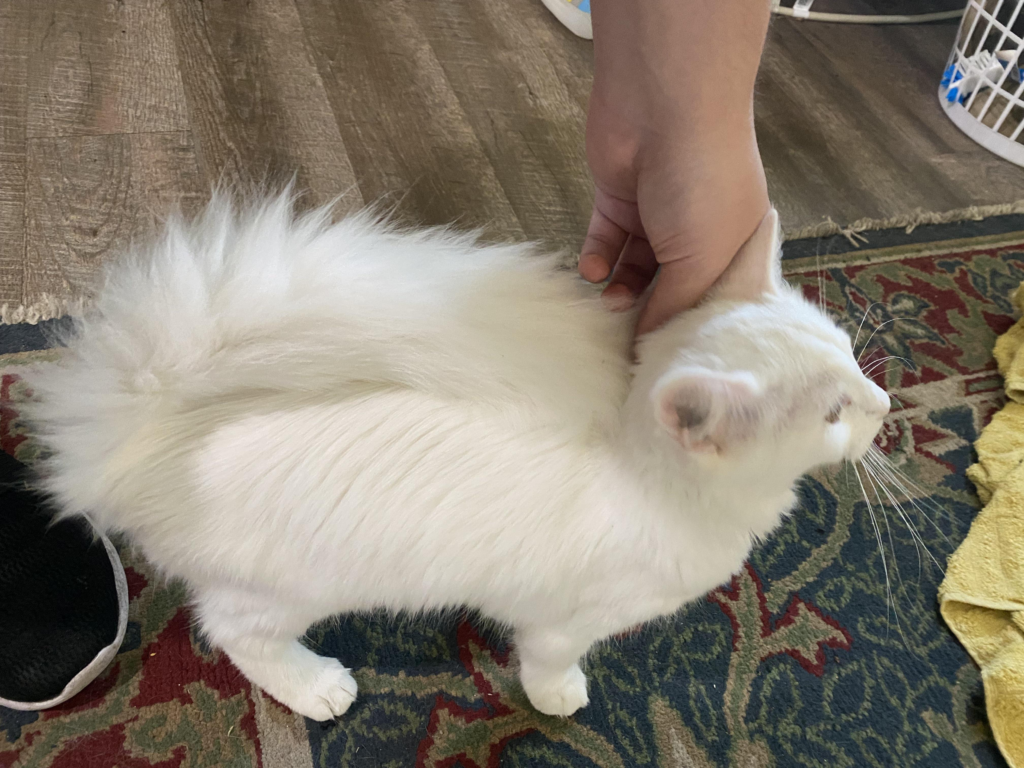
A Flat-to-Back Tail is bent and carried flat along the back.
5: Kinked Tail
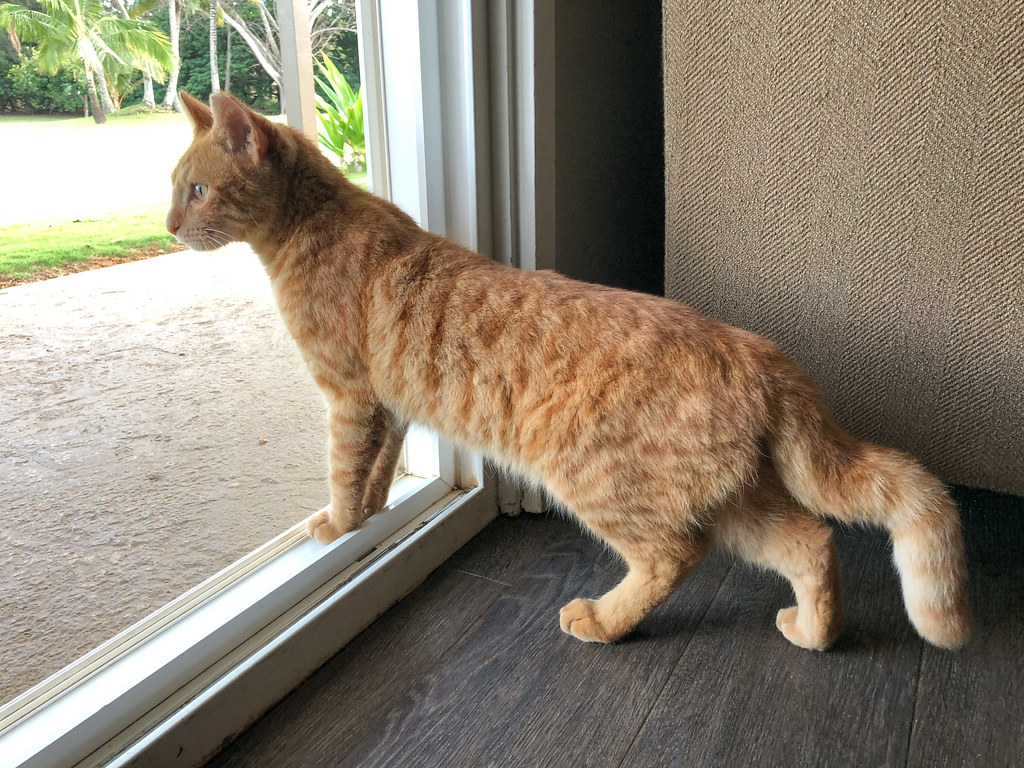
A Kinked Tail has one or more permanent bends or twists, usually near the tip.
6: Corkscrew (Piggy) Tail
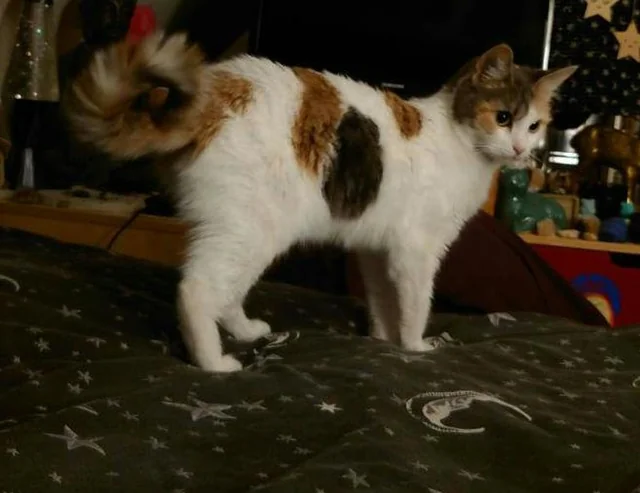
A Corkscrew Tail refers to a tail that curls in a spiral shape, resembling a screw or a spring.
Because of its appearance, it is sometimes informally called a Piggy Tail.
7: Bob Tail
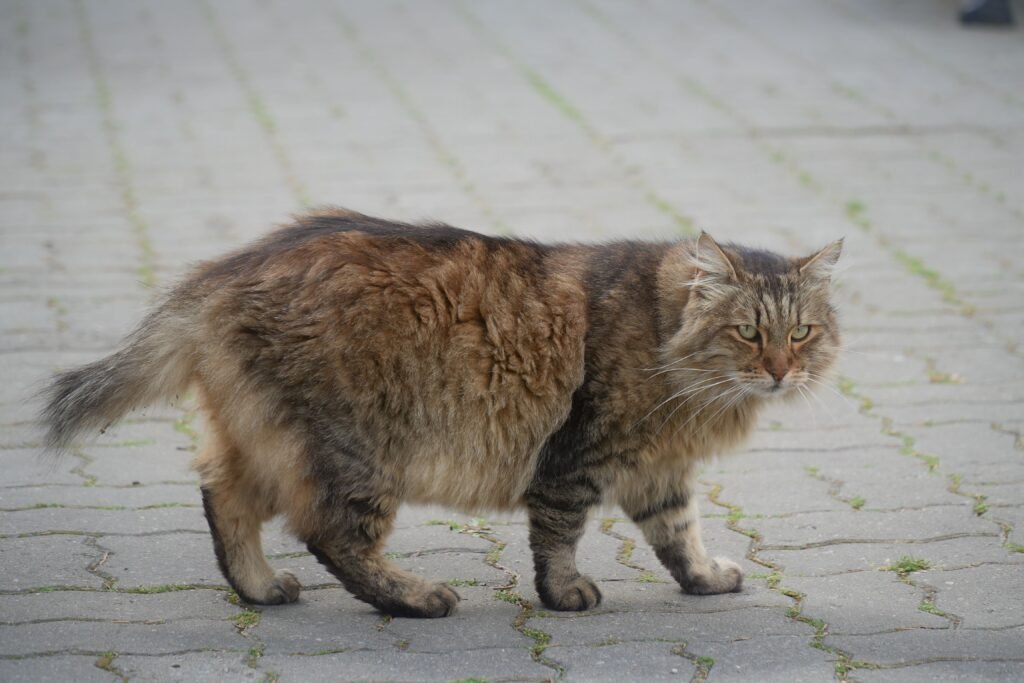
A Bob Tail refers to a short tail, typically around 6-7 centimeters (about 2.4-2.8 inches) in length.
Representative breeds include:
- American Bobtail
- Japanese Bobtail
In addition, some less common breeds are:
- Kurilian Bobtail
- Mekong Bobtail
8: Rumpy Manx
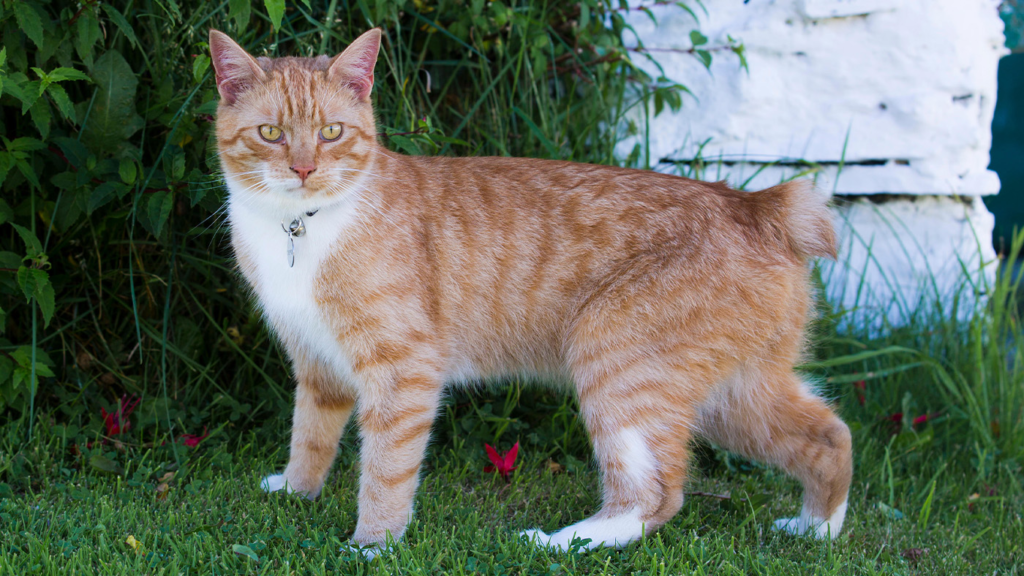
A Rumpy Manx refers to the tail characteristic of “Rumpy” individuals within the Manx cat breed, meaning they are tailless. Unlike bobtailed cats, Rumpy Manx cats have no visible tail at all.
Why Are Some Cat Tails Short?
Some cats are born with naturally short, kinked, or hooked tails. Scientists have discovered that these tail shapes are caused by several different genetic mutations rather than a single gene.
Research indicates that these short or hooked tails are associated with at least three genetic factors.
These include:
- The T-Box gene, which determines the extremely short tail of Manx cats.
- The HES7 gene, which determines the tail morphology of Japanese Bobtails.
- Researchers believe that at least one additional gene is involved, although it has not yet been identified.
Characteristics of Different Genes
The T-Box gene appears only in Manx cats and is relatively rare.
In contrast, variations in the “HES7” gene are very common and frequently appear in stray cat populations in Southeast Asia and Southern China.
A 2016 study found:
- Cats with the C/T genotype are associated with mild to moderate shortening or kinking of the tail.
- Cats with the C/C genotype are associated with more severe tail shortening or pronounced kinking.
Furthermore, research also indicates:
- Tail shortening is caused by a reduced number of caudal vertebrae or fusion between vertebrae.
- Kinked tails are associated with the development of hemivertebrae within the caudal vertebrae.
The Legend of the Manx Cat and Noah’s Ark
According to one popular legend, the Manx cat lost its tail while boarding Noah’s Ark. As the last animal to enter before the flood, it was caught in the closing door of the ark, leaving its descendants forever tailless.