
This article will dive deep into everything you need to know about your cat’s teeth. Ever wondered when your kitten’s baby teeth fall out and get replaced by adult teeth? Or how to spot signs of oral and dental problems? Let’s explore these important topics step-by-step, with clear explanations.
Adult Cat Teeth: Number, Types, and What They Do
Adult cats, typically those over one year old, have a total of 30 permanent teeth. This is quite a bit fewer than dogs, who usually have 42 permanent teeth. The reason for this difference is that cats have smaller skulls, which simply don’t have enough space for as many teeth as dogs.
By the time a cat is about 5 to 6 months old, all 30 of these permanent teeth will have grown in. Each type of tooth has a special name and a main job, as you can see in the breakdown below.
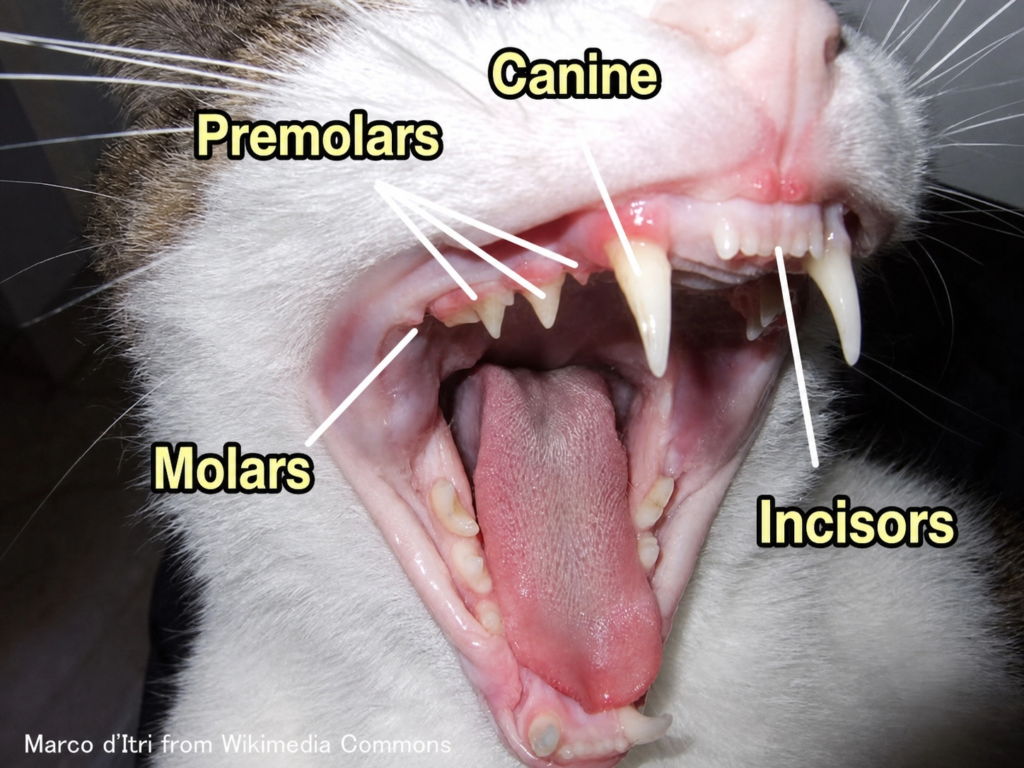
Canine Teeth (Fangs)
•Number: 2 on the top jaw + 2 on the bottom jaw = 4 total
•Job: To grab prey by the neck and pierce it, often to sever the spinal cord.
Incisors (Front Teeth)
•Number: 6 on the top jaw + 6 on the bottom jaw = 12 total
•Job: To tear meat and scrape it off bones.
Premolars
•Number: 6 on the top jaw + 4 on the bottom jaw = 10 total
•Job: To cut meat or cat grass.
Molars
•Number: 2 on the top jaw + 2 on the bottom jaw = 4 total
•Job: To slice meat and crush harder foods.
The Special Role of Canine Teeth
Out of a cat’s 30 permanent teeth, the four canine teeth (two on top, two on bottom) are super important for hunting. These teeth are wide from side to side, acting like a “wedge.” When a cat bites down hard with these wedges into a prey animal’s neck, they can often hit the spinal cord precisely, cutting it off efficiently. The spinal cord is a bundle of nerves inside the backbone, and if it’s severed, the animal usually dies instantly.
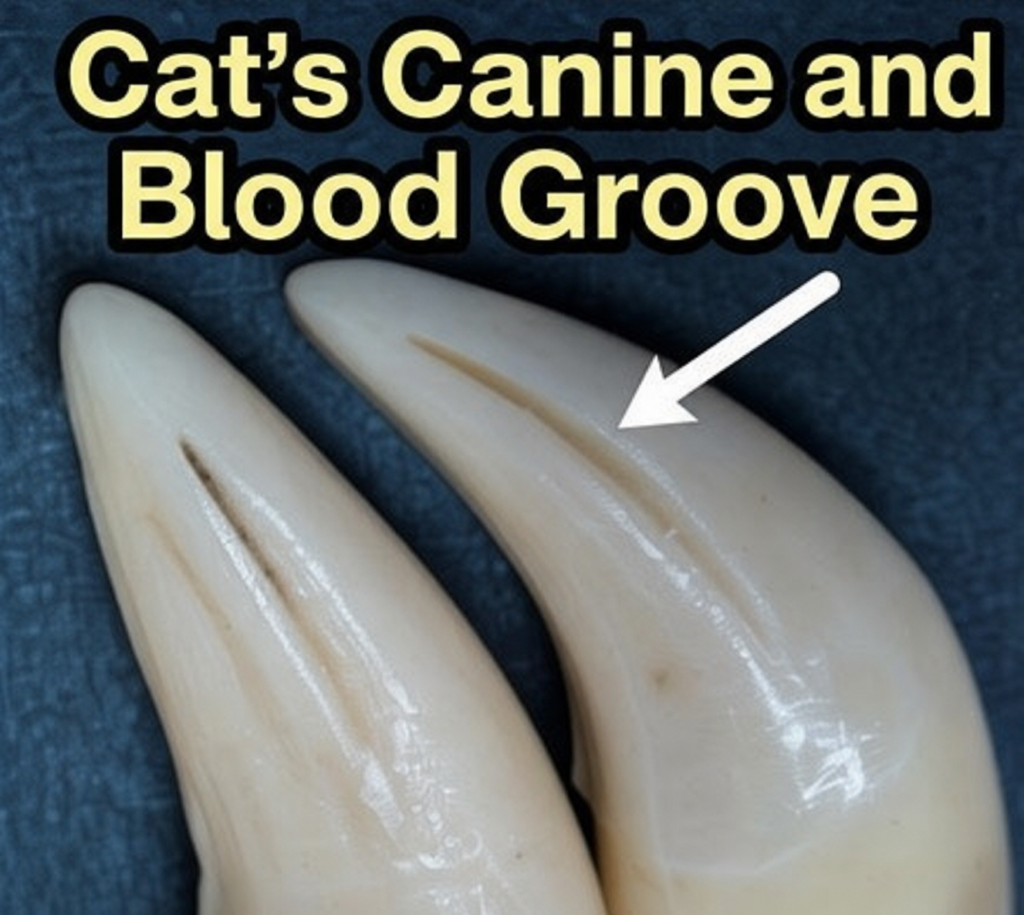
It’s also believed that there’s a special sensing system at the base of the canine teeth. This helps cats fine-tune their bite angle, making it even more accurate when targeting the spinal cord. Some canine teeth might even have tiny grooves, called “bleeding grooves,” which act like little drains to guide blood away and keep it from sticking to the teeth. However, these grooves aren’t as obvious in house cats as they are in big cats like lions.
Incisors: Small but Mighty Front Teeth
Cats have six incisors on their upper jaw and six on their lower jaw. The inside of these teeth connects to the entrance of the vomeronasal organ (also known as Jacobson’s organ). When a cat makes that funny face called the “Flehmen response,” they pull back their lips. This allows scents to enter this organ more easily, helping them better detect pheromones.
These incisors also act like a tiny comb when your cat grooms itself, helping to clean its fur. You might also see your cat biting its own claws; in these moments, the incisors are mainly used for “holding and gripping.”
Molars: The Meat-Cutting Machines
What we usually call “back teeth” are the molars, which are divided into premolars and molars. Cat molars are sharp and interlock like scissors when they bite. Unlike human molars, which meet flatly, a cat’s molars have sharp points and are slightly offset front-to-back. This structure makes them more like “meat shears,” perfect for cutting meat.
This specialized tooth structure, designed for tearing meat, is called the “carnassial” tooth. It’s a result of cats evolving as carnivores. Besides tearing meat, cats also use these teeth when biting off pieces of cat grass.
By the way, the molars on a cat’s upper jaw are tiny, almost symbolic, and often hard to see clearly.
The muscles that help a cat open and close its mouth are called the “masticatory muscles.” The muscles that work when closing the mouth include the temporalis (T), masseter (M), and medial and lateral pterygoid muscles (P). On the other hand, the digastric muscle (D) is mainly responsible for opening the mouth (Kim, 2018).
The biting force produced by these muscles is estimated to be about 7.5 kilograms (73.3 N) for the canine teeth and about 12 kilograms (118 N) for the carnassial teeth. However, these numbers are based on skeletal models, and the actual force a cat uses when biting might be even stronger.
Being able to crunch dry food with a satisfying “CRUNCH” is a good sign that your cat’s masticatory muscles and teeth are healthy.
Kitten Teething: The Process of Changing Teeth
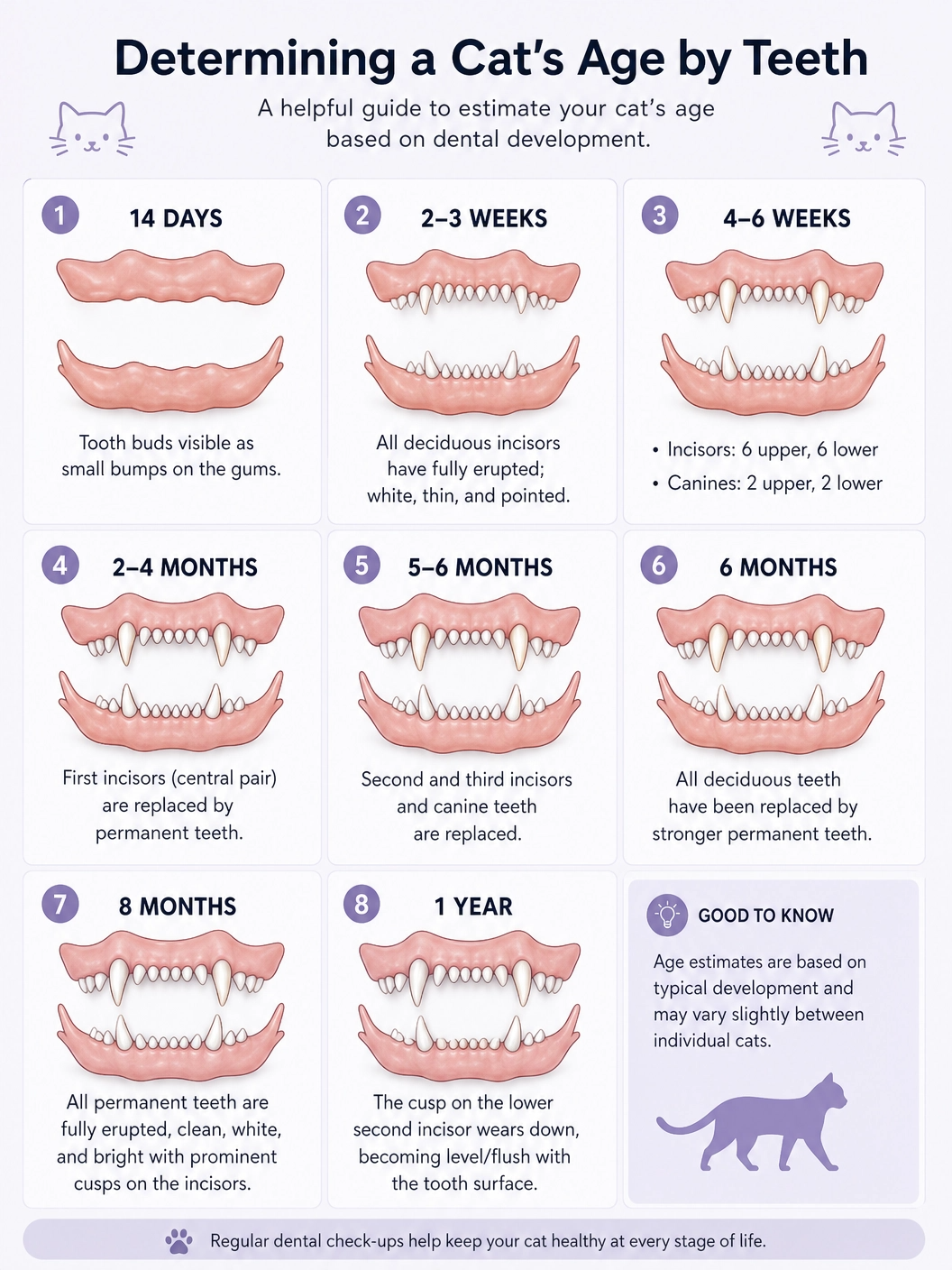
Just like humans, cats go through a process of changing teeth, known as “tooth replacement,” which usually finishes within about six months after birth.
Newborn kittens don’t have any teeth; their mouths are designed for nursing from their mother or a bottle. Around 15 to 20 days after birth, their baby teeth (deciduous teeth) start to appear. As they finish nursing, kittens gradually move from milk to solid food.
By about 30 to 35 days old, all 26 baby teeth will have grown in. Then, starting around 3 months of age, as their skull develops, these baby teeth will gradually fall out and be replaced by the permanent adult teeth they’ll use for the rest of their lives.
The general timeline and order for baby teeth being replaced by adult teeth are shown below. Because there’s limited space in a kitten’s mouth, they don’t grow molars during the baby tooth stage.
Timeline and Order of Tooth Replacement
Kitten Deciduous and Permanent Tooth Eruption Times
Incisors (Front Teeth)
•Baby teeth start growing: 2–3 weeks old
•Baby teeth fall out + Permanent teeth appear: 3–4 months old
Canine Teeth
•Baby teeth start growing: 3–4 weeks old
•Baby teeth fall out + Permanent teeth appear: 4–5 months old
Premolars
•Baby teeth start growing: 3–6 weeks old
•Baby teeth fall out + Permanent teeth appear: 4–6 months old
Molars
•Baby teeth start growing: None
•Permanent teeth appear: 4–6 months old
It’s often hard to find fallen baby teeth because kittens usually swallow them without you even noticing. Because they’re so rare, some people even say that “a cat’s baby tooth is a symbol of good luck.”
During the process of baby teeth being replaced by permanent teeth, sometimes you might see two teeth growing in the same spot on the gum, meaning both old and new teeth are present. Usually, the baby tooth will fall out naturally. However, in a few cases, the baby tooth doesn’t fall out and stays in the gum. This is called “retained deciduous teeth.”
If left untreated, this can lead to crooked teeth, which can affect how your cat chews. So, if your kitten still has baby teeth after 6 months of age, it’s a good idea to talk to your vet. They might need to be removed.
For a quick reference, you can download our comprehensive ‘Cat Age by Teeth’ infographic below to keep as a handy guide for your pet’s dental health.
Checking Your Cat’s Teeth and Oral Health
Here are some common dental problems in cats and a table of related diseases. If you notice any of these unusual changes in your cat’s teeth, it’s wise to be cautious and consider if there’s a risk of disease. If so, take your cat to the vet for a check-up as soon as possible.
Bad Breath (Halitosis)
Possible Related Diseases: Feline Immunodeficiency Virus (FIV), Periodontal disease, Tooth decay (cavities), Stomatitis (inflammation of the mouth), Tooth resorption, Chronic enteritis (inflammation of the intestines), Small intestinal diarrhea, Oral cancer, Acute glomerulonephritis (kidney disease)
Loose Teeth
Possible Related Diseases: Periodontal disease
Tooth Discoloration
Possible Related Diseases: Tooth resorption
Oral Swelling
Possible Related Diseases: Feline Viral Rhinotracheitis (FVR), Feline Leukemia Virus (FeLV) infection, Feline Immunodeficiency Virus (FIV), Stomatitis, Tooth resorption, Periodontal disease, Oral cancer
A cat’s mouth is actually a really important “barometer” that reflects their overall health. It’s a good idea for owners to get into the habit of checking their cat’s mouth regularly.
Cat Teeth Q&A
Here’s a list of the most common questions and concerns about cat teeth. If you have similar questions, read on—you might find clues and help to solve your problems.
This might be caused by misaligned teeth (malocclusion).
Normally, a cat’s upper and lower teeth should fit together correctly without getting in each other’s way. But if the teeth are misaligned, they might bump into each other, causing the mouth to stay partly open.
Common reasons for this can be genetic factors or retained deciduous teeth (baby teeth that don’t fall out). Later in life, it’s often due to injuries or broken teeth.
If you notice your cat’s mouth suddenly becomes half-open and can’t close, you should first consider the possibility of an injury and take them to an animal hospital as soon as possible. If their mouth has always been unable to close completely since they were a kitten, it’s more likely an issue with their teeth alignment itself.
For treatment, some orthodontic methods might be used, such as inclined planes, bite-correcting devices, or tipping caps. However, these are specialized procedures, and not all animal hospitals can perform them.
Cat Malocclusion (Misaligned Teeth)
This is especially common in brachycephalic breeds (flat-faced cats). Because of their unusual skull structure, their teeth can become severely crooked, and they might need more complex treatments like tooth extractions.
Fundamentally, the most effective way to deal with these congenital (born-with) problems is to avoid breeding flat-faced cats.
This could be “retained deciduous teeth.”
If a cat older than 6 months still has baby teeth, it’s called retained deciduous teeth. The exact cause isn’t fully understood.
There’s also a very rare condition called “Feline Knees-Teeth Syndrome.”
This syndrome is characterized by:
•Patellar (kneecap) fractures that happen without any obvious injury.
•Baby teeth that haven’t fallen out and remain in the jawbone at the same time.
This disease is extremely rare. Since it was first reported in scientific literature in 2004, only about 60 cases have been recorded in the United States, and a few in the UK. Recently, there have also been reports of cases in Japan.
The newer name for this condition is “Patellar fracture And Dental anomaly Syndrome (PADS),” which describes its features more accurately.
If your cat has retained deciduous teeth along with unexplained bone fractures, it’s a good idea to investigate further for the possibility of this syndrome.
If the pulp is exposed, aggressive treatment is needed.
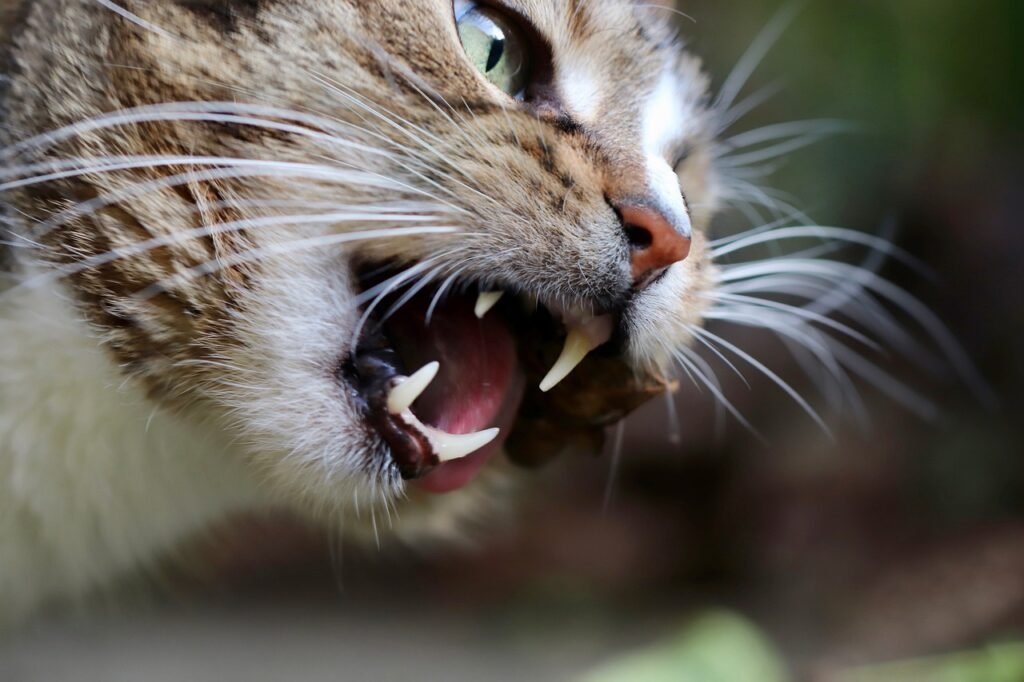
A broken tooth is called a “fracture.” In cats, this is especially common in the canine teeth (fangs). Accidents like traffic collisions, falls from high places, or bumps during play can all cause teeth to break due to strong force.
If the pulp (made of blood vessels and nerves) in the center of the tooth is not exposed, it’s called a “simple crown fracture” (just damage to the tooth surface).
If there’s a small hole in the middle of the tooth and the pulp is exposed, it’s called a “complicated crown fracture” (the tooth is truly broken).
Once a complicated crown fracture occurs, whether it’s a baby tooth or a permanent tooth, aggressive treatment is a must. If left untreated, the exposed pulp can cause severe pain, and bacteria can enter the wound, leading to abscess formation.
Baby teeth are usually treated by extraction. Permanent teeth might be treated with extraction or pulp capping (protecting the exposed pulp).
In short, if a tooth is broken and you see redness in the center, you should get it checked by a vet as soon as possible, before it turns brown or black.
This might be a broken tooth root.
The visible part of the tooth is called the “crown,” and the part buried in the gum is called the “root.” When the root breaks, it’s called a “root fracture.”
Crown fractures are usually easy to spot, for example, if the tooth looks shorter or there’s bleeding. But since the root is inside the gum, it’s hard to see from the outside, making it difficult to detect.
The simplest way to check is to gently touch the tooth with your hand and wiggle it from side to side. If the root is broken, you’ll clearly feel it loosen.
If the pulp inside the root is still alive, it might be able to heal itself by forming new dentin and cementum after being stabilized. However, if the pulp has died, it can’t heal naturally and is prone to bacterial infection. In such cases, extraction is usually the preferred treatment.
Tooth discoloration in cats can be linked to several diseases. Here are common situations:
Yellow
This is usually natural discoloration due to aging. Long-term eating of dry or wet food can cause pigments to gradually build up on the tooth surface, making the teeth appear yellow. It’s similar to how human teeth can turn yellow from drinking coffee or eating curry over time.
Brown
This might be due to tartar buildup, especially common on the back teeth (premolars and molars). It’s often associated with periodontal disease.
Pink to Red
This could be related to gingivitis (gum inflammation), bleeding from a broken tooth, or tooth resorption lesions. If the root area turns red, special attention is needed.
Gray to Black
This might mean the tooth pulp has died (the nerve is dead). When the pulp dies, decomposed substances react with iron in the blood to form iron sulfide, which makes the tooth appear black.
Except for natural discoloration due to age, other tooth color changes are usually signs of potential disease. It’s recommended to include this as part of a health check and take your cat to the vet as soon as possible.
Additionally, if you see black vertical cracks on the surface of a canine tooth, it might indicate a tooth fracture. If your cat also has difficulty eating or shows signs of pain when scratching, you should also seek veterinary attention quickly.
This might be a “tooth root abscess.”
Generally, a cat’s bad breath isn’t exactly “fragrant.” When it’s mild, it might smell like a “sewer” or “fishy.” When it’s severe, it can even be described as smelling like “rotten eggs” or “like a fart.”
Common Cause of Severe Bad Breath: Tooth Root Abscess
A tooth root abscess is when inflammation occurs at the root of a tooth and pus collects. This can happen in humans, dogs, and cats, and it usually produces a very strong, foul odor.
This terrible smell comes mainly from sulfur compounds, which are also found in waste products, which is why some people describe the smell as being “like a fart.”
Tooth root abscesses can sometimes occur along with periodontal disease. Therefore, owners need to regularly check their cat’s mouth and try to get into the habit of brushing their teeth.
However, the reality is that most cats won’t calmly cooperate with teeth brushing.
So, more practical ways to help with oral care include:
•Dental-cleaning cat food
•Oral care treats
•Cat tooth-cleaning tools
For information on how to brush your cat’s teeth, you can refer to a “Complete Guide to Brushing Your Cat’s Teeth.” For choosing safe oral care products, you can also check relevant ingredient information.