

Cats have an extraordinary sense of hearing, with a hearing range that can extend from around 48 to 85,000 Hz. This range extends far beyond human hearing and even surpasses dogs when it comes to detecting high-frequency sounds. Cats are also remarkably good at locating where sounds come from, using tiny differences in the time it takes for each ear to receive a sound. Some tests have measured their sound localization accuracy at around 5 degrees, compared with approximately 1 to 3 degrees in humans and 8 degrees in dogs. But what about the question many cat owners ask: How far can cats hear? There is no fixed maximum distance. How far a sound travels and whether a cat can hear it depend largely on its volume, frequency, and the surrounding environment.
Today, let’s take a closer look at the fascinating world of feline hearing, exploring scientific research and the natural development of a cat’s auditory system along the way.
How a Cat’s Hearing Develops
Of a cat’s five senses, hearing is often considered one of the most highly developed. This may have a lot to do with the needs of their wild ancestors, who relied on sound to detect prey in low-light conditions. A kitten’s hearing system goes through a remarkably fast and carefully timed development process during the first few weeks of life.
- Early responses and electrical activity: Basic electrical responses to sound can be detected as early as 2 to 3 days after birth.
- Expanding frequency range and sound localization: By around day 6, a kitten’s hearing range gradually expands to approximately 200–6,000 Hz. Responses to the direction of sounds begin to appear around day 7.
- Ear canal opening and physical development: The external ear canals gradually open between approximately 6 and 14 days after birth and are fully developed by around day 17. By about day 31, the outer ears begin to develop deeper curves that help collect sound waves.
- Recognizing sounds: Between days 13 and 16, kittens begin turning toward sounds and exploring where they come from. By 3 to 4 weeks of age, they can start recognizing the voices of their littermates and humans, and may also begin showing defensive responses to certain sounds.
Hearing Problems in White Cats and How to Test for Them
Some white cats, particularly those with blue eyes, may have a higher risk of hearing problems. According to some research, when both parents are white cats, approximately 52% to 96% of their offspring may develop certain forms of hearing impairment. Pure white cats with two blue eyes may have a higher risk of bilateral hearing loss, while cats with one blue eye may be more likely to experience hearing impairment in the ear on the same side as that eye.
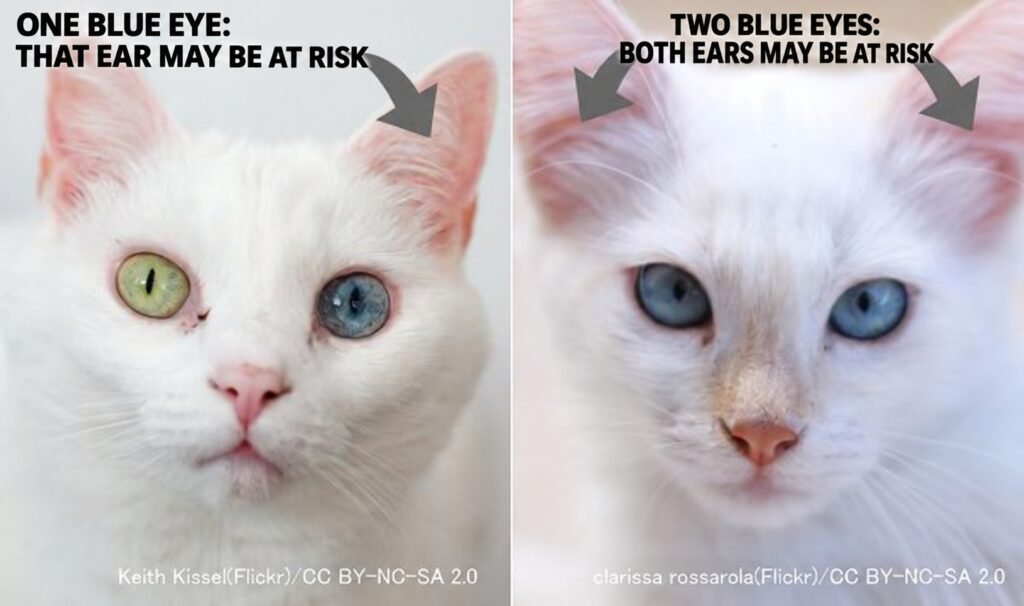
These figures can vary depending on the study population, genetic background, and how hearing impairment is defined. They should not be applied to all white cats, and coat color or eye color alone cannot confirm that a cat is deaf.
If you want to check your cat’s hearing, you can start by observing everyday behavior, such as whether your cat turns its head or ears toward sounds. For a more reliable assessment, a veterinarian may recommend a specialized test called a Brainstem Auditory Evoked Response (BAER) test, which measures the brain’s electrical responses to sound.
A real-life example is Huckleberry (Huck), a deaf rescue cat with a white coat and two different-colored eyes. His owner shares how they communicate through sign language, training, and communication buttons on Huckleberry’s Instagram. His story has also been featured by Newsweek, showing that deaf cats can still communicate, form strong bonds with their owners, and enjoy happy lives.
How Good Is a Cat’s Hearing?
Compared with humans and dogs, cats have a particularly impressive hearing range and an excellent ability to distinguish different pitches. They can detect certain high-frequency sounds that fall completely outside the range of human hearing.
Hearing Range and Test Results
Different research methods and testing standards can produce slightly different results. Based on the approximate ranges reported in the source material, the hearing ranges of these three species are:
- Humans: Approximately 20–20,000 Hz.
- Dogs: Approximately 40–65,000 Hz.
- Cats: Approximately 48–85,000 Hz.
In some experiments, extremely high-frequency stimuli of around 100,000 Hz have also triggered electrical responses in a cat’s brain. However, this does not necessarily mean that cats consciously perceive these stimuli as sounds in the same way they perceive ordinary noises.
High-Frequency Pitch Recognition and Sound Preferences
Cats are particularly good at distinguishing pitches in the higher frequency range. According to the reported findings, cats can distinguish differences of approximately half a musical interval in the lower frequency range and around one-fifth to one-tenth of an interval in the higher frequency range. They are also quite sensitive to high-frequency rhythmic sounds played simultaneously from different directions.
Some research suggests that cats can hear relatively quiet sounds at around 20 decibels, particularly within a frequency range of approximately 250–35,000 Hz. They also appear especially sensitive to sounds above 20,000 Hz coming from positions about 20 to 40 degrees to either side of the center of their heads.
This high-frequency sensitivity may be closely connected to their hunting instincts. Small prey animals, including rodents, can communicate using sounds in frequency ranges of approximately 17,000–148,000 Hz, giving cats an evolutionary advantage when detecting their movements.
How Cats Recognize Voices and Their Own Names
When discussing how cats respond to sounds, it is important to distinguish between hearing a sound, recognizing a particular voice, and actually understanding human language. These are different abilities, and it is easy to overestimate what cats understand if we interpret their behavior too much like human behavior.
Recognizing Their Owner’s Voice
A 2013 experiment involving 20 cats explored whether cats could distinguish their owner’s voice from the voices of strangers. Researchers first played recordings of three unfamiliar people speaking, followed by a recording of each cat’s owner.
Fifteen of the 20 cats responded to their owner’s voice, although their reactions were often subtle, such as turning their ears or moving their heads toward the sound.
The findings suggest that cats may be able to distinguish their owner’s voice from unfamiliar voices, but this does not mean they understand human language.
For more on how cats recognize familiar people, see our article: Do Cats Recognize Their Owner’s Voice and Face?
Can Cats Recognize Their Own Names?
A follow-up experiment published by the same research team in 2019 reportedly found that cats can recognize their own names, even when they are spoken alongside other familiar words.
This suggests that cats may learn to associate the sound of their names with themselves, although recognizing a name is not necessarily the same as understanding its meaning in the way humans do.
Read more: Do Cats Know Their Names? What Science Has Discovered
What Kinds of Voices Do Cats Prefer?
Some sources suggest that cats may be less comfortable with deep, rough-sounding male voices and may respond more positively to higher-pitched voices in the 2,000–6,000 Hz range, which are somewhat similar to the sounds made by kittens.
However, this should be treated as a possible preference rather than a universal rule. Every cat has its own personality and experiences, so individual reactions to different voices can vary considerably.
A Remarkable Natural Radar: How Cats Locate Sounds
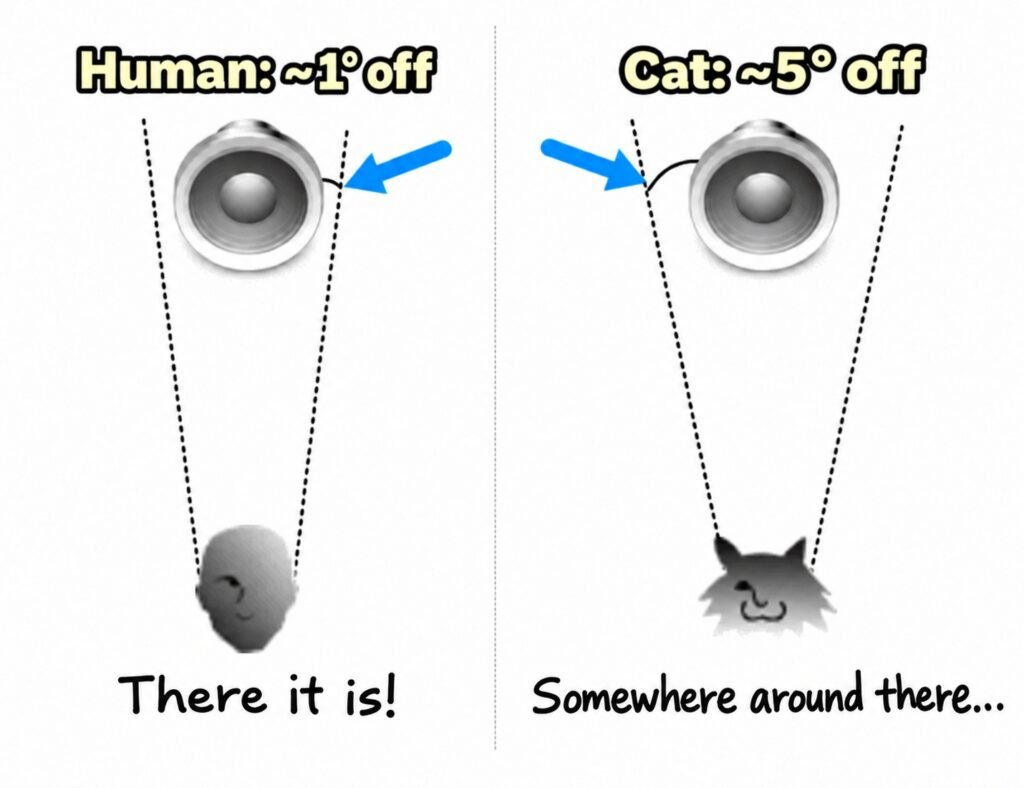
Sound localization is the ability to determine the direction a sound is coming from. Cats have an impressive ability in this area, with some test results suggesting an accuracy of approximately 5 degrees. Under certain testing conditions, around 75% of cats were able to detect a directional difference of 5 degrees. The time difference between a sound reaching the left and right ears has been reported to be as little as 25–80 microseconds.
For comparison, some reference tests have measured sound localization accuracy at approximately 8 degrees in dogs and 1 to 3 degrees in humans. These figures come from specific testing conditions and research methods, so they should be viewed as general reference points rather than absolute measurements of each species’ abilities.
Much of a cat’s impressive sound localization ability comes from its flexible outer ears. When a cat hears something, its ears can swivel toward the source, helping it collect more information about the sound. By comparing tiny differences in the timing and intensity of the sound reaching each ear, the cat can work out where the noise is coming from with remarkable precision.
This ability is especially useful when hunting, as it allows cats to detect and track small animals even when they cannot see them.
What Sounds Are Cats Sensitive To?
Cats react differently to different types of sounds. Some noises naturally catch their attention and may encourage them to play or explore, while others can make them feel nervous, frightened, or stressed.
Sounds That May Excite or Interest Cats
Bells: The gentle jingling of a toy bell can catch a cat’s attention and spark its curiosity, sometimes encouraging it to investigate or play.
Running or dripping water: The sound of dripping water often attracts cats. Some cats are even fascinated by running water and enjoy playing with it, which may explain why they sometimes prefer drinking from a running faucet.
Bird calls: Cats are naturally sensitive to the sounds of birds. These calls can trigger their hunting instincts, making them watch closely, perk up their ears, or even make those distinctive chattering noises at birds outside the window.
Their owner’s voice: Cats often become more relaxed and comfortable when they hear a familiar voice. Calling their name gently, speaking softly, or using a calm, reassuring tone can help strengthen the bond between a cat and its owner.
Sounds That May Frighten or Stress Cats
Loud household noises: High-volume sounds from vacuum cleaners, hair dryers, and other household appliances can make cats feel anxious or frightened, especially when they are sudden or unavoidable.
Trains and trucks: The loud rumbling of truck engines and passing trains can be unsettling for some cats, particularly when the noise is unexpected or accompanied by strong vibrations.
Thunder and lightning: Storms can be stressful for cats. Loud thunder, sudden flashes of lightning, and changes in the surrounding environment may cause them to hide or seek a quiet, sheltered place.
Sharp, unpleasant noises: Sounds such as metal scraping against metal or the sharp clicks of nail clippers can make some cats uncomfortable. Their sensitive hearing may make these noises particularly unpleasant.
Dogs barking: Loud or sudden barking can put cats on alert and may trigger feelings of fear or anxiety, especially if they are unfamiliar with the dog.
Of course, not every cat reacts the same way. A sound that fascinates one cat may frighten another, depending on its personality, past experiences, and level of familiarity with the noise.
Everyday Ear Care, Collar Bells, and Hearing Health

Because cats have such sensitive hearing, it is important to pay attention to how they respond to sounds in their everyday environment. A few simple precautions can help keep your cat comfortable and protect its hearing.
- Be thoughtful about collar bells: Continuous jingling may cause stress or discomfort for some cats, although individual reactions vary. Rather than assuming that all collar bells are harmful, pay attention to your cat’s behavior. If your cat seems bothered by the noise, consider a quieter alternative and always choose a properly fitted, safety-release collar.
- Provide a quiet place away from loud noises: When vacuuming, playing loud music, or dealing with fireworks, make sure your cat has access to a quiet space where it can retreat whenever it feels uncomfortable. Never force your cat to stay near a noise that frightens it.
- Watch for changes in hearing: If your cat suddenly becomes less responsive to sounds, it could be a sign of an ear problem or another health issue. Conditions such as otitis media (middle ear inflammation) and otitis interna (inner ear inflammation) can affect hearing. If you notice unusual changes in your cat’s response to sound, schedule a veterinary examination rather than assuming it is simply ignoring you.
Cats may not always respond when we call their names, but that does not mean they cannot hear us. Their remarkable hearing allows them to detect sounds that we may never notice, locate tiny noises with impressive accuracy, and stay alert to the world around them. Understanding how their hearing works can help us create a more comfortable home and better appreciate just how extraordinary our feline companions really are.