

Cats have some ability to learn by watching others and imitating what they see. They can learn to connect human actions with their own movements. In one key study, a trained domestic cat watched a person perform certain actions and was then tested to see whether she could copy them. The cat matched the person’s actions in 13 out of 16 valid trials (81.2%). However, this study involved just one cat, so the results do not mean that all cats can imitate humans.
Even when no one has taught them how, cats sometimes figure out how to open doors by moving lever-style door handles. We might guess that they learned this by watching people do it. But just how good are cats at imitation?
What Is DAID?
A research team from the Department of Ethology at Eötvös Loránd University in Hungary wanted to find out whether cats have the same imitation skills that researchers had already identified in dogs. To test this, they used a training method called “DAID,” short for “Do As I Do.” Here is how the method works.
The DAID Method
- A person performs a specific action in front of the cat. If the cat happens to perform the same action, for any reason, the person immediately says “Do it!” and gives the cat a reward.
- The person then performs a different action in front of the cat. If the cat copies that action, it receives a reward in the same way.
- Through patient, repeated practice, the cat learns an important connection: it does not have to perform one particular action to earn a reward. Instead, it can earn a reward by copying the action it has just watched a person perform.
- Once the cat understands the DAID rule, the person can demonstrate a completely new action and say “Do it!” The cat should then try to imitate what it just saw.
The video below shows what DAID training looks like with a dog. Although the trainer uses only one command, “Do it!”, the dog can copy and repeat many different actions that a person has just demonstrated. This shows that the dog has learned the DAID rule.
DAID requires an animal to recognize what different actions have in common: they are all actions it has just watched a person perform. In other words, the animal must understand the idea of copying an observed action, rather than simply learning to perform one specific movement. This requires a more advanced level of brain activity than ordinary action learning.
The DAID Experiment With a Cat
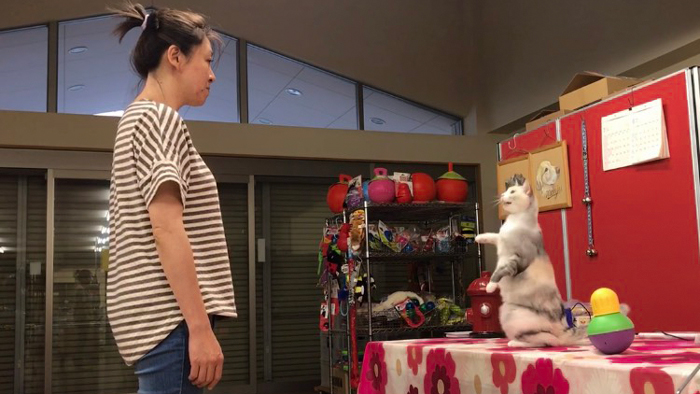
The cat that took part in the DAID study was named Ebisu. She was an 11-year-old female cat in 2019 and lived with her owner in Ichinomiya, Aichi Prefecture, Japan. Her owner was a dog trainer known for working with the DAID method and had even published books about it. The research team traveled all the way to Japan to find out whether the same kind of training could work with cats.
First, the researchers needed to teach Ebisu the DAID rule. They used five actions that were already familiar to her and completed 21 training sessions, each consisting of 3 to 10 trials.
After a preliminary test confirmed that she understood the rule, the researchers moved on to the actual experiment. This time, they introduced two actions that Ebisu had never performed before:
- Touching a box placed 50 cm away with one of her front paws.
- Rubbing her head against the box.
The researchers demonstrated these actions and asked Ebisu to copy them using the “Do it!” command. The person performed nine hand-based demonstrations and seven face-based demonstrations. Two trials were excluded because the tests were incomplete. The researchers then recorded how Ebisu responded.
When the person demonstrated an action using a hand:
- Moved a front paw: 7/9 (77.8%)
- Touched the box with any part of her body: 8/9 (88.9%)
- Touched the box with a front paw: 6/9 (66.7%)
When the person demonstrated an action using their face:
- Rubbed her face against something: 6/7 (85.7%)
- Touched the box with any part of her body: 4/7 (57.1%)
- Rubbed her face against the box: 4/7 (57.1%)
Research paper: Did we find a copycat? Do as I Do in a domestic cat (Felis catus)
Can We Really Call This Imitation?
At first glance, the results seem to show that Ebisu did a pretty good job of copying human actions. However, there are other possible explanations for her behavior.
For example, perhaps she was simply curious about the unfamiliar box. Maybe the person’s hand or head accidentally acted as a visual cue, directing her attention toward the box. Another possibility is that she understood the person’s goal was to touch the box, rather than actually copying the specific movement.
If Ebisu was acting for any of these reasons, we might expect to see her randomly touching the box with different parts of her body, or simply looking at the box without moving toward it.
But that was not what happened. In 81.3% of the valid trials (13/16), she moved the same body part that the person had used. In 75% of the trials (12/16), she also moved from her starting position and touched the box. Both percentages were quite high.
There were other possible explanations to consider as well. Perhaps the person used additional verbal cues during the demonstrations, such as “Spin!” or “Touch!” Or perhaps Ebisu had learned to recognize the demonstrated actions as visual cues and simply remembered what she had seen.
However, the researchers controlled for these possibilities. The only verbal command used in every trial was “Do it!” The actions Ebisu was asked to copy were also completely new to her, meaning she could not have practiced them in advance or learned to respond to them as familiar visual cues.
Based on these observations, the researchers concluded that Ebisu’s behavior was unlikely to be explained by simple curiosity about a new object, following the direction of a person’s attention, understanding only the person’s goal, or responding to specific verbal or visual signals. Instead, the most likely explanation was that she was actually imitating the actions themselves.
In other words, she really was a “copycat” in the literal sense of the word.
There is one more interesting detail. Ebisu’s rate of complete imitation (using the same body part to touch the box, whether with her front paw or face) was 62.5% (10/16). Statistically, this was not considered higher than what might happen by chance. The researchers suggested that several factors may have affected her performance, including her health (she had kidney problems), fatigue from repeated testing, and reduced motivation because she was already full.
Cats’ Ability to Learn by Watching and Imitating
Studies on cats learning by watching others are not new. In fact, researchers have reported several examples of this ability over the years.
For example:
- Kittens that watch their mothers catch prey are more likely to develop hunting and prey-catching behaviors themselves (source: Caro, 1980).
- Kittens that watch their mothers press a lever need fewer attempts to learn how to perform the same action (source: Chesler, 1969).
- Kittens that watch their mothers eat an unfamiliar food tend to start eating that same food sooner (source: Wyrwicka, 1980).
Cats are born relatively helpless and take time to develop, which makes them altricial animals. From a zoological point of view, it makes sense that they have an ability to learn by closely watching their parents. However, in all of these earlier studies, the animals they observed were other cats.
The important difference in the DAID study is that Ebisu was watching a human, not another cat. This suggests that cats may be able to recognize how their own body parts correspond to those of humans, even though the two species have very different bodies.
This ability may be something that cats generally have, or it may be a special skill that only Ebisu possessed. The fact that cats sometimes learn to open lever-style door handles without anyone teaching them suggests that learning by watching human behavior may actually be quite common.
A cat skillfully opens a lever-style door handle with its front paw, apparently without being taught how.
There is another interesting detail about the study. The Hungarian research team traveled all the way to Japan because they had been unable to teach cats the DAID rule themselves, partly due to time limitations.
Considering this background, there are two possibilities: Ebisu may have had an unusually strong ability to copy actions she had just seen, or her owner may have spent a great deal of time preparing and training her before the researchers arrived.
How to Teach Your Cat to Imitate You at Home

Another recent study suggests that playing with or training cats may also stimulate their owners’ brains. Some findings indicate that training does not have to go perfectly to be beneficial, so why not give the DAID method a try at home?
When choosing actions for your cat to imitate, start with movements that cats can already perform naturally, such as touching an object with a front paw or making a “meow” sound. Actions that are natural for humans, such as bending a hand into an unusual shape to make an “Hmm” gesture or saying “Good morning,” would be much harder for a cat to copy, even if they are not completely impossible.
For example, during her earlier training, Ebisu practiced several different actions over and over again, including:
- Standing upright on her hind legs.
- Spinning around in place.
- Touching a toy with a front paw.
- Opening a drawer.
- Picking up a hanging string with her mouth.
Training tends to work better when you build on movements your cat already performs naturally, rather than asking her to do something completely unfamiliar.
Examples of cat imitation skills:
- Spinning around in place
- Picking up a string with the mouth
- Opening a drawer with a front paw
When teaching your cat new behaviors or working on training, use positive reinforcement as your main approach. This means rewarding your cat immediately after she performs the desired action. A favorite lickable treat or gentle petting can be a great reward.