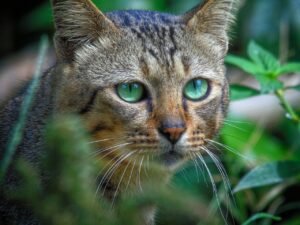

Cats see the world differently from humans. While we rely heavily on color and fine details, cats are built to detect movement, see in low-light conditions, and quickly respond to their surroundings.
But what exactly makes a cat’s eyes so unique? Why do their pupils become narrow vertical slits during the day but turn into large circles at night? And why do their eyes seem to glow in the dark?
The answer lies in their fascinating eye anatomy.
From the cornea at the front of the eye to the light-sensitive retina at the back, every part of a cat’s eye plays an important role in helping them hunt, explore, and survive. In this guide, we’ll take a closer look at how cat eyes are structured, how they work, and what makes feline vision so different from our own.
Why Are Cat Eyes So Unique?
A cat’s eyes are one of the most remarkable examples of evolutionary adaptation. Designed for a predator’s lifestyle, they give cats several important advantages, including excellent night vision, impressive motion detection, and a wide field of view.
Unlike humans, cats are crepuscular animals, meaning they are most active during dawn and dusk when light levels are low. Their eyes are specially adapted to these conditions, allowing them to detect movement and navigate their surroundings even when visibility is limited.
One of the biggest reasons cats can see well in dim light is the large number of rod cells in their retina. These specialized cells are extremely sensitive to light and help cats detect shapes and movement in darker environments. Cats also have a unique reflective layer behind the retina called the tapetum lucidum, which reflects unused light back through the retina and improves their ability to see in low-light conditions.
Cats are also excellent at spotting fast-moving objects. This ability is essential for hunting, allowing them to notice even small movements from potential prey. Their forward-facing eyes provide better depth perception, while their wider field of view helps them monitor more of their surroundings at once.
However, cat vision is not simply “better” than human vision — it is different. Humans are better at seeing fine details and a wider range of colors, while cats are specialized for detecting movement and seeing in challenging lighting conditions.
All of these unique abilities come from the specialized anatomy of the cat eye.
The Basic Anatomy of a Cat Eye
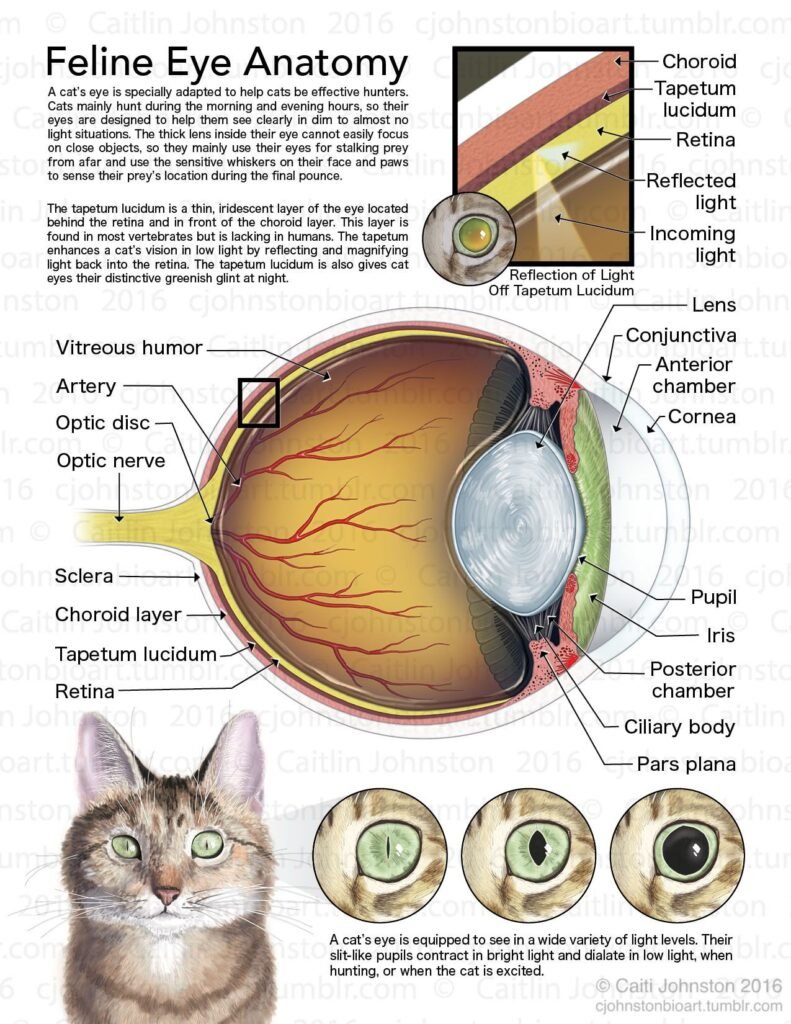
At first glance, a cat’s eye may look similar to a human eye, but its internal structure is highly specialized for a predator’s needs.
A cat’s eye is made up of several important parts that work together to capture light, process visual information, and send signals to the brain.
Starting from the front of the eye, light first passes through the cornea, the transparent outer layer that protects the eye and helps focus incoming light. Behind the cornea is the iris, the colored part of the eye that controls the size of the pupil. By adjusting the pupil’s size, the iris regulates how much light enters the eye.
A cat’s pupil is especially unique. In bright conditions, it narrows into a thin vertical slit to reduce excess light. In darker environments, it expands dramatically into a large, round opening to collect as much light as possible.
Behind the pupil is the lens, which focuses light onto the retina at the back of the eye. The retina contains millions of light-sensitive cells that convert incoming light into electrical signals. These signals are then sent through the optic nerve to the brain, where they are interpreted as images.
One of the most distinctive features of a cat’s eye is the tapetum lucidum, a reflective layer located behind the retina. This structure gives light a second chance to stimulate the retina, improving night vision and creating the familiar glowing effect seen in cats’ eyes at night.
Cats also have a third eyelid, or nictitating membrane, a protective layer that helps keep the eye moist and shields it from dust, debris, and injury.
Together, these structures create a highly specialized visual system that allows cats to thrive as skilled hunters and adaptable predators.
A Closer Look at Each Part of a Cat’s Eye
Cornea
The cornea is the clear outer surface at the front of a cat’s eye. It acts like a protective window, allowing light to enter while helping focus that light toward the inside of the eye.
Because cats rely heavily on vision for hunting and navigation, maintaining a clear and healthy cornea is essential. Even a small injury or cloudiness in this layer can interfere with their ability to see clearly.
The cornea is also highly sensitive because it contains many nerve endings. This sensitivity helps protect the eye by triggering quick reactions, such as blinking, when something touches or irritates the surface.
Compared with humans, cats have relatively large corneas in proportion to their eye size. This allows them to collect more available light, which is especially helpful in the low-light conditions where cats are most active.
A healthy cornea is one of the first steps in creating clear vision, making it a critical part of the feline visual system.
Sclera
The sclera is the tough outer layer of the eyeball that helps maintain its shape and protect the delicate structures inside. In humans, the sclera is easily visible as the white part of the eye, but in cats, it is usually hidden beneath the surrounding tissues and eyelids.
The main job of the sclera is to provide structural support and protect the eye from external pressure or injury. It also serves as an attachment point for the muscles that control eye movement.
Although the sclera does not directly help cats see, it plays an important supporting role by keeping the eye stable and properly protected.
Because most of a cat’s sclera is not visible, their eyes often appear larger and more expressive compared with human eyes — a feature that many people find especially appealing.
Iris
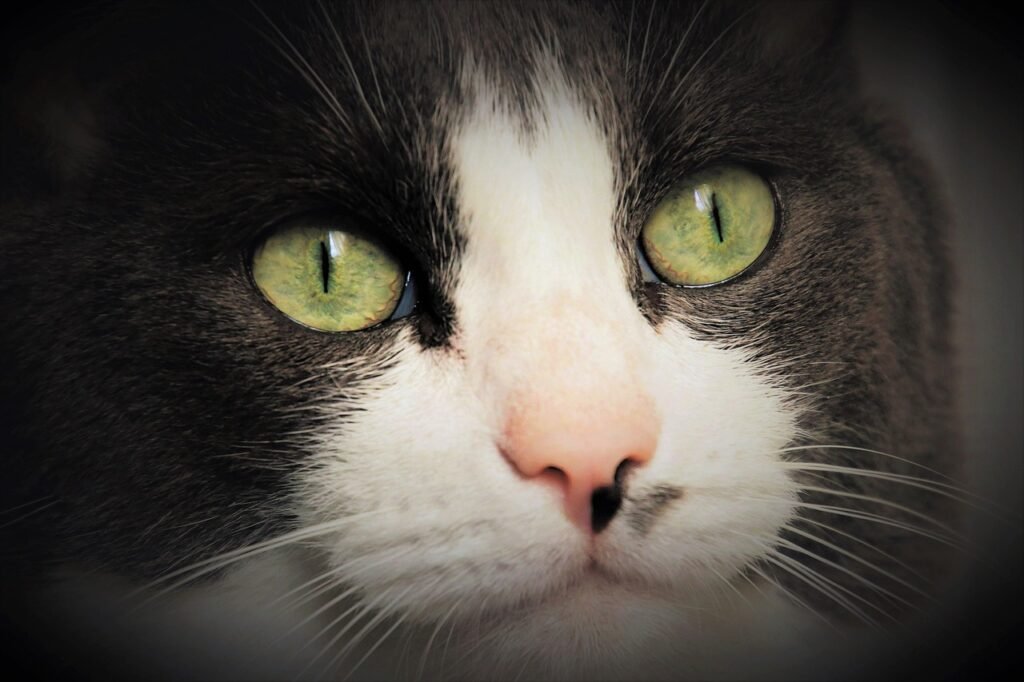
The iris is the colored part of a cat’s eye located between the cornea and the lens. It controls the amount of light entering the eye by adjusting the size of the pupil.
This function is extremely important because cats experience a wide range of lighting conditions throughout the day. In bright sunlight, the iris contracts the pupil to reduce incoming light and protect the retina. In dim environments, it allows the pupil to expand so the eye can capture more available light.
Melanin in the iris determines a cat’s permanent eye shade, which is why kitten eye color changes from blue to green, gold, or copper as melanin production increases.
Beyond appearance, the iris is a key part of how cats adapt their vision to different environments, helping them transition quickly between bright and dark conditions.
Pupil
The pupil is the opening in the center of the iris that allows light to enter the eye. While human pupils are usually round, a cat’s pupil has a distinctive vertical slit shape — one of the most recognizable features of feline anatomy.
This unique design gives cats exceptional control over the amount of light reaching the retina. In bright environments, a cat’s pupil can narrow into an extremely thin slit, reducing the amount of light entering the eye and protecting the sensitive retina.
In low-light conditions, the pupil expands dramatically, becoming almost round and allowing as much light as possible to enter. This ability helps cats see during dawn, dusk, and nighttime hours when many other animals struggle.
The vertical shape of the pupil also provides another advantage for hunting. It helps cats accurately judge distance, making it easier to calculate the precise timing and position needed when jumping or pouncing on prey.
A cat’s changing pupils are not only fascinating to observe — they are a perfect example of how anatomy supports their natural hunting behavior.
Lens
The lens is a transparent structure located behind the pupil. Its main job is to focus incoming light onto the retina, creating a clear image that the brain can process.
When light enters the eye, the lens changes its shape slightly to adjust focus. This process allows cats to see objects at different distances, from nearby toys to moving objects across a room.
A cat’s lens is relatively large compared with the size of its eye, which helps gather more light in darker environments. However, because the lens is less flexible than a human lens, cats are not as skilled at focusing on very close objects.
This is why cats may have difficulty seeing objects directly in front of their nose. Instead, they rely heavily on their whiskers and other senses when exploring very close spaces.
Although the lens has limitations, it plays a crucial role in helping cats form clear images and respond quickly to their surroundings.
Aqueous Humor and Vitreous Humor
Inside a cat’s eye are two important transparent substances: aqueous humor and vitreous humor. Although they are often overlooked, both play essential roles in maintaining healthy vision.
Aqueous humor is a clear fluid located between the cornea and the lens. It provides nutrients to parts of the eye that do not have their own blood supply, including the cornea and lens. It also helps maintain proper eye pressure, which is important for keeping the eye functioning normally.
Behind the lens is the vitreous humor, a clear gel-like substance that fills most of the inside of the eyeball. It helps the eye maintain its shape, supports the retina, and allows light to pass smoothly through the eye.
Together, these fluids create the transparent environment needed for light to travel from the front of the eye to the retina. Without them, the visual system would not be able to function properly.
Retina
The retina is one of the most important parts of a cat’s eye. Located at the back of the eyeball, this thin layer contains millions of specialized cells that convert light into signals the brain can understand.
The retina contains two main types of photoreceptor cells:
- Rod cells, which detect light intensity and movement
- Cone cells, which help with color vision and detail recognition
Cats have a much higher number of rod cells than humans, which gives them excellent sensitivity in low-light conditions. This is one of the main reasons cats can move confidently through dim environments where humans would struggle to see.
However, cats have fewer cone cells compared with humans, meaning their color vision is more limited. Instead of seeing the full range of colors that humans experience, cats mainly perceive shades of blue, yellow, and green.
The retina is where light becomes meaningful visual information. After processing incoming light, it sends signals through the optic nerve to the brain, allowing cats to recognize objects, detect movement, and understand their surroundings.
Tapetum Lucidum
The tapetum lucidum is one of the most fascinating features of a cat’s eye. This specialized reflective layer sits behind the retina and helps cats make better use of available light.
When light enters the eye, some of it passes through the retina without being absorbed. The tapetum lucidum reflects this unused light back through the retina, giving photoreceptor cells a second opportunity to detect it.
This “second chance” at capturing light greatly improves a cat’s vision in dark environments. It is one of the reasons cats can move, hunt, and explore at night with remarkable confidence.
The tapetum lucidum is also responsible for the glowing effect often seen when a light shines into a cat’s eyes in the dark. This phenomenon, known as eyeshine, occurs because the reflective layer sends light back toward the viewer.
Depending on the cat and the lighting conditions, this glow may appear green, yellow, or even blue.
While this adaptation provides excellent night vision, it comes with a small trade-off. The reflection of light can slightly reduce image sharpness, meaning cats may not see fine details as clearly as humans in bright conditions.
Optic Nerve
The optic nerve is the communication pathway between the eye and the brain. It carries visual information collected by the retina and delivers it to the brain, where it is processed into the images a cat sees.
When light reaches the retina, photoreceptor cells convert it into electrical signals. These signals travel through the optic nerve to the visual centers of the brain, where information about shapes, movement, brightness, and color is interpreted.
The optic nerve is essential for normal vision. If it becomes damaged, the connection between the eye and the brain can be disrupted, potentially leading to partial or complete vision loss.
Interestingly, where the optic nerve leaves the retina, there are no light-sensitive cells, creating a small natural blind spot. However, cats do not notice this because their two eyes work together and their brains compensate for missing information.
The optic nerve completes the journey of vision, transforming light entering the eye into a meaningful picture of the world around them.
Third Eyelid (Nictitating Membrane)
The third eyelid, also called the nictitating membrane, is a unique protective feature found in cats and many other animals.
Located at the inner corner of the eye, this thin, semi-transparent membrane can move across the surface of the eyeball to provide additional protection and moisture.
Unlike the upper and lower eyelids, the third eyelid is not mainly used for blinking. Instead, it helps remove dust and small particles from the eye surface while spreading tears evenly across the cornea.
You may occasionally notice a cat’s third eyelid while they are sleeping, waking up, or feeling relaxed. However, if the third eyelid remains visible for a long period or covers a significant portion of the eye, it may indicate an underlying health issue and should be checked by a veterinarian.
This special structure is another example of how cats’ eyes have evolved to protect themselves while living an active and often challenging lifestyle.
How Do Cat Eyes Work Together?
A cat’s eye is not just a collection of individual parts — it is a highly coordinated visual system where every structure works together to help cats understand and respond to their surroundings.
The process begins when light enters the eye through the cornea. As the first major focusing surface, the cornea bends incoming light and helps direct it deeper into the eye.
Next, light passes through the pupil, which is controlled by the iris. The pupil acts like an adjustable camera opening. In bright environments, it narrows into a thin vertical slit to reduce the amount of light entering the eye. In darker conditions, it expands widely to capture as much available light as possible.
After passing through the pupil, light reaches the lens, which fine-tunes the focus and directs the image onto the retina. The retina contains millions of specialized photoreceptor cells, including rod cells and cone cells, which convert light into electrical signals.
Rod cells are especially important for cats because they are highly sensitive to low levels of light and movement. This allows cats to detect subtle motion even in dim environments, making them effective hunters during dawn, dusk, and nighttime.
Behind the retina, the tapetum lucidum provides another advantage. It reflects unused light back through the retina, giving photoreceptor cells a second opportunity to capture information. This improves a cat’s ability to see in low-light conditions and creates the familiar “eye shine” effect when light hits their eyes in the dark.
Finally, the visual signals travel through the optic nerve to the brain, where they are processed into a complete image. The brain combines information about movement, brightness, depth, and shape, allowing cats to quickly react to changes in their environment.
This entire process happens incredibly fast. Every part of the eye — from the adjustable pupil to the light-sensitive retina — works together to support a cat’s natural abilities as a predator.
How Are Cat Eyes Different From Human Eyes?
Cats and humans share many basic eye structures, but their eyes are designed for very different purposes.
Humans evolved as highly visual animals that rely on detailed vision and a wide range of colors. Cats, on the other hand, evolved as predators that need to detect movement, judge distance, and see effectively in changing light conditions.
These differences shape the way cats experience the world.
| Feature | Cats | Humans |
|---|---|---|
| Night vision | Excellent | Limited |
| Color vision | More limited, mainly blue and yellow-green tones | Richer color perception |
| Motion detection | Extremely sensitive | Good, but less specialized |
| Field of view | About 200 degrees | About 180 degrees |
| Pupil shape | Vertical slit | Round |
Night Vision
One of the biggest differences between cat eyes and human eyes is their ability to see in low light.
Cats have a much higher concentration of rod cells in their retina compared with humans. These cells are extremely sensitive to light and help detect shapes and movement in dark environments.
In addition, cats have a tapetum lucidum, a reflective layer that allows light to pass through the retina twice. This gives cats a significant advantage when hunting in dim conditions.
However, cats do not see in complete darkness. They still need some amount of available light to form an image.
Color Vision
Although cats see colors, their color vision is not as broad as human vision.
Humans are trichromatic, meaning we have three types of cone cells that allow us to perceive red, green, and blue wavelengths.
Cats are generally considered dichromatic, with two main types of cone cells. They are better at seeing blue and yellow-green colors but have difficulty distinguishing red and green tones.
As a result, the world through a cat’s eyes is likely less colorful than what humans experience, with more emphasis on brightness, contrast, and movement rather than vivid colors.
Motion Detection
Cats are exceptionally good at noticing movement.
Their visual system is highly tuned to detect even small changes in their surroundings. A slight movement from a toy, insect, or small animal can immediately capture a cat’s attention.
This ability is essential for hunting. Instead of relying only on sharp details, cats are designed to quickly identify movement patterns and respond with speed and accuracy.
Humans can also detect movement well, but our vision is more specialized for detailed observation rather than rapid tracking of small moving targets.
Field of View
Cats have a wider field of view than humans.
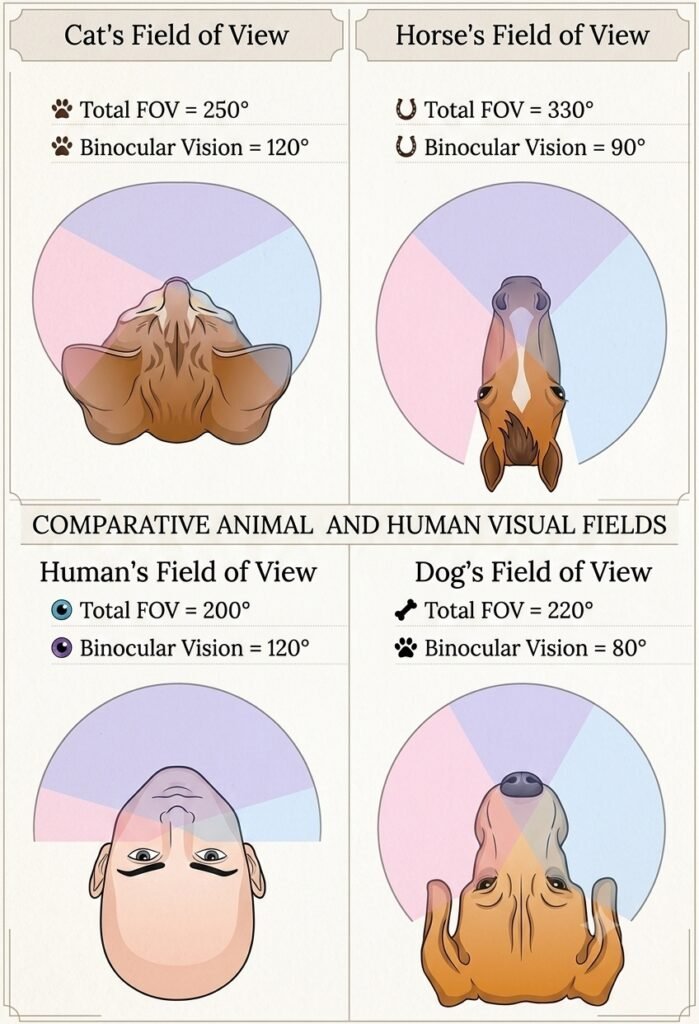
A cat’s field of vision is approximately 200 degrees, while humans typically have around 180 degrees. This wider view allows cats to monitor more of their surroundings without moving their heads.
This is especially useful for predators. A cat resting quietly can still notice movement approaching from different directions, helping it stay aware of potential threats or opportunities.
Pupil Shape
The vertical slit pupil is one of the most recognizable features of a cat.
Unlike human round pupils, cat pupils can change dramatically in size. This allows them to adapt quickly between bright sunlight and low-light environments.
The vertical shape also helps cats estimate distance more accurately when preparing to jump. By judging depth and distance precisely, cats can make highly accurate movements when chasing prey or jumping onto surfaces.
Together, these differences create a visual system perfectly adapted to a cat’s lifestyle — one focused on hunting, awareness, and survival.
Common Cat Eye Problems
A cat’s eyes can reveal a lot about its overall health. Changes in appearance, discharge, or behavior may indicate that something is wrong and should not be ignored.
While some eye issues are minor, others may require veterinary attention.
Here are some common cat eye problems:
A cat’s third eyelid, also called the nictitating membrane, is normally hidden when the cat is healthy and alert.
If the third eyelid becomes visible and covers part of the eye, it may indicate irritation, eye disease, dehydration, illness, or other underlying health problems.
Occasional visibility when a cat is sleeping or just waking up can be normal. However, persistent exposure should be checked by a veterinarian.
Red or irritated eyes are often a sign of inflammation. In young kittens, eye redness or discharge may sometimes appear around the time they begin opening their eyes. Learn more about when kittens open their eyes and what is considered normal during this stage.
Common causes include:
Conjunctivitis
Allergies
Foreign objects
Eye injuries
Bacterial or viral infections
A cat with persistent redness, swelling, squinting, or sensitivity to light may need professional evaluation.
Healthy cat eyes should appear clear and bright.
Cloudiness or a change in transparency may be associated with conditions such as:
Corneal damage
Corneal ulcers
Cataracts
Glaucoma
Other internal eye problems
Any sudden change in eye clarity should be taken seriously.
Some eye discharge can be normal, especially small amounts of clear tears.
However, thick, yellow, green, or sticky discharge may suggest infection or inflammation.
Other warning signs include:
Frequent blinking
Pawing at the eyes
Swelling around the eye
Avoiding bright light
Early attention can help prevent minor eye problems from becoming more serious.