

A cat’s sense of taste is weak. Humans have 9,000 taste buds. Cats have 473. They make up for this deficiency with a superior sense of smell. Their most powerful response to food is through smell, not taste.
What Is a Cat’s Sense of Taste?
Taste is a chemical sense. It begins when substances in food or drink interact with specialized sensory cells called taste receptor cells. These cells help detect different chemical qualities and send signals through nerves to the brain, where the information contributes to the perception of taste.
Cats have taste buds on their tongue and in other parts of the oral cavity. These structures contain receptor cells that respond to certain chemical stimuli. Their taste system allows them to detect several taste qualities, including sourness, bitterness, and savory compounds associated with amino acids and nucleotides.
However, cats do not experience every taste in the same way humans do. One of the clearest differences is sweetness: domestic cats lack a functional sweet-taste receptor of the type humans use to detect sugars.
This does not mean that a cat’s sense of taste is simply weaker or less developed. Instead, it is adapted to a different sensory world, one shaped by the nutritional needs and feeding habits of an obligate carnivore.
How Do Cats Detect Flavors?
When a cat eats, food molecules dissolve in saliva and come into contact with taste receptor cells. These cells respond to particular chemical features of the food and transmit signals through sensory nerves.
Taste is only one part of the experience. A cat also uses its sense of smell, along with information about a food’s texture, temperature, and physical form. Together, these signals contribute to what we commonly call flavor.
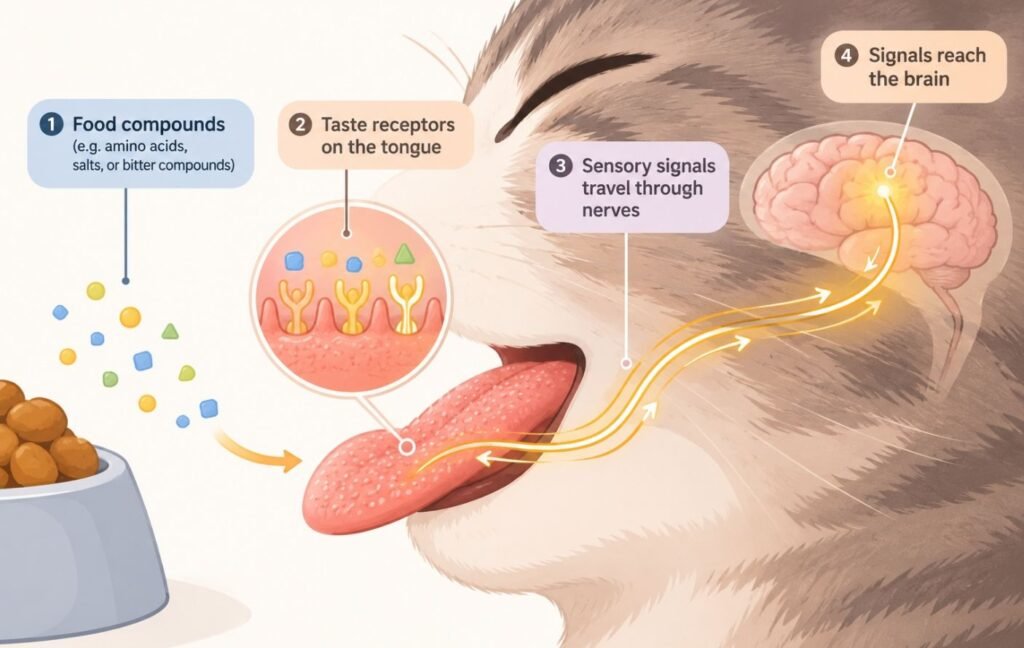
The taste system does not work as a single, universal detector. Different receptor systems respond to different types of compounds. Some are involved in detecting bitter substances, while others respond to savory compounds or other chemical stimuli.
Researchers have studied feline taste responses by examining taste-related nerves, receptor genes, and the behavior of cats when they are offered different foods. These studies help explain why cats may respond strongly to some flavors while showing little interest in others.
The Five Basic Taste Qualities
Taste begins when chemicals in food or drink interact with sensory cells. In humans, five basic tastes are widely recognized: sweet, salty, sour, bitter, and umami.
Do cats experience those tastes in the same way we do? Research into feline anatomy, taste nerves, and taste receptors suggests that their sensory world differs from ours in several important ways.
One clarification: spiciness is not technically a taste. The burning sensation caused by chili peppers is mainly associated with sensory pathways involved in pain and temperature. It is included here because it is often discussed alongside taste.
As noted earlier, cats lack a functional sweet-taste receptor of the kind found in humans, and their response to salt is relatively limited. Their sense of taste is therefore different from ours—not simply a less sensitive version of the human experience. Cats have sensory systems adapted to their own biology and feeding habits.
Sweetness: Why Cats Aren’t Drawn to Sugar
Sweetness is the taste associated with sugars and certain other compounds. Humans and dogs can detect a wide range of sweet substances, but cats do not respond to sweetness in the same way.
Researchers at the Monell Chemical Senses Center investigated two genes involved in forming the mammalian sweet-taste receptor: Tas1r2 and Tas1r3. They found that the cat’s Tas1r3 gene appears functional, but Tas1r2 is a pseudogene—a gene that no longer produces a functional product. Without the T1R2 protein, cats cannot form the usual T1R2/T1R3 sweet-taste receptor (Li et al., 2006).
In practical terms, cats lack the functional receptor that humans use to detect sweetness. This helps explain why cats generally show little interest in sweet-tasting foods, although individual food preferences can depend on smell, texture, fat, protein, and other factors.
The same genetic change has been identified in other members of the cat family, including tigers and cheetahs. Researchers believe these species are also unable to detect sweetness in the usual way.
For an obligate carnivore, the ability to detect sugar may be less important than the ability to recognize the amino acids and other compounds found in animal tissue.
Saltiness: Can Cats Taste Salt?
Saltiness is most commonly associated with sodium chloride (NaCl), or table salt.
That does not mean cats are completely unable to respond to salty substances. Sensory units that normally respond to amino acids and nucleotides can also respond to sodium chloride and potassium chloride. However, the reported detection threshold is above 50 millimolar (mM), or roughly 0.3% for sodium chloride. This suggests that cats are relatively insensitive to salt compared with animals that have a more specialized salt-detection mechanism.
Scientists once proposed that meat-eating animals had a separate type of nerve unit dedicated to salt. Later interpretations suggested that the response might instead come from sensory units that primarily detect amino acids but also react to salt at higher concentrations.
Sourness: A Different Sensitivity Across the Tongue
Sourness is associated with acids and the hydrogen ions they release.
Researchers have reported differences among species in how many fungiform papillae are served by a single taste nerve fiber known as the chorda tympani. The reported averages are about 5.4 papillae in goats, 3.4 in dogs, and 3 in cats.
The location of sour sensitivity also varies. Rats and goats appear more sensitive to sour stimuli near the front of the tongue, while cats show greater sensitivity toward the back. In the image below, the yellow areas indicate the regions reported to respond to sour substances.
The sensory fibers involved in sour taste can carry signals quickly. In studies of dogs and cats, the response to a sour stimulus is strong at first but then fades relatively quickly. One possible explanation is that these animals may reject an unpleasant food soon after tasting it, so a prolonged response may not be necessary. That explanation is a hypothesis, however, rather than a proven reason for the response pattern.
In one study, researchers measured the response of feline taste units to a range of compounds at a concentration of 50 mM (Boudreau, 1985). The list below follows the order reported in the source, from stronger to weaker responses.
Substances reported to trigger responses in cat sour-sensitive taste units
- Malic acid
- ATP (adenosine triphosphate)
- ITP (inosine 5′-triphosphate)
- Sodium phosphate
- O-phosphoethanolamine
- L-histidine
- IDP (inosine 5′-diphosphate)
- Butyrylcholine chloride
- L-cysteine
- L-tryptophan
- L-proline
- L-isoleucine
- Tetrasodium pyrophosphate
- Phytic acid
- L-arginine
- L-lysine
- IMP (inosine 5′-monophosphate)
The study reported especially strong, sustained responses to malic acid (pH 2.2), ATP (pH 3.0), ITP (pH 2.8), sodium phosphate (pH 4.64), and L-histidine (pH 7.4). Because these compounds do not all produce acidity in the same way, the findings are best understood as responses of particular sensory units—not as a simple ranking of how sour each substance would taste to a person.
Researchers once proposed that cats had a special type of “water-sensing nerve fiber” that responded specifically to water (Cohen, 1954). However, the sensory units described as sour-sensitive were also reported to respond to distilled water and quinine, a bitter compound. This overlap led researchers to suggest that the two responses might involve the same sensory structures.
Bitterness: Detecting Potentially Harmful Compounds
Bitterness is associated with a wide range of compounds, including alkaloids, terpenes, glycosides, some amino acids, and some peptides.
Humans can detect certain bitter compounds at very low concentrations. For comparison, sucrose may be detectable at around 0.7%, table salt at about 0.055%, and quinine—a classic bitter compound—at approximately 0.00005% (Hagiwara, 1980). These figures illustrate how sensitive the human sense of taste can be to certain bitter substances.
Cats also respond to compounds such as quinine, caffeine, and tannic acid. In research on feline taste nerves, one group of taste-related sensory units has been called the Xb unit. These units respond to a range of chemical stimuli and have been associated with bitter-taste responses (Boudreau, 1985).
The source study lists a variety of compounds that can trigger responses in these units, including:
Compounds reported to trigger responses in cat taste units
- Phosphorus-containing compounds
- Butyrylcholine chloride
- Malic acid
- Phytic acid
- Acetylacetone
- p-Hydroxyphenylacetic acid
- Vanillin
- Methyl maltol
- Lactones
- Quinine
- Caffeine
- Tannic acid
- Bile salts
- Deoxycholic acid
- Taurocholic acid
These results should not be read as a straightforward list of substances that all taste bitter to cats. Individual nerve units can respond to more than one kind of chemical stimulus, and a laboratory response does not always tell us exactly how an animal experiences a substance.
The source research also suggests that some bitter-responsive areas are concentrated toward the front of the cat’s tongue. One possible explanation is that early detection may help an animal reject potentially harmful substances before swallowing them.
In 2015, researchers at the Monell Chemical Senses Center investigated genes involved in producing bitter-taste receptors, known as Tas2r genes. They found that 12 of the relevant genes remained functional in cats. This supports the idea that cats have a substantial capacity to detect a range of bitter compounds.
Umami: Why Cats Respond to Amino Acids
Umami is the savory taste associated with certain amino acids and nucleotides. It was identified as a distinct taste by Japanese chemist Kikunae Ikeda in 1908, after he isolated glutamate from kombu broth. Other well-known umami compounds include inosinate, found in foods such as bonito flakes, and guanylate, found in shiitake mushrooms.
Umami is now widely recognized as the fifth basic taste in humans. Research into taste receptors, including the discovery of glutamate receptors in taste cells, helped establish its biological basis.
Cats have taste-sensitive nerve units that respond to amino acids and nucleotides. These are often called amino acid units in studies of feline taste physiology (Boudreau, 1985). In cats and dogs, they are found in several areas of the tongue, with particularly strong representation among the fungiform papillae near the tip.
Rats have similar sensory responses in the middle of the tongue and on the roof of the mouth. The cited research reported no equivalent amino-acid-sensitive mechanism in goats, which are herbivores.
The average number of fungiform papillae served by a single taste nerve was reported as about 3.2 in cats, 4.1 in dogs, and 4.6 in rats. In both cats and dogs, the response to a stimulus begins to decline after about a second. The nerve fires less frequently, and the animal gradually adapts to the stimulus.
Amino acid units can respond strongly to compounds containing nitrogen or phosphorus, including certain nitrogen-containing ring compounds, sodium phosphate, sodium pyrophosphate, nucleotide diphosphates and triphosphates, and some amino acids. Other compounds can inhibit these responses, depending on the sensory unit and the substance involved.
The following amino acids were reported to trigger particularly strong responses in cats (Boudreau, 1985):
Amino acids that trigger strong responses in cats
- Proline
- Cysteine
- Ornithine
- Lysine
- Histidine
- Alanine
By contrast, the following amino acids were reported to produce weaker responses or to inhibit the response of particular sensory units:
Amino acids with weaker or inhibitory responses
- Tryptophan
- Isoleucine
- Leucine
- Arginine
- Phenylalanine
These lists describe responses in specific experimental systems. They should not be interpreted as a complete ranking of which amino acids cats prefer to eat.
In 2017, a team of French and British researchers studied a laboratory model of the cat’s amino acid receptor, focusing on the N-terminal region of feline T1R1. They reported that the receptor could bind to six amino acids, with particularly strong binding to alanine and isoleucine. Cysteine did not bind in the same way. The researchers also found that small amounts of IMP and GMP could affect binding, with IMP producing especially notable changes for histidine, followed by alanine, isoleucine, and arginine.
In humans, L-glutamate and L-aspartate are recognized as umami-related amino acids. The feline receptor findings suggest that cats may detect a broader range of amino-acid signals through this system. That would make sense for obligate carnivores, whose diets depend heavily on animal protein.
It is tempting to conclude that cats experience a richer or more complex umami sensation than humans do. However, receptor binding alone cannot tell us exactly how a cat experiences flavor. The idea that cats perceive a broader range of umami sensations remains a hypothesis.
Cat Taste Buds vs. Human Taste Buds
Cats and humans both use taste buds to detect chemical information in food, but the number and function of these structures differ.
| Feature | Cats | Humans |
|---|---|---|
| Approximate number of taste buds | Around 470 | Around 9,000–10,000 |
| Sweet-taste receptor | Nonfunctional in the usual form | Functional |
| Response to savory compounds | Adapted to particular amino acids and nucleotides | Responds to familiar umami compounds, including glutamate |
| Taste experience | Shaped by feline biology and diet | Shaped by human biology and diet |
The difference in taste-bud numbers is striking, but it should not be interpreted as a simple measure of how well an animal can taste. Taste sensitivity depends on more than the number of taste buds. It also depends on the types of receptors present, how sensory cells respond to compounds, and how the brain processes those signals.
Cats may have fewer taste buds than humans while remaining highly responsive to certain food-related chemical signals. Their taste system is not a smaller version of ours; it is a system adapted to their own needs.
This difference also makes cat food surprisingly interesting to humans. Have you ever wondered what your cat’s food actually tastes like? In a YouTube video, Cat Owners Try Cat Food For The First Time, several cat owners try cat food and share their reactions. Their responses offer a fun glimpse into how people experience a food made for another species.
But a human taste test can only tell us what cat food tastes like to a human. A flavor that seems bland, unusual, or unappealing to us may be perceived differently by a cat, whose taste receptors and food preferences are shaped by feline biology. Our reaction to cat food is not a reliable measure of how much a cat enjoys it.
You can watch the video here:
Cat Taste Buds vs. Dog Taste Buds
Cats and dogs share some similarities in their taste systems, but they are not identical.
Both species can detect several taste-related stimuli and respond to savory compounds. However, dogs have a functional sweet-taste receptor, while cats lack the usual functional receptor for sweetness. This is one of the clearest differences between the two species.

Dogs also have more taste buds than cats according to commonly cited estimates, although exact counts vary across sources.
These differences reflect the distinct evolutionary and dietary histories of cats and dogs. Cats are obligate carnivores, while dogs have a more flexible omnivorous feeding biology.
It is important not to assume that a flavor appealing to a dog will have the same effect on a cat. Even when two animals can detect a similar taste quality, they may respond differently to the compounds that produce it.
What Makes Food Taste Richer?
Some foods taste fuller, richer, or more satisfying than others, even when they aren’t noticeably sweeter or saltier. Scientists study how certain compounds can enhance the overall flavor of food, making savory notes seem more pronounced and the taste experience feel more complete.
In 2021, researchers investigated whether cats respond to some of these flavor-enhancing compounds in the same way humans do. They focused on the calcium-sensing receptor (CaSR), a protein that may help detect certain compounds in food. Using computer modeling, laboratory experiments, and taste-preference tests with cats, the researchers examined how cats responded to different combinations of amino acids and other compounds.
The results suggested that cats respond to some of these compounds differently from humans. Cats showed greater acceptance of an amino acid mixture when calcium chloride was added, but showed little interest in glutathione on its own. This suggests that a compound’s effect on food acceptance may depend on the other ingredients it is combined with.
The researchers also found evidence of CaSR expression in the vallate papillae, the large taste-related structures near the back of a cat’s tongue. This offers a clue about how cats detect certain food compounds, although more research is needed to understand how this receptor influences their food preferences.
Spiciness: Can Cats Feel the Burn?
Spiciness is not a basic taste. The burning sensation caused by chili peppers comes largely from the activation of sensory pathways associated with pain and heat.
In one study, researchers stimulated cats’ tongues with electrical stimulation or capsaicin, the compound responsible for the heat of chili peppers. They observed an increase in blood flow to the cats’ lips, suggesting that these stimuli activated a reflex involving sensory and autonomic pathways (Karita, 1993).
The exact nerve pathways involved are complex. Researchers have investigated signals carried from the tongue and throat toward the brain, as well as the pathways that control changes in blood flow to the lips. For a general reader, the key point is that cats can show a measurable physiological response to capsaicin, even though this does not tell us precisely how they consciously experience the sensation.
So, could a cat experience something similar to the “That’s hot!” feeling a person gets from eating chili? Possibly—but the evidence is not enough to describe the sensation in human terms. What we can say is that capsaicin can trigger a response in cats and that this response involves pathways associated with irritation, pain, and temperature rather than taste alone.