
With so many cat food options on the market, it’s easy for cat owners to feel overwhelmed and unsure which one to pick. The first step is understanding the ingredients, additives, and how to read the information on packaging labels. Once you grasp these key points, choosing the right cat food for your furry friend becomes much simpler. This guide takes the perspective of a typical cat owner and explains how to select cat food that meets both your cat’s health needs and taste preferences.
Types of Cat Food
Commercial cat food is usually categorized by its moisture content. Even cats that aren’t picky can get bored if they eat the same type of food every day. Changing flavors or textures occasionally can help stimulate their appetite. Here’s a breakdown based on moisture content:
Dry Cat Food
Dry cat food contains less than 10% moisture. The production process generally works like this: the raw ingredients are ground into a mash, mixed, and then processed through a large machine called an extruder. Heat and pressure cook and sterilize the mixture. The food is shaped through a mold called a die, producing various shapes like triangles or fish shapes, and then cut into small pieces called kibble by a rotating blade.
Once cut, moisture must be kept below 12% to prevent mold growth, even though many brands label it as 10% or less for safety. After opening, dry cat food begins to oxidize, so it should be stored in a sealed container away from direct sunlight.
Wet Cat Food
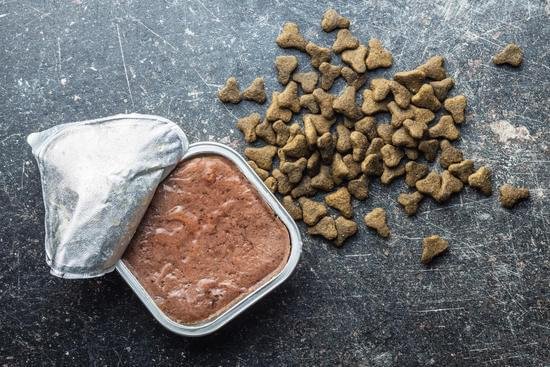
Wet cat food contains over 75% moisture. It’s often made by grinding ingredients, adding thickeners, and forming small loaf-like pieces. To maintain high moisture content, some wet foods include gravy or jelly, which is why you often see chunks of meat floating in a jelly-like sauce when opening a can.
Wet food usually has a stronger aroma and more pronounced meaty texture, making it more satisfying for cats. However, it’s generally more expensive and can leave residue in the mouth, increasing the risk of tartar buildup and bad breath. Any leftovers should be covered and refrigerated or frozen.
Ingredients and Raw Materials in Cat Food
Cat food ingredients fall into two main categories: raw materials/ingredients and additives. Here, we’ll focus on the main ingredients that provide energy, following standards commonly used in North American pet food labeling.
Meat
“Meat” refers to raw meat and organs from mammals or poultry, as well as by-products from animals. Processed products like meat meal, meat and bone meal, and chicken meal are also considered meat.
Common mammal meats include beef, pork, lamb/mutton, and venison. Some brands also use less common meats like bison, goat, or kangaroo. Poultry options include chicken, turkey, quail, and duck.
Seafood
“Seafood” includes all fish, shellfish, and other marine products, including processed items like fish meal and fish extract. Common fish ingredients include tuna, salmon, mackerel, sardines, and menhaden. Shellfish may include shrimp and crab, while soft-bodied seafood includes squid and octopus. Common bivalves are scallops, clams, and mussels.
Grains
Grains include whole, cracked, or ground cereals and their processed products. Examples include corn, wheat, rice (including brown rice), oats, barley, sorghum, and millet.
- Grain-Free cat food excludes these grains.
- Gluten-Free cat food specifically avoids wheat gluten.
Legumes
Legumes include beans and their processed products, such as soy, soy meal, soy flour, bean pulp, chickpeas, and red beans.
Vegetables
Vegetables include carrots, cabbage, pumpkin, spinach, tomatoes, kale, and watercress. In cat food, vegetables are usually a minor ingredient, often listed later in the ingredient list.
Sugars / Carbohydrates
Sugars refer broadly to carbohydrates, including digestible sugars and indigestible fiber. On pet food labels, both are often grouped under “sugars.” Common examples are glucose, fructose, sucrose, honey, oligosaccharides like FOS (fructo-oligosaccharides), and MOS (mannan-oligosaccharides).
Dairy
“Dairy” includes raw milk and its processed products, as well as by-products from processing. Depending on processing and moisture content, this includes whole milk, skim milk, whole milk powder, and skim milk powder. Other dairy products like whey, cheese, butter, and cream are also classified as dairy ingredients.
By-Products (Bran, Hulls, and Grain Residues)
By-products originally referred to things like rice bran or grain hulls. In cat food, this category includes leftover parts of grains from milling or processing. Common examples are rice bran, wheat bran, wheat germ, barley bran, and psyllium husks.
Another common by-product is gluten feed, which comes from the leftovers during corn starch production.
Fats and Oils
“Fats and oils” covers both plant-based oils and animal fats, including their processed products. Fatty acids that make up these fats, like linoleic acid, linolenic acid, and other polyunsaturated fatty acids, also fall into this category. On labels, they are often simply listed as “fats and oils” without specifying whether they are plant or animal-based.
Nuts and Seeds
This category includes hard-shelled nuts and seeds. Common examples are almonds, chestnuts, sesame seeds, and peanuts. Seeds like chia and flaxseed/linseed are also often included in cat food formulas.
Starches
Starch is a polysaccharide made up of 9 or more sugar molecules. Common sources include rice starch, glutinous rice starch, corn starch (including waxy corn), tapioca/cassava starch, potato starch, and wheat starch.
Fruits
This category includes fruits and processed fruit products. Common examples on cat food labels are apples, grapes, bananas, and various berries.
Algae
Algae includes all types of seaweed and their processed products. Examples are nori, kelp, wakame, hijiki, chlorella, spirulina, agar, and carrageenan.
If the label only says “seaweed” or “seaweed meal,” it’s best to confirm with the manufacturer which specific types of algae are included.
Mushrooms and Fungi
This category refers to fungi with fruiting bodies. Common mushrooms include champignon, enoki, shiitake, and crab-flavored mushrooms. Some formulas may also include medicinal fungi like Agaricus.
Additives in Cat Food
Cat food contains additives in addition to raw ingredients. These additives help maintain the appearance, flavor, and safety of the food.
Colorants
Colorants are added to make food visually appealing, usually by giving it a red or brown tone. Cats cannot see red, so the purpose is to attract the owner’s attention and make the food look fresh or high-quality.
Preservatives
Preservatives maintain food freshness and prevent spoilage. Over 80% of preservatives used in cat food are potassium sorbate. Even though they are safe within regulated limits for human food, they should not be added without control in pet food.
Curing Agents
Curing agents like sodium nitrite are mainly used in wet food to keep meat looking bright red. Again, cats do not notice the color; it is intended for the human eye.
Thickeners and Stabilizers
Thickeners increase the food’s viscosity or texture. Stabilizers prevent the food from falling apart, and gelling agents create a gel-like consistency in some formulas.
Acids and Flavor Enhancers
Acids add tartness, while flavor enhancers improve taste and appeal to cats. These are especially useful in formulas that might otherwise seem bland.
Antioxidants
Antioxidants prevent ingredients from oxidizing and degrading in quality. Some antioxidants are safe for cats, while others may be toxic, so it’s important to check labels carefully.
Nutritional Supplements
This category includes minor ingredients that support cat health. Examples are yeast, cellulose, yucca extract, limonite, probiotics, and prebiotics.
Reading Cat Food Labels
Cat food packaging must follow the labeling requirements of the country or region where it is sold. Clear, accurate labels help cat owners make informed choices and ensure the product meets safety and nutritional standards.
United States
In the U.S., cat food is regulated by the Food and Drug Administration (FDA) under the Federal Food, Drug, and Cosmetic Act (FD&C Act).
Labels on cat food sold in the U.S. are required to include the following information:
- Product Name – Clearly identifying the food.
- Net Weight or Volume – Showing the total amount of food in the package.
- Manufacturer or Distributor Information – Including name and contact details.
- Ingredient List – Ingredients must be listed in descending order by weight.
- Guaranteed Analysis – A statement showing minimum protein, minimum fat, maximum fiber, and maximum moisture content.
- Intended Use or Life Stage – For example, “For Adult Cats” or “Kitten Formula.”
Additionally, the AAFCO (Association of American Feed Control Officials) provides widely recognized guidelines for pet food nutrition and labeling. While AAFCO is not a government agency, its standards are adopted by the FDA and the pet food industry to ensure that ingredient lists and nutrition information are scientifically accurate and consistent across brands.
European Union
In the EU, cat food labeling is regulated under Regulation (EC) No 767/2009 by the European Commission. EU law requires that labels include:
- Product Name – Clearly identifying the food.
- Intended Use – For example, “For Adult Cats.”
- Ingredient List – All ingredients must be listed.
- Additives – Vitamins, minerals, and other functional additives must be clearly noted.
- Analysis of Nutrients – Including protein, fat, fiber, and moisture content.
- Manufacturer or Distributor Information – Name, address, and contact information.
- Net Weight – The total amount of food.
- Batch Number, Production Date, and Expiration Date – To ensure traceability and safety.
EU regulations emphasize that all label information must be clear, accurate, and not misleading, so that cat owners can make safe and informed choices.
Calorie Needs for Cats
The feeding amounts listed on cat food packaging are usually just rough estimates. To understand your cat’s nutritional intake more accurately, you can use some simple calculations based on your cat’s weight, age, and activity level.
How to Calculate Calorie Requirements
Cats need energy from food every day to stay alive and maintain a healthy body. This energy requirement is called the Daily Energy Requirement (DER).
DER is calculated using the formula:
DER = RER × Activity Factor
Here, RER (Resting Energy Requirement) refers to the energy a healthy cat needs while resting in a comfortable environment and not fasting. It is essentially the baseline energy requirement.
The RER can be calculated using the standard formula for small animals (cats under 2 kg):
RER (kcal/day) = 70 × [body weight in kg]^0.75
There’s also a simplified version commonly used in the U.S.:
RER (kcal/day) = 30 × [body weight in kg] + 70
For example, a cat weighing 3 kg has a resting energy requirement of about 160 kcal/day. Tables are available to quickly check RER values for different weights.
RER Quick Reference Table
| Weight (kg) | RER (kcal/day) |
|---|---|
| 1.0 | 70 |
| 1.5 | 95 |
| 2.0 | 118 |
| 2.5 | 139 |
| 3.0 | 160 |
| 3.5 | 179 |
| 4.0 | 198 |
| 4.5 | 216 |
| 5.0 | 234 |
| 5.5 | 251 |
| 6.0 | 268 |
| 6.5 | 285 |
| 7.0 | 301 |
| 7.5 | 317 |
| 8.0 | 333 |
| 8.5 | 348 |
| 9.0 | 363 |
| 9.5 | 379 |
| 10.0 | 393 |
| 10.5 | 408 |
This table provides a quick way to estimate the resting energy requirement for cats of different weights without doing full calculations.
Total Daily Energy Requirement (DER / MER)
Once you know the RER, you multiply it by an activity factor to get the DER, which represents the total energy your cat needs in a day.
Common activity factors used in North America (from AAFCO and NRC guidelines) include:
| Cat Status | Activity Factor | Notes |
|---|---|---|
| Indoor adult cat | 1.2–1.4 | Normal activity |
| Active adult cat | 1.4–1.6 | Outdoor or high activity |
| Mid-pregnancy | 1.5 | Energy needs increase |
| Late-pregnancy | 2.0–2.5 | Energy needs rise significantly |
| Nursing mother | 2.0–4.0 | Depends on milk production |
| Inactive or overweight cat | 1.0–1.2 | Reduce calorie intake |
Using RER tables and activity factors, you can estimate the daily energy requirement for cats of any weight.
For instance:
- A standard adult cat weighing 3 kg has an RER of 160 kcal/day. Using an activity factor of 1.4 for a typical adult cat, the DER would be roughly 160 × 1.4 ≈ 224 kcal/day.
- A larger cat weighing 9 kg that was recently spayed or neutered has an RER of 363 kcal/day. Using a reduced activity factor of 1.2 for a post-surgery cat, the DER would be about 363 × 1.2 ≈ 436 kcal/day.
Keep in mind, these calculations are estimates. They are a starting point, not an exact feeding prescription. The general approach is to feed according to the calculated amount, then monitor your cat’s body weight and muscle condition. Adjust the portion up or down as needed. The key is observing your cat daily and avoiding feeding based on guesswork.
Pay Attention to “Feeding Guidelines”
Cat food packages often list recommended daily feeding amounts based on weight. However, it’s important to note that the weight referred to is usually your cat’s ideal body weight—not its current weight if it’s underweight or overweight.
For example, two cats may have the same ideal weight of 5 kg. One of them, however, is overweight and actually weighs 6 kg. If the packaging suggests feeding 15 g per kg of body weight, using actual weight would feed the overweight cat 90 g instead of the 75 g needed for its ideal weight, resulting in a 20% overfeeding.
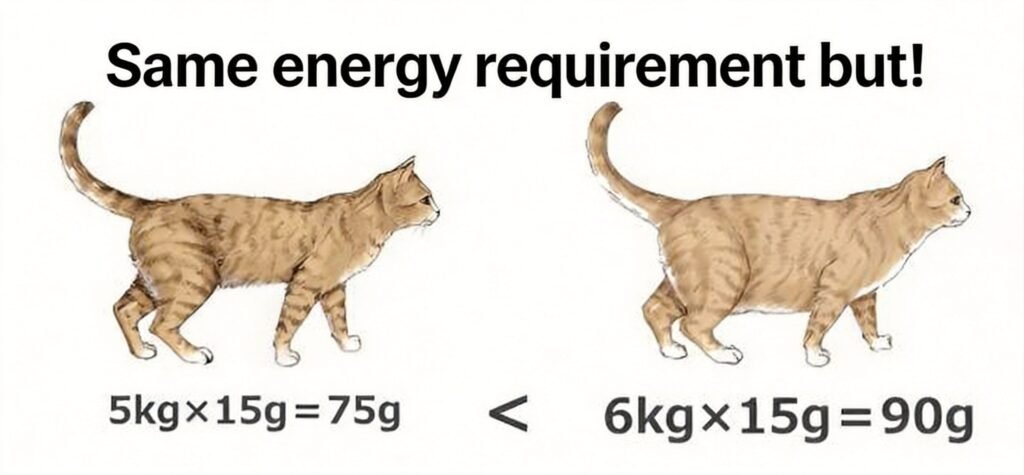
Even if the packaging doesn’t explicitly mention this, always use ideal body weight as the reference point when determining portions. This ensures your cat receives the right amount of calories without overfeeding or underfeeding.
Feeding Methods for Cats
There are several ways to feed cats, and each method has its own advantages and disadvantages. The best feeding method depends on your cat’s body type, the number of cats you have, how convenient the method is, and whether your cat has any chronic health conditions—always following your veterinarian’s advice in such cases.
Free-Feeding (Ad Libitum)
Free-feeding allows cats to decide when and how much to eat on their own. The main benefits are that it’s low-effort and requires no special knowledge. However, the downsides are that it’s hard to prevent overeating and difficult to track how much your cat actually eats. Studies suggest that about 40% of cats fed this way are at risk of becoming overweight.
Portion-Controlled Feeding (Measured Feeding)
Portion-controlled feeding is when the owner determines the exact amount of food and calories the cat receives. The advantages include easier control over intake, quick detection of changes in appetite, and better weight management. The main drawbacks are that it requires some effort and needs basic knowledge of how much your cat should eat.
Scheduled Feeding (Timed Feeding)
Scheduled feeding focuses on controlling when your cat eats rather than how much. The benefits are that it can make monitoring appetite easier and somewhat helps with controlling intake. However, it has downsides: intake may not be fully controlled, overfeeding is still possible, and it can be more time-consuming for the owner.
For detailed information on ingredients, additives, safety standards, potential risks, and recommended amounts, you can refer to the comprehensive guide The Cat Food Ingredients List.
If you want to read more about cat nutrition and diet, return to our main guide at Cat Nutrition & Diet.