
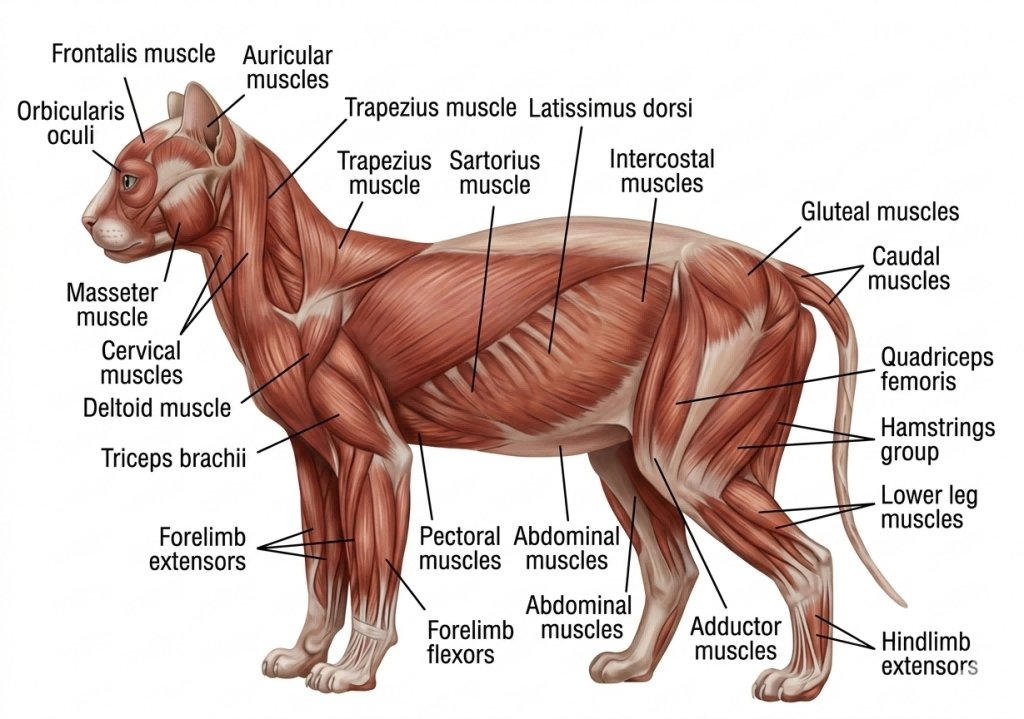
What gives cats their incredible flexibility, agility, and lightning-fast reflexes? It all comes down to their muscular system. A cat’s muscle structure is actually more like a sprinter’s than a marathon runner’s. Think of them as miniature lions—their bodies are perfectly built for explosive bursts of speed to catch prey. In fact, cats have 517 muscles in their bodies, which lets them make those amazing, split-second dodges. Keep reading to learn more fascinating facts about your cat’s muscles. You can also explore the complete Cat Anatomy guide for a full overview of how a cat’s body works.
Cat Muscle Anatomy
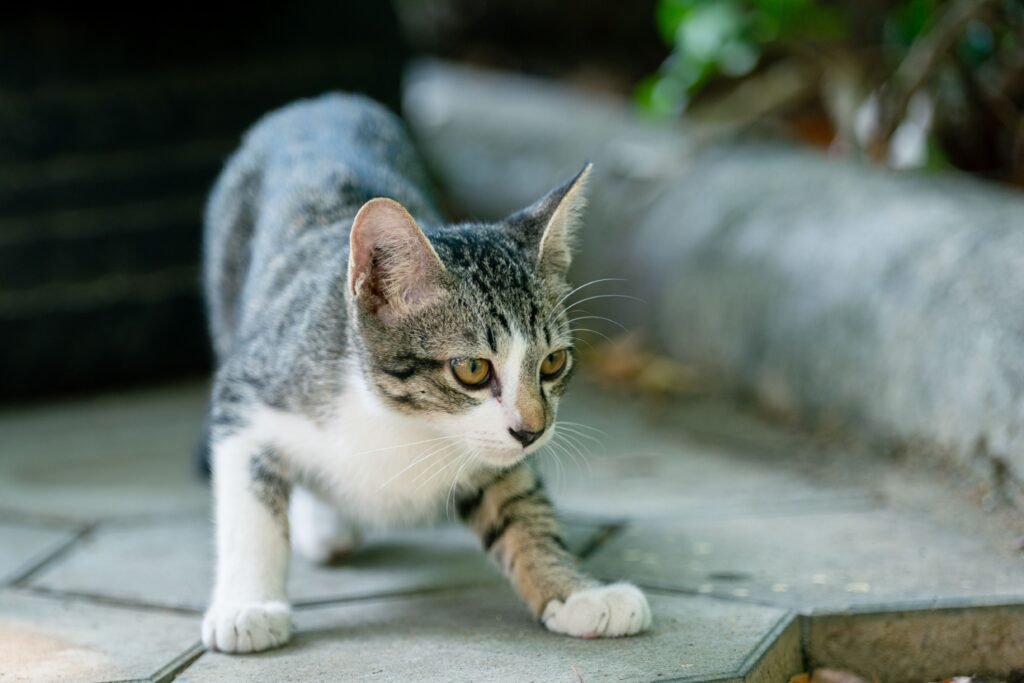
Cats have a high percentage of “fast-twitch” muscle fibers (white muscle), making them perfect for a hunting style similar to a cheetah’s that relies on explosive power. Unlike dogs, who track their prey over long distances and wear them out, cats evolved to use sudden bursts of speed to close the gap in an instant.
It’s estimated that a cat can reach speeds of about 30 mph (50 km/h) in short bursts, run a 100-meter dash in around 7 seconds, and jump up to five times their shoulder height (about 5 feet or 1.5 meters).
When we talk about muscle fibers, they are generally divided into three types:
- Type I: Weaker, but doesn’t get tired easily (high endurance).
- Type IIx: Very strong, but gets tired quickly (high power).
- Type IIa: Somewhere in between the other two.
- The table below breaks down these differences more clearly.
In addition, researchers looked at 32 different muscles in cheetahs, cats, and dogs to see what percentage of Type I, Type IIa, and Type IIx fibers they had. Here are the results:
| Animal | Type I (Endurance) | Type IIa (Intermediate) | Type IIx (Power) |
| Cheetah | 28.3% | 26.7% | 45.0% |
| Cat | 21.3% | 21.5% | 57.2% |
| Dog | 32.0% | 47.7% | 20.3% |
As you can see, the “quick-to-tire” Type IIx fibers make up 45.0% of a cheetah’s muscles and a whopping 57.2% of a cat’s muscles—more than half! In dogs, it’s only 20.3%.
On the flip side, the “endurance” fibers (Type I and Type IIa combined) make up 55% in cheetahs and 42.8% in cats, but a massive 79.7% in dogs.
These numbers clearly show that cheetahs and cats are “sprinters” built for explosive power, while dogs are “marathon runners” built for endurance.
Cheetahs and cats rely on high-speed sprints that last only a few dozen seconds to catch their prey. Dogs, however, track their prey for a long time until the prey gets tired and slows down.
This huge difference in hunting styles is basically hardwired into their natural muscle fiber makeup.
Reference: Distribution of muscle fibers in skeletal muscles of the cheetah (Acinonyx jubatus) – ScienceDirect
Cat Head and Neck Muscles
Let’s look at the muscles from the head down to the neck.
Frontalis Muscle
The frontalis muscle is used to lift the area between the eyebrows. In humans, this is where we get forehead wrinkles. But since cats don’t make as many facial expressions, this muscle isn’t very well-developed.
Orbicularis Oculi Muscle
The orbicularis oculi muscle is what closes the eyelids. When the whiskers (sensory hairs) above a cat’s eyes are touched, they blink reflexively—that’s this muscle at work.
Masticatory Muscles (Jaw Muscles)
As the name suggests, the masticatory muscles are used for chewing.
The muscle that opens the mouth is the lateral pterygoid muscle (it’s deep inside and you can’t see it from the outside). The muscles that close the mouth are mainly the masseter, the temporalis, and the medial pterygoid muscle.
Cats have more muscles for closing their mouth than opening it. This gives them a much stronger bite force for clamping down on prey.
Ear Muscles
In anatomy, there isn’t just one “ear muscle.” It’s actually a group of up to 32 tiny muscles that control how the ear moves.
Cats can move their left and right ears independently, like little radar dishes. This amazing ability comes entirely from these tiny muscles attached around the base of the ear (the pinna). For cats, who often hunt by ambushing prey in low light, hearing is everything. To get the best hearing possible, these muscles evolved to let the ears swivel freely and catch sounds from any direction.
Also, when a cat is ready to fight, they pin their ears flat against their head. This protects their ears from getting bitten or scratched.
Occipital and Neck-Related Muscles
These muscles attach to the back of the head and neck. They are mainly used to turn the head or lift it backward.
The main ones are the sternocephalicus muscle (connecting the breastbone to the back of the skull) and the cleidocephalicus muscle (connecting the collarbone to the back of the neck).
Because cats walk on four legs, they have to keep their heads lifted to see where they’re going. That’s why these muscles are so strong and bulky.
Humans, on the other hand, walk on two legs and don’t need to constantly hold our heads up and back. So, our neck muscles are much smaller, leaving only minor structures like the splenius muscle.
Cat Torso Muscles
Now let’s explore the muscles of the cat’s torso and core, including the chest, back, belly, and lower back.
Latissimus Dorsi
The latissimus dorsi is a huge muscle that connects the spine, shoulder blade, and upper arm bone (humerus). It works by pulling the upper arm backward. Pulling the arm backward is what gives a four-legged animal the power to push forward, which is why it’s so well-developed in both cats and dogs.
In humans, since we evolved from living in trees to walking upright, this muscle isn’t super developed unless we do specific exercises like swimming.
If a human’s latissimus dorsi is weak, it’s harder to pull the arms back and keep them close to the body. Gravity pulls the arms forward, which can lead to a slouched or “hunched” posture.
Intercostal Muscles
The intercostal muscles sit right between the ribs. When they contract, they expand the chest cavity like a pair of bellows, pulling air into the lungs.
When your cat is lying on its side and you see its belly rising and falling, that’s the intercostal muscles working. These muscles are controlled by the thoracic nerves. If the spinal cord in the chest area gets injured and these nerves are paralyzed, the ribs can’t move to breathe.
However, mammals have an amazing backup system. The diaphragm (which is actually a muscle, not just a membrane) is controlled by nerves in the neck. As long as the diaphragm is working, the animal can still breathe.
Pectoral Muscles (Chest Muscles)
The chest muscles are divided into deep and superficial pectorals. They connect the breastbone to the upper arm. In humans, these are the pectoralis major and minor—the muscles you use when doing push-ups.
For four-legged animals like cats and dogs, who are basically in a “push-up position” all day long, these muscles are incredibly strong.
Abdominal Muscles (Abs)
The abs are made up of the rectus abdominis, transversus abdominis, and external abdominal oblique muscles. They connect the ribs, pelvis, and spine.
•Rectus abdominis: Pulls the ribs and pelvis closer together.
•Transversus abdominis and external oblique: Mainly used for twisting the spine.
When a cat runs at top speed, it arches its back like a cheetah. This happens because the ab muscles contract, bringing the front and back legs together and bending the spine.
Also, when a cat falls from a high place, it can twist its body in mid-air to land on its feet. This amazing trick is thanks to the ab muscles working together to quickly rotate the spine.
The abs also play a super important role in everyday bodily functions by increasing pressure in the belly when the cat pees, poops, or throws up.
Cat Pelvis and Tail Muscles
Let’s look at the muscles from the pelvis down to the tail.
Gluteal Muscles (Glutes)
The gluteal muscles are made up of the gluteus maximus, medius, and superficialis. They connect the thigh bone (femur) to the pelvis and work to pull the thigh backward.
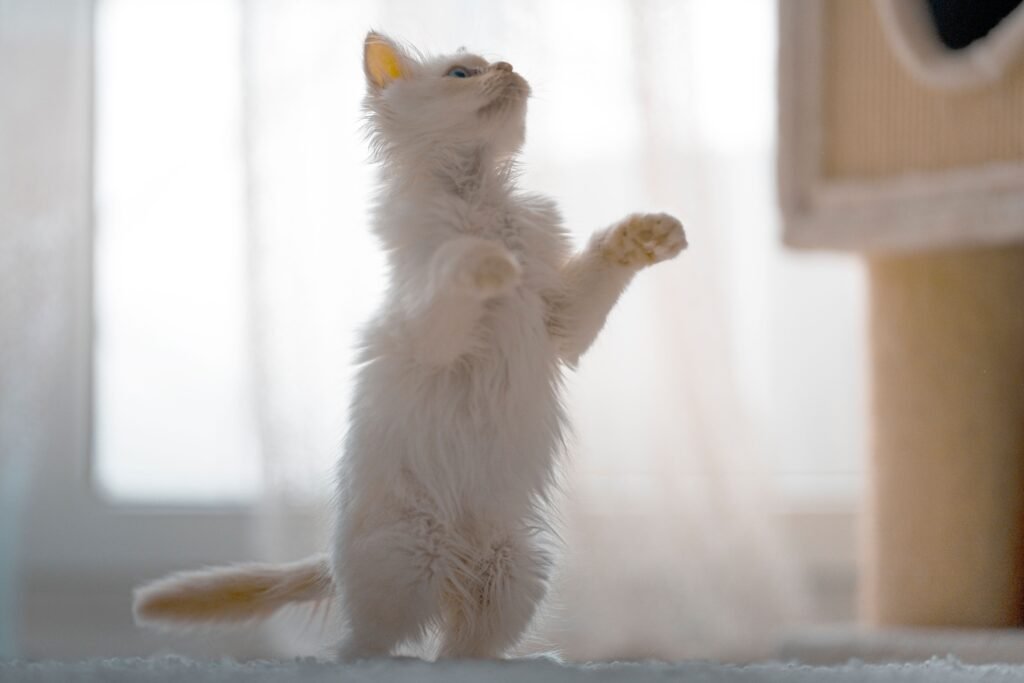
A cat can jump several times its own body length, and that’s all thanks to the explosive power of the glutes. The fact that a cat can hit 30 mph (running 100 meters in about 7 seconds) is also driven by the massive power generated when these muscles contract.
Tail Muscles
The tail muscles connect the sacrum (base of the spine) to the tailbones and control how the tail moves.
In cat breeds with naturally short tails (like the Pixie-Bob), these muscles are barely used. Interestingly, scientists have also found some unique muscles in cats that connect the tailbones directly to the thigh bone!
The complex muscle network in a cat’s tail allows for remarkably expressive movements. Discover what these movements mean in our article on cat tail body language.
Cat Shoulders and Front Legs Muscles
Here’s a breakdown of the muscles from the shoulder down to the tips of the front paws.
Trapezius Muscle
The trapezius connects the shoulder blade, neck bones, and the back of the skull. When a cat runs at full speed, it swings its front legs far forward, just like a cheetah. The trapezius is the muscle that pulls the shoulder blade and the whole front leg forward. The top part above the collarbone is called the cleidocervicalis, and the bottom part is the cleidobrachialis. They look like one big muscle, but they are actually controlled by different nerves.
Deltoid Muscle
The deltoid connects the shoulder blade to the upper arm and is mainly responsible for swinging the arm forward. In humans, this is the muscle on the outside of the shoulder that gives us our “shoulder width.”
Triceps Brachii
The triceps connect the shoulder blade and upper arm to the elbow. They straighten the elbow and pull the upper arm backward (keeping the arm tucked in).
In four-legged animals like cats and dogs, this muscle is huge because their front legs have to support their body weight all the time.
Think of it like holding a push-up position all day—of course, it’s going to be strong! Humans walk on two legs, so our arms don’t support our weight. If we don’t exercise, our triceps can easily get flabby.
Extensor Muscles of the Digits
This is a group of muscles that straighten the wrist and toes (bending them upward).
The main ones include the extensor carpi radialis, pronator teres, common digital extensor, lateral digital extensor, and extensor carpi ulnaris.
Flexor Muscles of the Digits
This group of muscles bends the wrist and toes inward.
The main ones include the flexor carpi ulnaris, deep digital flexor, superficial digital flexor, and flexor carpi radialis.
The deep digital flexor is incredibly important because it’s the muscle a cat uses to extend its claws! Also, when a cat sits in the classic “loaf” position, all the flexor muscles are working to keep the wrists folded under.
Brachialis Muscle
The brachialis connects the upper arm to the forearm and is mainly used to bend the elbow.
When a cat winds up to swat with its paw, this is the muscle that bends the arm back. In humans, it’s one of the main muscles that makes up the “biceps” (the classic “muscle flex” bump).
Cat Hind Legs Muscles
Finally, let’s look at the muscles from the thigh down to the back paws.
Quadriceps Femoris (Quads)
The quads are a group of four muscles that connect the pelvis to the thigh bone, and the thigh bone to the lower leg bones (tibia and fibula). These four muscles are the rectus femoris, vastus lateralis, vastus medialis, and vastus intermedius. In humans, these make up the front of the thigh.
Out of these four, only the rectus femoris connects the pelvis to the kneecap, which allows it to lift the thigh toward the belly. The other three mainly straighten the lower leg (straightening the knee), which is exactly what happens when a cat jumps.
Adductor Muscles
The adductors connect the pelvis to the inside of the thigh and work to pull the leg inward toward the body. These are the inner thigh muscles, and they are heavily used when a cat makes sharp, side-to-side turns while running.
Sartorius Muscle
The sartorius connects the pelvis to the kneecap and is used to lift the thigh toward the belly.
When a cat walks or runs, the main muscles that pull the thigh forward are the sartorius, the rectus femoris (part of the quads), and the iliopsoas (a deep core muscle).
The name “sartorius” has a funny origin—it comes from the Latin word for “tailor,” because it’s the muscle tailors used to sit cross-legged while working!
Knee Flexors (Hamstrings)
The knee flexors are commonly known as the hamstrings. They are made up of the biceps femoris, semitendinosus, and semimembranosus muscles.
Their main job is to bend the knee backward. The quads (four muscles) are on the front of the thigh, and the hamstrings (a group of muscles) are on the back. These two groups balance each other out to keep the leg strong and stable.
Lower Leg Muscles
These muscles connect the thigh bone to the lower leg bones, and the lower leg bones to the foot.
The most famous ones are the gastrocnemius muscles (the calf muscles) on the inside and outside of the leg, which mainly help bend the knee.
There are also the deep and superficial digital flexors, which are used to straighten the ankle or curl the toes.
Toe Extensor Muscles
These muscles are used to straighten a bent ankle or uncurl bent toes.
They include the cranial tibial muscle, the long fibular muscle, and the long digital extensor, which straightens the toes.