
When you’re ready to welcome a kitten into your home, it’s important to understand some basic cat care. This includes how to prepare formula, bottle-feed, and assist with elimination. These are essential skills when caring for very young kittens.
If you’re new to kitten care, please read “How to Take Care of Your Kitten” first, then combine it with this article to learn more about scientific feeding practices.
Preparing for Feeding
If the mother cat is present, she will instinctively handle most of the feeding. Your role as the owner is to provide plenty of food for the mother cat to ensure she gets enough nutrition, and to weigh the kittens daily to monitor their growth.
If the mother cat isn’t around, or if she’s present but the kittens are developing slowly, you’ll need to step in and bottle-feed them. This provides the essential water and nutrients they need to survive and grow.
The following are general bottle-feeding methods applicable to kittens of all ages. Always wash your hands before handling feeding tools or touching the kittens. Also, if the mother cat is present, she might hiss if you try to take her kittens away, which is a normal protective reaction.
Preparing the Bottle
Choose a small, kitten-specific bottle. Thoroughly wash the nipple to remove any plastic smell.
When trimming the tip of the nipple to adjust the milk flow, you can either make a cross-shaped cut or a diagonal cut.
If the opening is too small, the kitten will struggle to get milk. If it’s too large, milk will flow out too quickly with just a gentle squeeze. In severe cases, milk could enter the kitten’s lungs, causing coughing or aspiration pneumonia. Therefore, make sure that when you gently squeeze the bottle, milk comes out one drop at a time.
Preparing the Kitten Formula Milk
Always use commercially available kitten formula. Do not use human baby formula or cow’s milk.
The table below shows the nutritional content of cat, cow, and goat milk. While these are approximate values, you can see that cat milk contains more fat and protein. Kitten formulas are specially formulated to closely match the composition of mother cat’s milk.
| Component | Cat Milk | Cow Milk | Goat Milk |
| Water | 79.0% | 88.0% | 87.0% |
| Fat | 8.5% | 3.5% | 4.1% |
| Protein | 7.5% | 3.3% | 3.6% |
| Carbohydrates | 4.0% | 5.0% | 4.7% |
| Calories (per 100ml) | 121kcal | 70kcal | 69kcal |
Commercial kitten formulas generally come in two forms: liquid and powder.
Liquid formula is convenient because you don’t need to adjust the concentration, but it’s usually more expensive. Powdered formula is more affordable, but you’ll need to mix it yourself before each feeding.
If the energy concentration is too high (meaning the formula is too thick), the kitten will get enough calories but not enough water. If the energy concentration is too low (meaning the formula is too thin), the kitten will get enough water but not enough calories.
Most commercial kitten formulas are formulated to be around “0.74-0.83 kcal/ml.” By following the recommended feeding schedule, you can usually meet your kitten’s energy and water needs simultaneously.
However, if you mix it by guesswork, the concentration can vary significantly. Therefore, when preparing formula, always use a digital scale and measuring spoons to accurately measure ingredients in grams.
Homemade Emergency Formula
If you can’t find kitten formula nearby, or if it’s late at night and the animal hospital is closed, you can temporarily make a homemade substitute to prevent hypoglycemia and dehydration.
Mix the ingredients below thoroughly and heat to 98.6-100.4°F (37-38°C). If you don’t have a bottle, you can use a thin straw to draw up the formula and use your finger to control the flow, allowing the kitten to lap it up little by little.
However, these are only temporary substitutes for emergencies. Please purchase kitten formula and bottles as soon as possible.
| Substitute Formula Recipe 1 | Substitute Formula Recipe 2 |
|---|---|
| • Condensed Milk: 90ml • Water: 90ml • Plain Yogurt: 120ml • Egg Yolks: 3 | • Milk: 250ml • Egg Yolks: 3 • Corn Oil: 15ml • Pinch of Salt |
By the way, Substitute Formula Recipe 1 is from “Care of the Orphaned Puppy and Kitten, in Small Animal Pediatrics: The First 12 Months of Life, 1st edition“; Substitute Formula Recipe 2 is from “Neonatal and Pediatric Care of the Puppy and Kitten.“
How Much and How Often to Feed a Kitten
Feeding Guidelines by Age (Weeks)
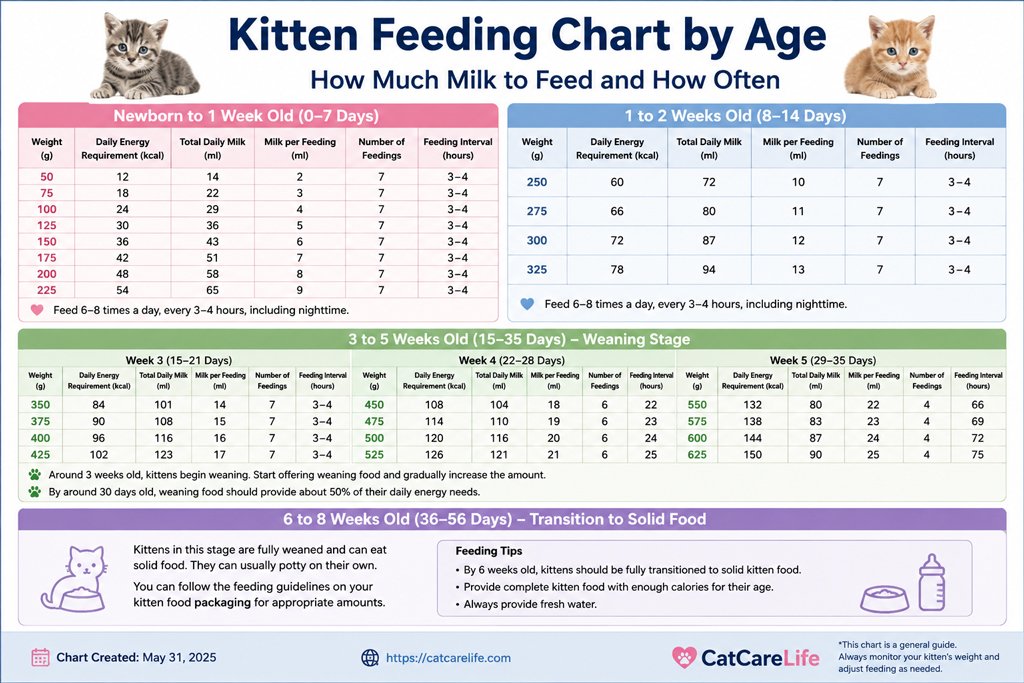
Kittens grow incredibly fast during their first six months. Since their energy needs change significantly each week, you’ll need to adjust the amount of milk you give them daily.
1-Week-Old Kittens: Feeding Volume and Frequency
“1-week-old” refers to kittens from birth to 7 days old. Kittens at this stage sleep about 80-90% of the day, so you need to provide a comfortable, warm sleeping area and feed them regularly.
Refer to the table below for feeding volumes and frequencies. Typically, kittens need to be fed 6-8 times a day, meaning you’ll need to feed them every 3-4 hours, day and night.
| Weight (g) | Daily Energy Requirement (kcal) | Total Daily Milk (ml) | Milk per Feeding (ml) | Number of Feedings | Feeding Interval (hours) |
| 50 | 12 | 14 | 2 | 7 | 3–4 |
| 75 | 18 | 22 | 3 | 7 | 3–4 |
| 100 | 24 | 29 | 4 | 7 | 3–4 |
| 125 | 30 | 36 | 5 | 7 | 3–4 |
| 150 | 36 | 43 | 6 | 7 | 3–4 |
| 175 | 42 | 51 | 7 | 7 | 3–4 |
| 200 | 48 | 58 | 8 | 7 | 3–4 |
| 225 | 54 | 65 | 9 | 7 | 3–4 |
Newborn kittens typically weigh around 100 grams, but there can be significant individual differences, usually between 50-150 grams. Since body size affects stomach capacity, it’s crucial to accurately measure their weight.
Normally, kittens gain about 10-15 grams per day. Since their caloric needs and stomach capacity can change in just three days, it’s recommended to weigh them daily with a digital scale, continuously monitor their weight changes, and adjust milk volumes accordingly.
1-week-old kittens sleep about 80-90% of the day. If you see them sleeping a lot, you might be concerned, but this is completely normal. Therefore, after feeding and assisting with urination, return them to their sleeping area as soon as possible so they can rest peacefully.
2-Week-Old Kittens: Feeding Volume and Frequency
“2-week-old” generally refers to kittens from 8 to 14 days old.
Refer to the table below for feeding volumes and frequencies. At this stage, kittens typically need to be fed 6-8 times a day, meaning you’ll need to feed them every 3-4 hours, day and night.
| Weight (g) | Daily Energy Requirement (kcal) | Total Daily Milk (ml) | Milk per Feeding (ml) | Number of Feedings | Feeding Interval (hours) |
| 250 | 60 | 72 | 10 | 7 | 3–4 |
| 275 | 66 | 80 | 11 | 7 | 3–4 |
| 300 | 72 | 87 | 12 | 7 | 3–4 |
| 325 | 78 | 94 | 13 | 7 | 3–4 |
3-5 Week-Old Kittens: Feeding Volume and Frequency
“3-5 weeks old” generally refers to kittens from 15 to 35 days old.
This period is the “weaning phase,” where kittens’ milk teeth gradually come in, and they begin transitioning from milk to solid food. Therefore, you’ll need to slowly introduce weaning foods.
During this time, kittens also start to be able to potty on their own. You can prepare a small litter box with low sides and non-clumping kitten-specific litter to help them practice.
Feeding Volume and Frequency
Refer to the table below for feeding volumes and frequencies.
| Weight (g) | Daily Energy Requirement (kcal) | Total Daily Milk (ml) | Milk per Feeding (ml) | Number of Feedings | Feeding Interval (hours) |
| 350 | 84 | 101 | 14 | 7 | 3–4 |
| 375 | 90 | 108 | 15 | 7 | 3–4 |
| 400 | 96 | 116 | 16 | 7 | 3–4 |
| 425 | 102 | 123 | 17 | 7 | 3–4 |
Week 4
| Weight (g) | Daily Energy Requirement (kcal) | Total Daily Milk (ml) | Milk per Feeding (ml) | Number of Feedings | Feeding Interval (hours) |
| 450 | 108 | 104 | 18 | 6 | 22 |
| 475 | 114 | 110 | 19 | 6 | 23 |
| 500 | 120 | 116 | 20 | 6 | 24 |
| 525 | 126 | 121 | 21 | 6 | 25 |
Week 5
| Weight (g) | Daily Energy Requirement (kcal) | Total Daily Milk (ml) | Milk per Feeding (ml) | Number of Feedings | Feeding Interval (hours) |
| 550 | 132 | 80 | 22 | 4 | 66 |
| 575 | 138 | 83 | 23 | 4 | 69 |
| 600 | 144 | 87 | 24 | 4 | 72 |
| 625 | 150 | 90 | 25 | 4 | 75 |
Around 3 weeks of age (15-21 days old), a kitten’s “suckling reflex” will gradually weaken. This is a normal developmental change and means it’s time to start preparing for weaning.
Introducing Weaning Foods
Starting around 15 days old, you can mix a small amount of weaning food into their milk to help kittens get used to the taste.
It’s recommended to choose commercially available pureed or gruel-like kitten weaning foods. Add about a small spoonful to the bottle during each feeding.
Commercial weaning foods typically have a caloric content of about “1-1.3 kcal/g.” Adding a small amount won’t significantly change the overall caloric concentration of the milk.
Increasing Weaning Food Proportion Around 4 Weeks Old
Around 4 weeks of age (22 days old), you can gradually increase the proportion of weaning food.
At this point, weaning food should provide about 20% of the kitten’s daily energy needs.
For example:
If a kitten needs 25 kcal per day:
•If the weaning food is 1 kcal/g, you’ll need about 25g.
•If it’s 1.3 kcal/g, about 20g will suffice.
The most important goal at this stage is to teach the kitten to actively lap up food with its tongue.
How to Feed Weaning Foods
First, lay down a towel to prevent making a mess.
Then, place a small amount of gruel-like, pureed, or paste-like weaning food in a stable, shallow dish for the kitten to try.
If the kitten actively starts lapping it up, that means weaning training is going well.
Since they often get food around their mouths and even on their whiskers, remember to wipe them clean after feeding.
Weaning Goal Around 30 Days Old
By about 30 days old, weaning food should account for approximately 50% of their daily energy needs.
6-8 Week-Old Kittens: Care Methods
“6-8 weeks old” generally refers to kittens from 36 to 56 days old.
This is the period when kittens are fully weaned and can eat solid food. They will also be able to potty independently.
Feeding Volume and Frequency
At this stage, kittens can typically eat solid kitten food. You can refer to the feeding guidelines on the kitten food packaging for appropriate amounts.
Transitioning to Solid Food
By 6 weeks old, kittens should be fully transitioned to solid kitten food. They should be able to chew harder foods normally. Therefore, you can provide complete kitten food with sufficient calories for their age.
Kitten Bottle Feeding Guide
There are several important details when bottle-feeding a kitten. When kittens are very young, you may even need to wake up at night to feed them. If you feed them carelessly while sleepy, it can lead to diarrhea or hypoglycemia, so you must be extra careful.
How to Warm Kitten Formula Milk
1.Fill a coffee cup or similar container about 80% full with water, then heat it in the microwave to make hot water.
2.Gently dip the nipple part into the hot water to preheat it, then attach it to the bottle. Place the entire bottle in the cup and soak for 20-30 seconds.
3.After removing it, drip a drop of formula onto your wrist to confirm the temperature is close to body temperature (98.6-100.4°F or 37-38°C). You can also use the “thermometer mode” of a baby thermometer to measure the temperature.
4.Important: Do not directly heat the formula in the microwave, as the temperature can easily become too high and uneven. Avoid this method if possible.
How to Bottle-Feed Kittens
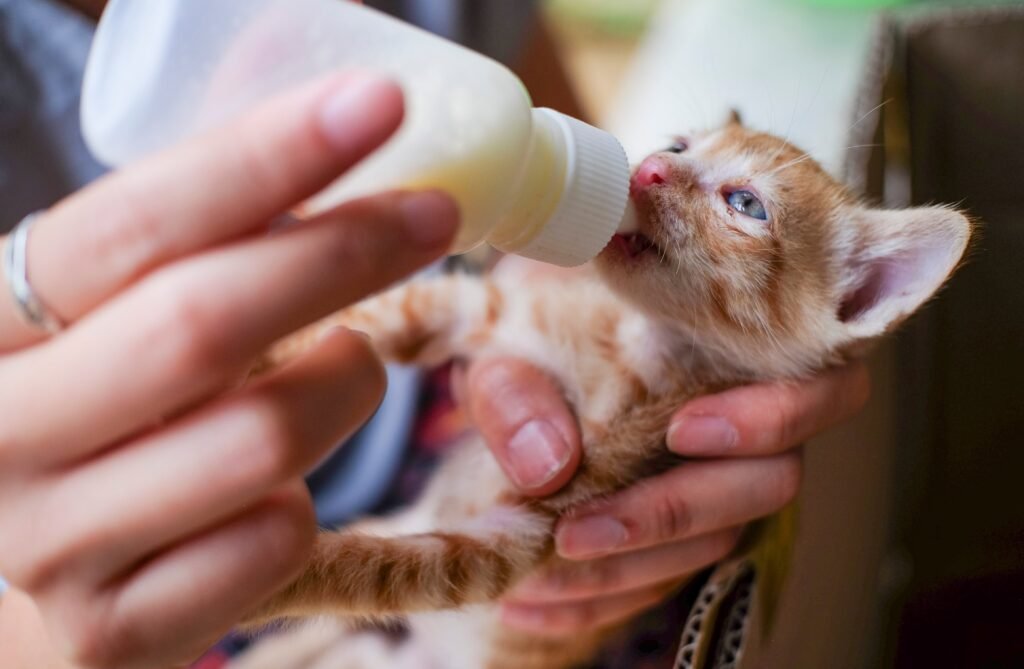
1.When feeding a kitten, avoid directly touching the nipple. Gently shake the bottle first to ensure there are no clumps of formula inside. Be careful not to shake too vigorously, as this could cause milk to spill.
2.The feeding posture is very important. If you let the kitten lie on its back to drink milk, it may not be able to swallow properly, and there’s a risk of milk entering its lungs, leading to aspiration pneumonia. Therefore, the kitten must be kept in a “belly-down” position.
3.You can lay a towel on your lap and have the kitten lie on it to feed. This provides stability and helps maintain the correct posture.
4.Gently support the kitten’s neck from behind with your hand to keep it stable, then bring the nipple close to its mouth.
5.Kittens will start feeding on their own through their suckling reflex, so you don’t need to forcefully squeeze the bottle. You can gently touch its throat with your fingertip to confirm it’s swallowing smoothly.
6.When drinking milk, kittens will often knead your hand with their front paws. This is an instinctive behavior called “milk treading,” which comes from their actions to stimulate milk production in their mother.
7.If their claws are making it difficult, you can support their neck from the side, as shown in the image below (note: image not provided in original text, so this will be a placeholder).
How to Tell When a Kitten is Full?
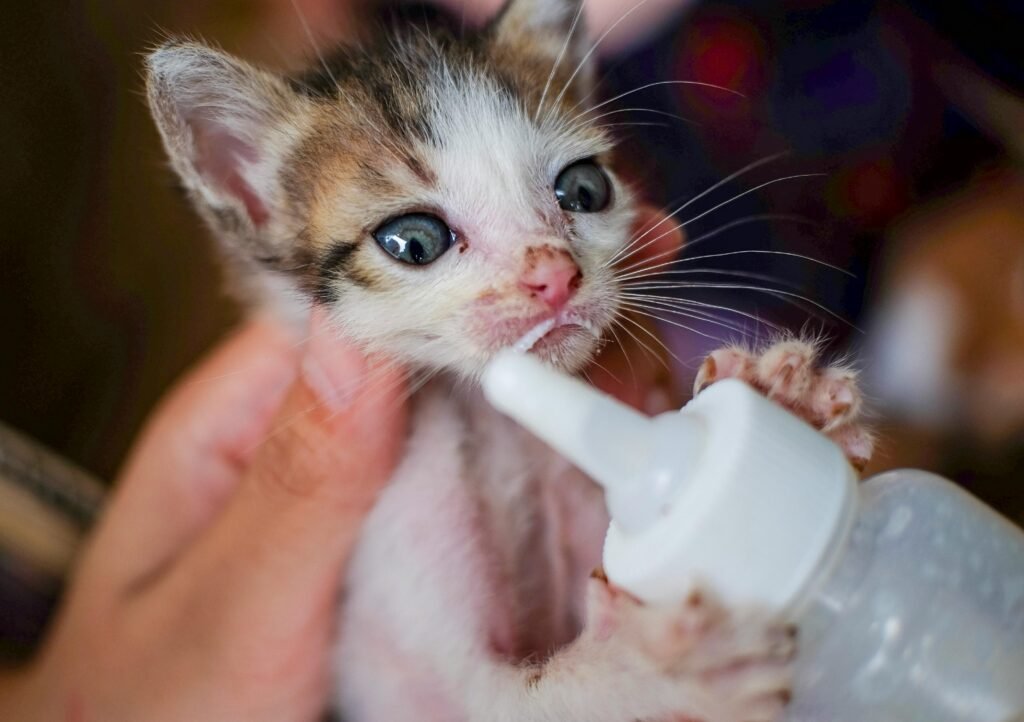
If foam appears at the corner of the kitten’s mouth, or if unconsumed milk dribbles out, these are usually signs that it’s “full.” Even if there’s still milk in the bottle, stop feeding and record the amount consumed.
Conversely, if you’ve fed the prescribed amount but the kitten continues to meow, it might be asking for “a little more.” However, be aware that a cat’s stomach capacity is limited, and overfeeding can lead to diarrhea, indigestion, or vomiting.
If you need to give more milk, it’s recommended to only add about 10% of a single feeding’s volume.
What to Do After Feeding a Kitten?
Burping and Elimination
1.After feeding, you can gently pat the kitten’s back with your fingertips or gently massage its abdomen to help it burp out any swallowed air.
2.You can bring your ear close to the kitten’s mouth to check for burping sounds.
3.Discard any leftover milk; do not save it for the next day. After each feeding, thoroughly wash all used bottles and containers, and sterilize them by boiling in hot water for about 3 minutes, ready for the next use.
4.After feeding, it’s “potty time.” Assistance with urination and defecation will be explained in the “Assisting with Elimination” section below. Generally, this needs to be done after each feeding until about 3 weeks of age, usually about 6-7 times a day.
5.After the kitten finishes drinking milk, wipe any residual milk from its mouth and return it to its bed to rest. Next, let’s discuss assisting with elimination.
Assisting with Elimination
Kittens cannot eliminate on their own until about 3 weeks of age, so they need assistance from their owner.
Assisting with Urination
1.After feeding, lay down newspapers or similar materials on the floor to prepare for any mess.
2.To prevent the kitten from spitting up the milk it just drank, gently hold it in a belly-down position with your non-dominant hand.
3.Then, with your dominant hand, take a dry tissue or cotton ball and gently wipe in a circular motion for about 10 seconds, just below the base of the tail (anus).
4.Important: Be very gentle; do not press hard, as this could damage the skin.
5.Wet wipes may not effectively absorb urine and can cause it to spread, so it’s recommended to use dry tissues or cotton pads.
6.Normally, kittens will pass a small amount of light yellow urine after each feeding. Male kittens may sometimes spray urine forcefully like a fountain, so be especially careful not to get the surroundings dirty.
Assisting with Defecation
1.After confirming that all urine has been passed, move the stimulation point slightly towards the tail and continue to gently stimulate the anal area.
2.Healthy kittens typically pass soft, yellow to brown stool, usually once a day, or about once every 24-36 hours.
3.Defecation is not as frequent as urination, so if no stool is passed, there’s no need to repeatedly force stimulation.
4.Afterward, gently clean the anal area with a dry tissue or baby wipe to keep it clean.
5.If you use a wet wipe, always follow up with a dry cloth to thoroughly remove moisture. This prevents the kitten’s body temperature from dropping as moisture evaporates from the skin.