

Recent research suggests that cats are indeed capable of linking a familiar voice to a corresponding face in their minds, a phenomenon known as cross-modal representation. In other words, when a cat hears its owner calling, it may actually conjure up the mental image of that person’s face, even if the face is not immediately visible. However, the strength of this ability varies depending on the cat’s environment and social experience: cats exposed to many different people, like those in cat cafés, tend to show stronger recognition and clearer reactions when the voice and face do not match, while household pets with more limited social exposure may respond less obviously, focusing more on the novelty of the situation rather than the mismatch itself.
How Was the Experiment Conducted?
Researchers observed a total of 87 cats, including both cats living in ordinary households and cats working in cat cafés. All of these cats had prior experience interacting with humans, so they were familiar with human voices.
The experiment itself was fairly simple: researchers played a recording of someone calling the cat’s name on a computer four times. Immediately afterward, a human face appeared on the computer screen for seven seconds. The researchers observed the cats’ reactions, noting behaviors such as curiosity, surprise, or prolonged attention toward the screen.
The main question the scientists wanted to answer was whether a cat’s brain could automatically link a familiar voice to the corresponding face.
What Is a “Violation of Expectation” Response?
The study used a common behavioral observation method called “violation of expectation,” which is based on the idea that animals react more strongly when something unexpected occurs.
For example, if you hear a familiar friend’s voice but see a completely unfamiliar face, you might look again to make sure you didn’t hear wrong. Cats can show a similar response: if they hear their owner’s voice but see a stranger’s face, they may focus more intently on the screen or try to get closer to investigate.
The Four Experimental Conditions
The researchers designed four combinations to test the cats:
- Owner’s voice → Owner’s face (expected match)
- Owner’s voice → Stranger’s face (unexpected mismatch)
- Stranger’s voice → Stranger’s face (expected match)
- Stranger’s voice → Owner’s face (unexpected mismatch)
By observing how cats reacted under each condition, the researchers could determine whether cats can link a particular voice to a specific face.
Results: Do Cats Really Link Voices to Faces?
According to the researchers’ predictions, cats would show signs of confusion or curiosity when the voice and face did not match, often staring longer at the screen or even attempting to get closer to smell it.
Each condition was tested approximately 47 to 51 times, and the results were statistically analyzed. The findings showed clear differences in cat behavior depending on the condition.
Cat Café Cats Showed Stronger Reactions
Cats working in cat cafés displayed significantly more interest when the voice and face were mismatched, often staring at the screen for longer periods. This suggests that these cats could link the voice they heard to a mental representation of a person’s face. When something “didn’t match,” it seemed unusual to them, drawing more attention to the face on the screen.
In other words, cats may actually be capable of associating an owner’s voice with their appearance.
Household Cats Showed Less Obvious Reactions
In contrast, cats living in ordinary households did not show strong reactions when the voice and face were mismatched. Researchers speculated this might be because household cats are typically exposed to fewer people, and therefore have less experience distinguishing different human faces.
Previous research has shown:
- Greater exposure to different faces improves the ability to recognize distinct faces.
- Some animals, like chimpanzees, also improve face recognition skills with experience as they grow.
Cat café cats, who interact with many different customers daily, are more accustomed to observing a wide variety of faces, which likely makes it easier for them to identify and remember different people.
Why Did Household Cats Look at the Screen Longer?
Interestingly, household cats spent more time looking at the screen in both “matching” and “mismatching” conditions compared to cat café cats.
Researchers suggested this could be due to:
- The sudden presence of unfamiliar experimenters
- Introduction of an unfamiliar device (computer, camera)
- Changes in the environment that are novel or unexpected
These factors alone can trigger curiosity in household cats. In contrast, cat café cats are regularly exposed to strangers and new situations, so they are less likely to react strongly to these changes.
Frequently Asked Questions
Yes, cats can recognize human faces, especially the faces of people they see often. Research suggests that cats use visual recognition together with other cues such as voice, smell, and body language to identify familiar individuals. However, compared to humans, cats rely more on sound and scent than facial details alone.
Yes, most cats can recognize their owners. Cats learn to identify the people who feed them, care for them, and interact with them regularly. They use a combination of voice recognition, scent recognition, and visual memory to know who their owner is.
Cats recognize their owners using multiple senses. They remember familiar voices, faces, scents, and daily routines. This process involves memory formation and cross-modal recognition, meaning the brain connects information from different senses, such as sound and sight.
Most cats do not recognize themselves in the mirror. Instead, they may think the reflection is another animal or simply ignore it after a short time. Scientists believe this happens because cats rely more on smell and sound than on visual self-recognition.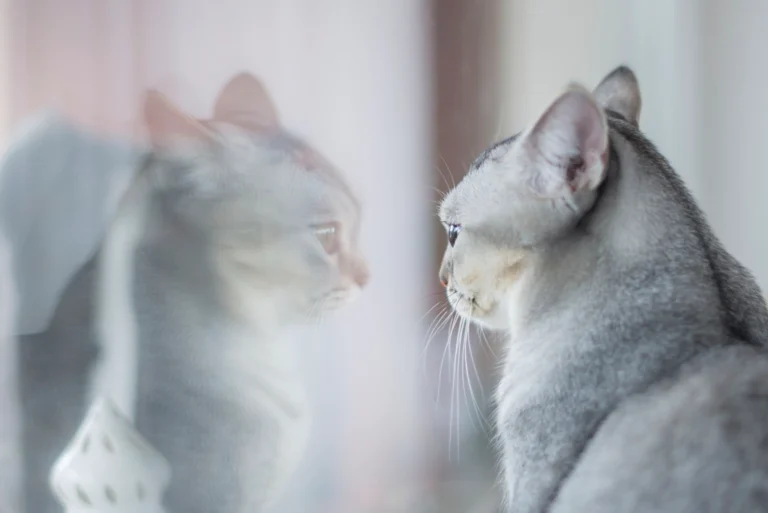
Yes, studies show that cats can recognize their owner’s voice. Cats often respond differently when they hear a familiar voice compared to a stranger’s voice. Even when they do not come immediately, they may still show subtle signs of recognition, such as ear movement or changes in attention.
Research suggests that cats can associate a familiar voice with the corresponding face. This ability is related to cross-modal representation, where the brain links auditory information (voice) with visual information (face). Cats that interact with many people may develop stronger face recognition abilities.