

When you call your cat’s name, it might turn its head, flick its ears, or swish its tail. But does this mean cats really understand their names, or are they just reacting to sounds?

The answer is clear: yes, cats can recognize their own names. This isn’t just something owners assume—it has been confirmed by scientific studies.
To explore this question, researchers designed a series of controlled experiments.
In 2019, a group of Japanese scientists studying animal cognition and behavior published a paper in the journal Scientific Reports showing that domestic cats can distinguish their own names from other words.
Between 2012 and 2017, the research team conducted four experiments. These experiments tested how cats reacted when hearing different words, when hearing their own name spoken by different people, and how their responses differed between single-cat homes and multi-cat environments.
Let’s take a look at how these experiments worked.
Experiment 1: Cats Can Recognize Their Names Among Similar Words
Subjects
8 male cats + 8 female cats
Average age: 3.69 years
All were pet cats living in 11 different households.
Method
Researchers used a behavioral testing method called the habituation–dishabituation paradigm, which is commonly used in animal cognition studies.
First, the researchers selected four common words that sounded very similar to the cat’s name in both length and pronunciation.
For example, if a cat’s name was “Tama,” the similar words might include sounds like “asa,” “kama,” “sara,” or “nata.”
These four words were recorded in the owner’s voice and played to the cat at 15-second intervals. After the cat became used to hearing these similar words, the researchers finally played the cat’s real name and observed the reaction.
Results
Out of the 16 cats, 11 cats (68.8%) showed habituation, meaning their reactions gradually became weaker as they heard the similar words repeated.
Among those 11 cats, 9 cats (81.8%) showed a much stronger reaction when they heard their own name, suggesting they could clearly distinguish it from the other words.
Experiment 2: Cats Can Tell Their Names Apart From Other Cats’ Names
Subjects
16 male cats + 18 female cats
Average age: 5.51 years
All lived in multi-cat environments with at least five cats, and 10 of them were cats working in cat cafés.
Method
In this experiment, the researchers used the names of other cats living in the same environment as the habituation stimuli.
The names were recorded in the voice of either the cat’s owner or the cat café owner. Four different cat names were played at 15-second intervals, followed by the test cat’s own name.
Results
Out of 34 cats, 15 cats (44.1%) showed habituation.
However, there was a noticeable difference between home cats and café cats:
- Household cats: 25% (6 out of 24)
- Cat café cats: 90% (9 out of 10)
Among the six household cats that showed habituation, all six (100%) reacted strongly when hearing their own name.
Among the nine cat café cats that showed habituation, only three (33.3%) showed a strong reaction to their own name.
Experiment 3: Cats in Multi-Cat Homes Can Still Recognize Their Names
Subjects
16 male cats + 13 female cats
Average age: 6.48 years
All lived in multi-cat environments, including 9 cat café cats.
Method
This experiment focused on comparing the behavioral differences between multi-cat households and cat cafés.
Results
- Multi-cat homes: 14 out of 20 cats (70%) showed habituation
- Cat cafés: 7 out of 9 cats (77.8%) showed habituation
Among the 21 cats that showed habituation, 13 cats (61.9%) reacted strongly when hearing their own name.
This suggests that even in environments with many cats and many different names being spoken, cats are still able to recognize their own names.
Experiment 4: Cats Can Recognize Their Name Even From a Stranger
Subjects
14 male cats + 19 female cats
Average age: 6.48 years
Cats came from homes with one to six cats.
Method
The experimental setup was mostly the same as in Experiment 1. The key difference was that the words and names were spoken by a third person rather than the cat’s owner.
Results
Out of 33 cats, 20 cats (60.6%) showed habituation.
Among those 20 cats, 13 cats (65%) showed a stronger reaction when hearing their own name.
This result suggests that cats are not only responding to their owner’s voice—they can actually recognize the sound pattern of their name itself, even when it is spoken by someone else.
How to Teach Your Cat Its Name
The experiments also revealed an interesting difference between household cats and cat café cats.
Cats in cafés were less able to distinguish their own name from other cats’ names. Researchers believe this may happen because the connection between a name and a reward becomes weaker.
For example, imagine someone calls out “Leo!” in a cat café, but a completely different cat named “Kotetsu” runs over. The visitor may pet Kotetsu anyway. From Leo’s point of view, the reward is no longer clearly connected to its own name.
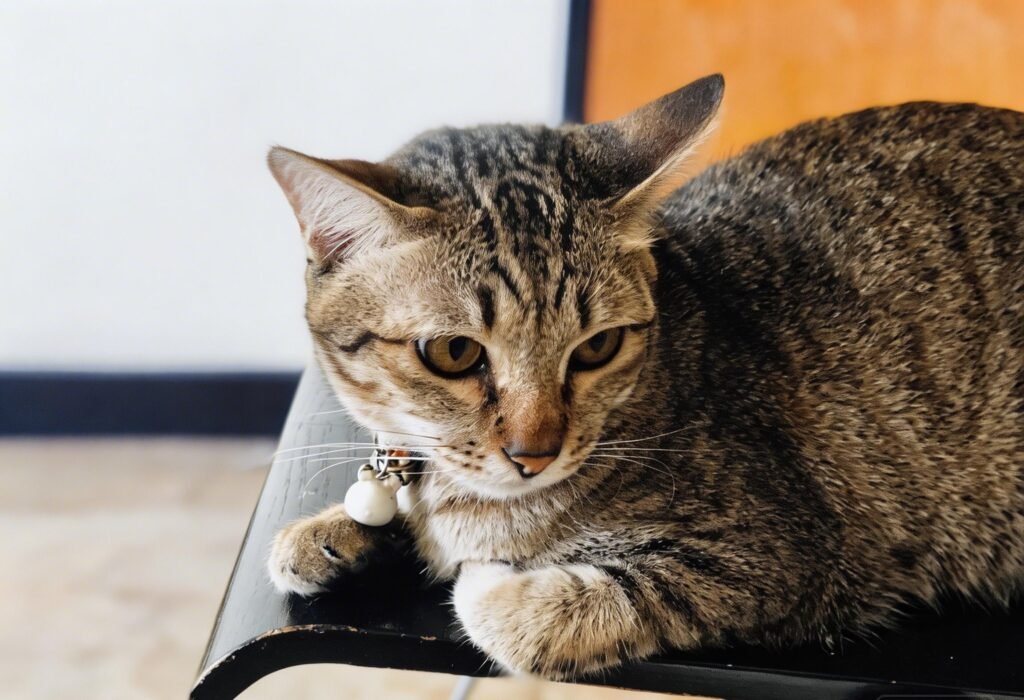
Over time, this can confuse cats. They may stop reacting to their own name or start responding to other cats’ names.
A simple way to teach your cat its name is to pair the name with positive experiences. For example, say your cat’s name before giving treats, toys, or attention.
Clicker training can also be very helpful, especially in homes with multiple cats or kittens. The idea is to help your cat learn that its name has meaning. When the cat hears its name and looks at you, immediately click and give a reward. Practicing this regularly can strengthen the connection between the cat and its name.
5 Signs Your Cat Knows Its Name
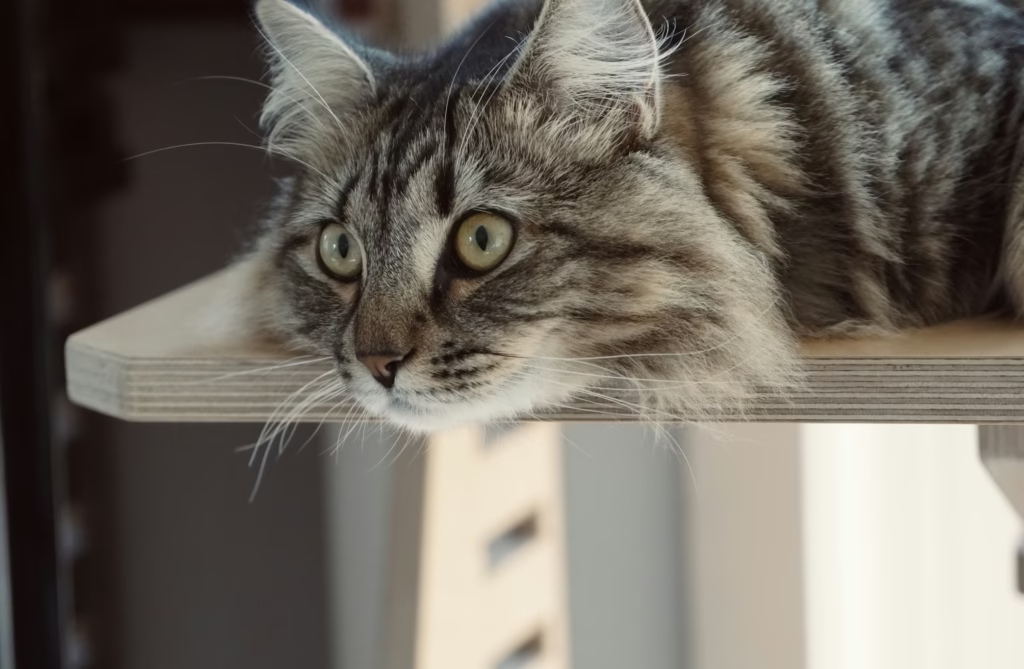
Even if your cat doesn’t always come when called, it may still recognize its name. Cats often respond in very subtle ways.
Animal behavior researchers usually watch for these signals:
1. Ear movement or head turning
If your cat twitches its ears or turns its head when you say its name, that is one of the most common signs of recognition. In studies, this type of reaction happened in about 87% of cats.
2. Tail or body movement
A cat that flicks its tail, stretches, or shifts its body may be acknowledging that it heard you—even if it does not walk over.
3. Eye contact or slow blinking
Cats sometimes respond with eye contact or a slow blink, which is a subtle but meaningful form of communication. Slight pupil dilation can also indicate alertness.
4. Walking toward you
Not every cat will come when called, but some do. If your cat often walks toward you after hearing its name, it probably understands the connection.
5. A short “meow”
About 38% of cats respond with a short vocal sound after hearing their name.
Why Does My Cat Ignore Me?
If your cat does not come when you call its name, it does not necessarily mean it failed to recognize it.
Cats are famous for being independent, and unlike dogs, they were not domesticated to follow human commands. Sometimes they simply choose not to respond.
Other possible reasons include:
Personality
Cats tend to be independent and less motivated by commands than dogs.
Subtle responses
Your cat might respond in a very small way—such as a tiny ear movement—that is easy to miss.
Different sleep schedule
Cats are often resting during the day. If you call them while they are napping, they may ignore you.
Distractions
Just like people, cats can get distracted by interesting sights, sounds, or smells.
Not in the mood
Sometimes cats simply don’t feel like responding.
Lack of positive reinforcement
If a cat’s name is not regularly connected with rewards or attention, it may not feel motivated to respond.
In other words, when your cat seems to ignore you, it may still know exactly what you said—it just chose not to answer.