

People often say things like, “Cats forget favors within three days,” or “They never forget unpleasant experiences from kittenhood.” But how much of this is backed by science? Here, we explore findings from various studies on feline memory and what they reveal about how cats remember.
Do Cats Forget When They’ve Been Bullied?

Cats are known for having strong memories of unpleasant experiences, which is why people often say, “Cats never forget being bullied.” On the other hand, compared with dogs, cats tend to respond poorly to training, and even teaching them to recognize their own names can be a struggle. At first glance, this seems contradictory: are cats’ memories actually good, or not? If there are factors that influence their memory, what might they be?
Classic conditioning experiments with cats suggest that the strength of memory is heavily influenced by how strongly the cat experiences pleasure or discomfort. In other words, events that evoke a strong emotional response—whether positive or negative—tend to stick in a cat’s memory more than neutral experiences.
Can Cats Play Hide-and-Seek?
The ability to recognize that an object continues to exist even when it is out of sight is called “object permanence.” Observing kittens playing hide-and-seek or adult cats waiting in front of the litter box for their owners makes it clear that cats possess this ability. But how does this compare to human children?
“The research was conducted by a team from the Department of Psychology at the University of Montreal in Canada.
Experimental Setup: Initially, a target object (a balled-up piece of aluminum foil) was placed near a partition and moved left and right using invisible thread to replicate the erratic movement of a small animal. Watching through an observation window from a starting point approximately 1.5 meters away, the cat became interested and attempted to approach the object by bypassing an opaque block screen placed in its path.
The Test: Because the block screen is opaque, the cat’s view of the target is momentarily obstructed as it passes behind the screen. At the exact moment the cat’s field of vision was blocked, the researchers moved the foil behind the partition—mimicking the natural behavior of prey darting into a bush or a burrow upon being spotted.
Conclusion: This setup functions as an “invisible displacement test,” as the object is hidden while the cat cannot visually perceive the movement. The significant departure from traditional tests is the removal of “unnatural” human intervention (such as a hand hiding a cup behind a screen like a magic trick). Instead, it successfully replicates a situation that occurs in the natural environment, such as a small animal taking cover.”
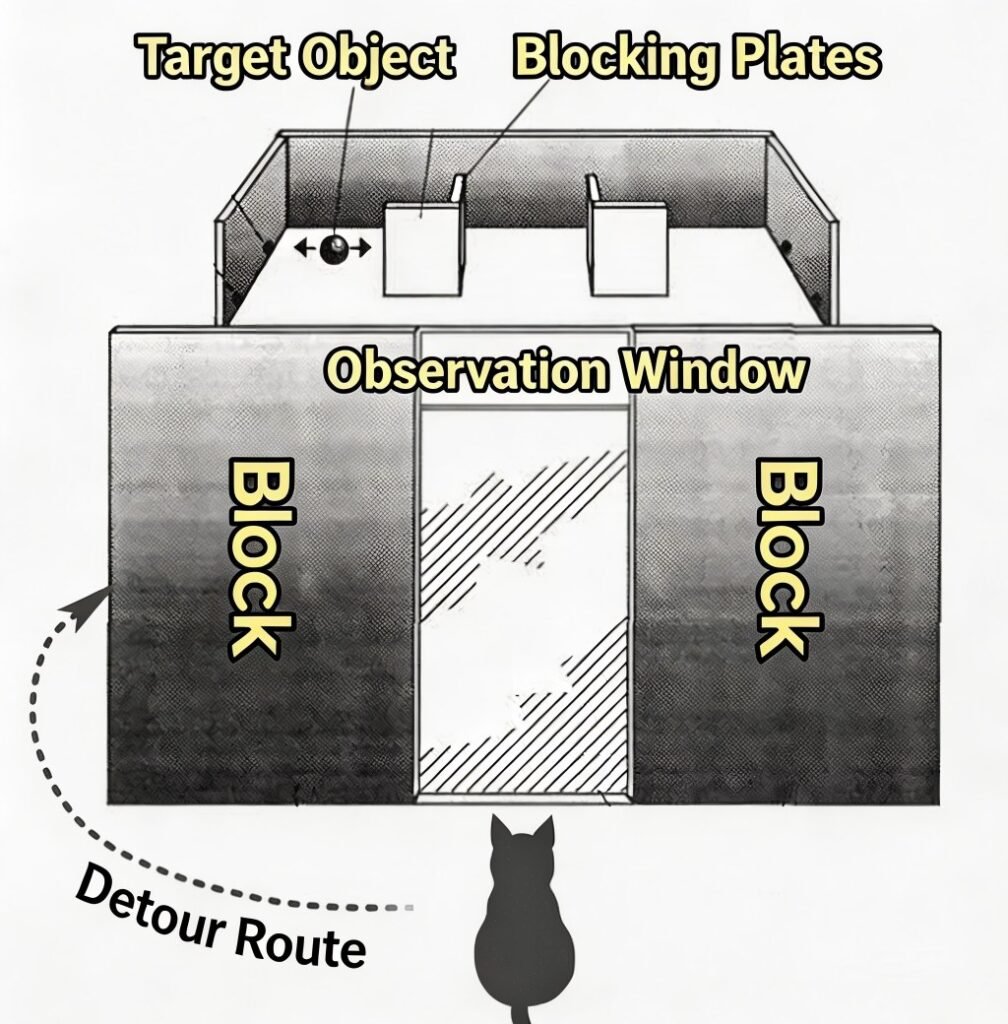
Research conducted by a team at the University of Montreal in Canada suggests that cats’ object permanence abilities may be equivalent to those of 1.5- to 2-year-old human children, challenging the older assumption that they were only at the level of a one-year-old.
Do Cats Have Episodic Memory?
Long-term memories of individual experiences are referred to as “episodic memory.” In humans, asking questions like “What did you have for dinner last night?” or “What was the name of your first crush in middle school?” can quickly confirm the existence of episodic memory. For animals that cannot speak, however, researchers need alternative methods to investigate.
Studies by Kyoto University indicate that cats may be capable of remembering even relatively minor events for short periods, even when those events are not associated with strong emotions.
How Do Cats Walk Without Bumping Into Things?
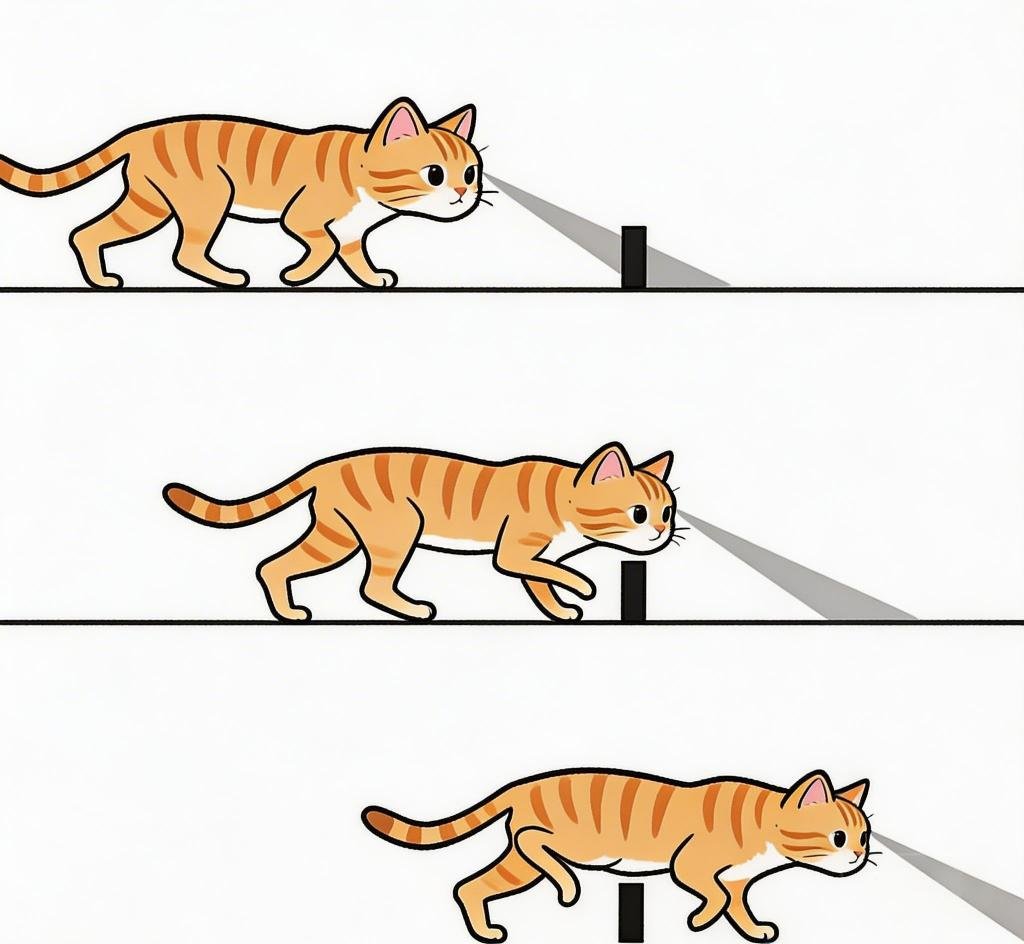
When cats encounter obstacles while walking, they skillfully lift their front paws first, followed by their hind paws, to step over them. The ability to temporarily remember the height of their front paws is called “obstacle memory” and is critical for moving without hitting anything.
Research from the University of Alberta in Canada shows that even with interruptions ranging from 10 to 200 seconds, cats are able to lift their hind paws to match the height of their front paws. Some cats can retain this obstacle memory for more than 10 minutes, whereas ordinary visual memory typically lasts only about 30 seconds.
How Long is a Cat’s Working Memory (Short-Term Memory)?
Working memory refers to the ability to temporarily hold information in mind while performing a task. For example, when a teacher writes something on the board, a student must use working memory to copy it into a notebook; without it, the information is lost as soon as the eyes leave the board.
Research conducted at the University of Moncton in Canada suggests that a cat’s working memory for visual information may last only about 30 seconds before it rapidly fades.
Do Cats Really Forget Favors Within Three Days?
Sometimes, after returning from a shower, an owner may find their cat darting away as if an intruder has appeared. Does this mean the cat forgets the owner’s face within minutes?
Studies by Tbilisi State University in Georgia indicate that while individual differences exist, cats can retain visual impressions for at least around 10 minutes. The saying that “cats forget favors in three days” might be more accurate as “cats remember the favor but forget who provided it.”
Do Cats Have a “Lucky Mindset”?
Though there’s no scientific evidence for it in humans, there is a known psychological tendency to prioritize memories associated with recent successes—sometimes referred to as a “lucky mindset.” For example, if someone wins a small lottery prize at a particular store, they may want to buy the next ticket there.
Research from Eötvös Loránd University in Hungary shows that cats can exhibit similar behavioral patterns, favoring actions or locations linked to recent positive outcomes.
Can Cats Remember Their Owner’s Voice and Face?
Humans naturally visualize a familiar face when they hear a recognizable voice; this phenomenon is called “cross-modal representation.” Do cats have the ability to integrate visual and auditory information in a similar way?
Kyoto University’s studies suggest that cats may indeed be able to simultaneously recall their owner’s voice and face in their minds. However, this ability seems to require that cats have previously observed multiple people and are able to distinguish their owner from strangers.