
Have you ever wondered:
- Why do cats have whiskers?
- What happens if you cut them?
- Do cat whiskers grow back?
- What does it mean when a cat’s whiskers point forward?
Cat whiskers aren’t just cute facial features. They are highly specialized sensory tools that help cats navigate, hunt, communicate, and stay safe. In many ways, whiskers act like a built-in radar system.
Here’s everything you need to know.
What Are Cat Whiskers, Really?
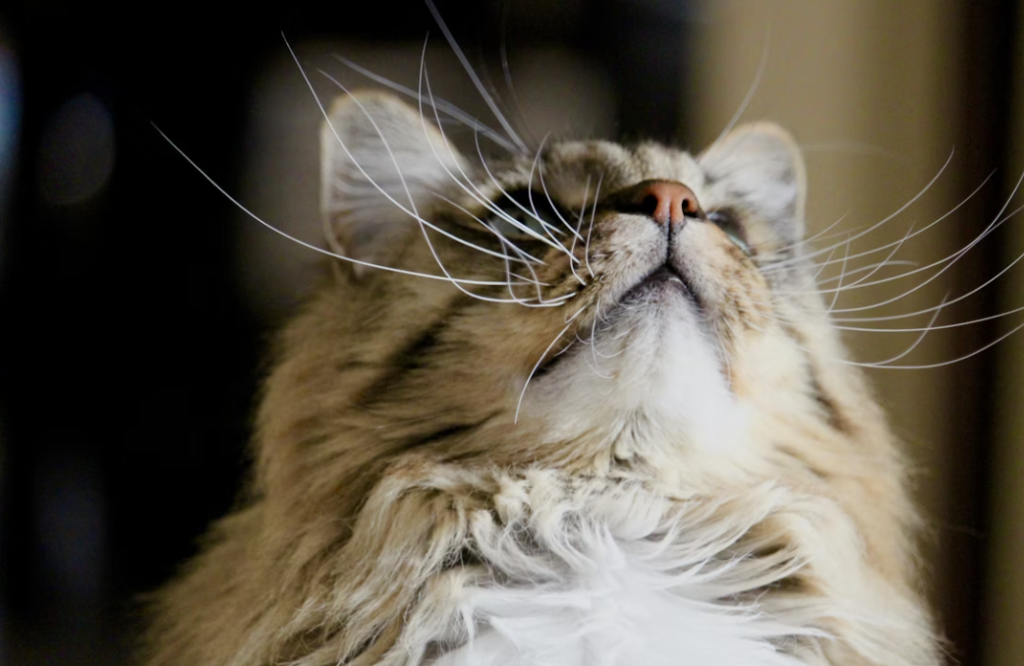
Cat whiskers are not ordinary hairs. They are called vibrissae, and they are thicker, deeper, and far more sensitive than regular fur.
While normal fur is about 0.05 mm thick, whiskers can range from 0.06 to 0.3 mm in diameter. More importantly, they are rooted much deeper in the skin—about 4 mm beneath the surface—where they connect to a dense network of nerves and blood-filled sensory structures.
That’s what makes them so sensitive.
Whiskers are embedded in a special area on the muzzle often called the whisker pad (sometimes described as omega-shaped because it looks like the Greek letter Ω).
What Do Cat Whiskers Do?
Whiskers serve multiple important functions:
1. Measuring Space
Whiskers help cats determine whether they can fit through tight openings. In general, a cat’s whiskers are roughly as wide as its body. If the whiskers brush against something, it’s a warning signal.
2. Detecting Air Movement
Whiskers can pick up extremely subtle air currents. This allows cats to detect nearby objects—even in total darkness—and track moving prey.
3. Protecting the Eyes
The whiskers above the eyes (called supraorbital whiskers) act like early warning sensors. If something touches them, it triggers a blink reflex to protect the eyes.
4. Evaluating Prey
When a cat catches prey, whiskers help it determine whether the animal is still moving.
5. Expressing Emotions
Whisker position can reflect mood. They are attached to small muscles, allowing slight voluntary movement.
Common whisker positions and meanings:
- Pointing forward → Alert, curious, excited
- Relaxed and slightly outward → Calm
- Pulled back tightly → Fearful, defensive, or stressed
- Slightly forward and lifted → Playful or interested
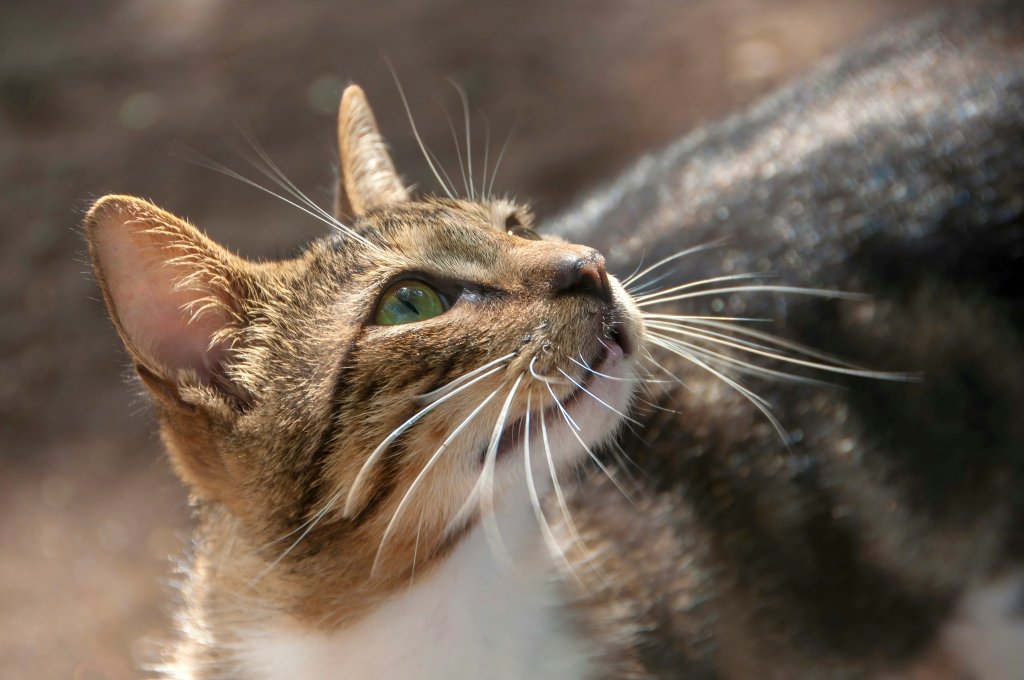
While these interpretations aren’t absolute, whiskers do contribute to emotional signaling.
How Many Whiskers Do Cats Have?
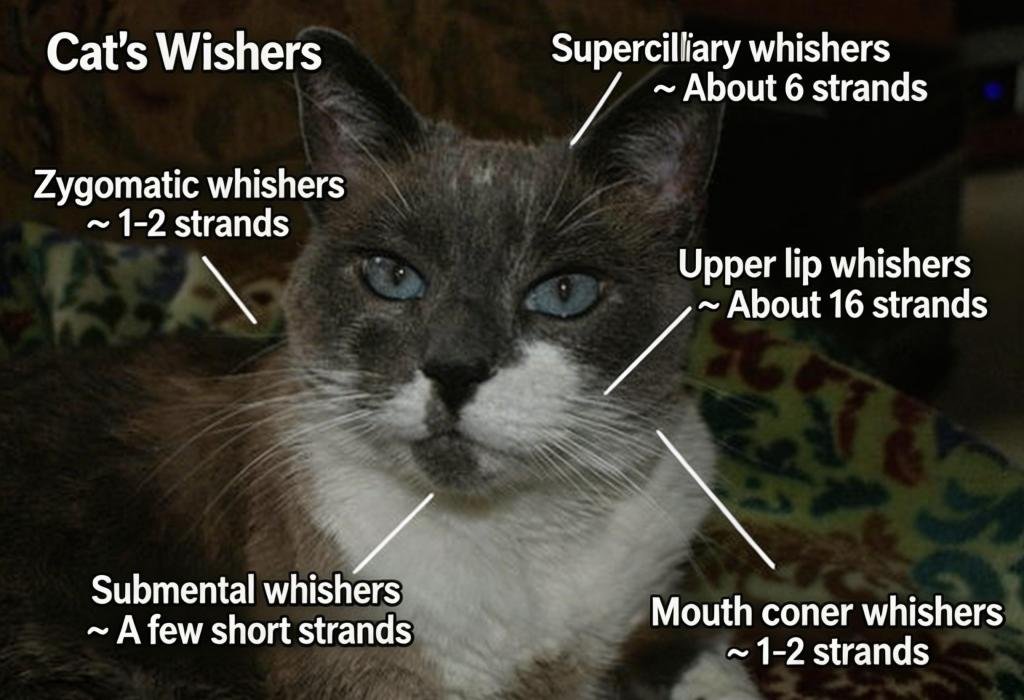
Most cats have about 24 whiskers on their muzzle—12 on each side—arranged in four rows.
But whiskers aren’t just on the face.
Cats also have:
- Whiskers above the eyes
- Shorter whiskers on the chin
- Whiskers near the cheeks
- Special whiskers on the back of the front legs called carpal whiskers
Carpal whiskers are thought to help cats during climbing, hunting, or gripping prey, though their exact function is still being studied.
What Is Whisker Fatigue?
You may have heard of something called whisker fatigue (sometimes called whisker stress).
This refers to the idea that when a cat’s whiskers constantly brush against the sides of a narrow or deep food bowl, it may cause discomfort or overstimulation.
Some cats may:
- Pull food out of the bowl
- Avoid eating from deep dishes
- Seem irritated during meals
While research is still limited, many veterinarians recommend using wide, shallow bowls to reduce potential whisker stress.
Can You Cut a Cat’s Whiskers?
Technically, cutting a whisker does not cause pain. The whisker itself has no nerves—just like regular hair.
However, you should never intentionally cut a cat’s whiskers.
Removing whiskers can:
- Disorient the cat
- Reduce spatial awareness
- Increase stress
- Make navigation harder, especially in low light
Whiskers are essential sensory tools. Cutting them is like temporarily disabling part of a cat’s navigation system.
Do Cat Whiskers Grow Back?
Yes.
Whiskers naturally shed and regrow, although much more slowly than regular fur. It may take several weeks to a few months for a whisker to fully grow back.
If you find a whisker on the floor, there’s no need to panic. Shedding is normal.
However, if whiskers are repeatedly broken or damaged, it’s worth checking for environmental causes.
*13 Steps to Creating a Cat-Friendly Home
Are Whiskers the First Hairs Kittens Grow?
Interestingly, yes.
In the womb, whiskers develop before most other types of fur. Newborn kittens are born blind and deaf, but their whiskers already function as touch sensors to help them navigate toward warmth and their mother.
Whiskers are one of the earliest working sensory systems in a kitten’s life.
The Science Behind Whisker Sensitivity
At the base of each whisker is a specialized structure filled with blood and surrounded by nerve endings. When the whisker moves—even slightly—the pressure change inside this structure activates nerve receptors.
Signals then travel through the trigeminal nerve to the brain, where cats have a dedicated sensory processing area for whisker input.
In other words, whiskers aren’t passive hairs. They are dynamic sensory organs connected directly to the brain.