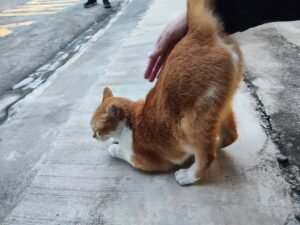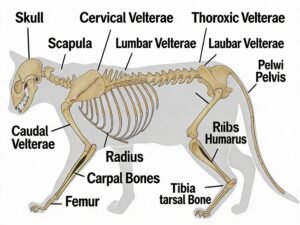

If you really watch a cat’s paws closely, you may notice something amazing — they are not just soft and cute, but also carefully designed for movement, balance, and hunting. In this guide, we will take a closer look at a cat’s front paws and back paws, including their bones, paw pads, and claws. Think of it as taking a short tour inside a cat’s paws, using simple explanations and pictures to help you understand how everything works.
Cat Toes
Cats have 18 toes in total. Each front paw has 5 toes, and each back paw has 4 toes. Compared to humans, this is like having one less big toe on each foot.
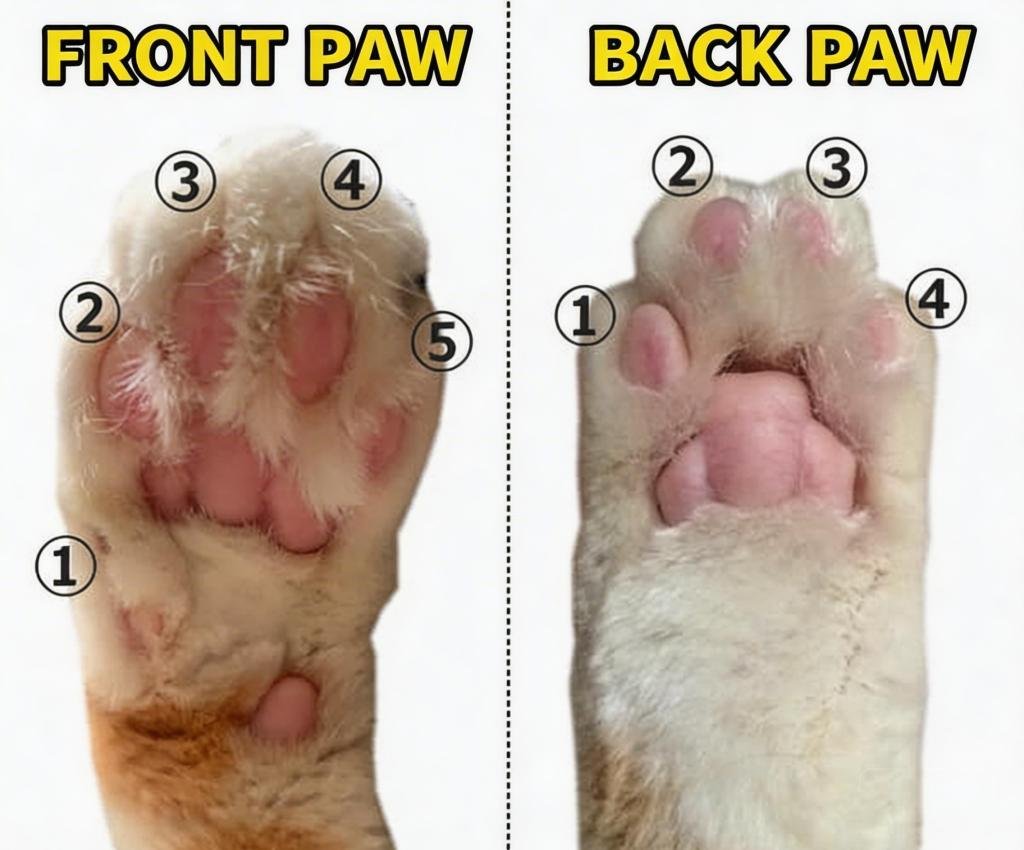
The extra toe on the top part of a cat’s front paw is called a dewclaw. It doesn’t usually touch the ground when the cat walks, but it can help with gripping things when climbing or holding objects.
Polydactyl Cats
Most cats have 18 toes, but in some areas — especially eastern Canada and the northeastern United States — you may sometimes see cats with extra toes. These cats are called polydactyl cats.
Polydactyl cats can have different numbers of toes. The most common case is having one extra toe on each front paw, giving them 20 toes total. It is less common to see extra toes only on the back paws, and it is even rarer to see extra toes on all four paws.
According to the Guinness World Records, a Canadian cat named Jake had 7 toes on each paw, for a total of 28 toes.
Fun Facts About Polydactyl Cats
People often say polydactyl cats are more agile than normal cats. Some of them can grab rolling objects with a single paw, performing movements that ordinary cats cannot easily do. Because of this dexterity, sailors used to bring these cats on ships to help catch mice. That is why they were sometimes called “ship cats.”
The famous American writer Ernest Hemingway once received a polydactyl cat named Snowball from a sailor. This cat later had many descendants, and their descendants still live in the yard of The Ernest Hemingway Home & Museum today. For this reason, polydactyl cats are sometimes called Hemingway cats.
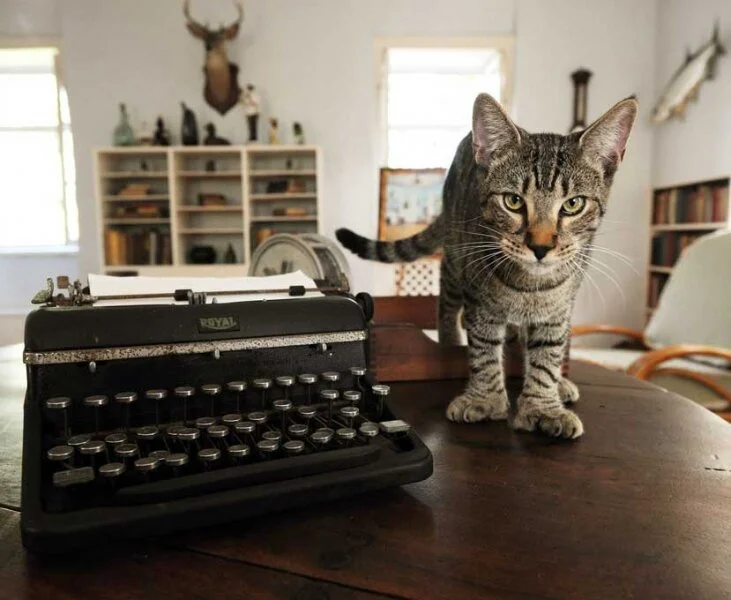
Polydactyly is most commonly seen in some breeds or populations such as the American Polydactyl and Clipper Cat types. A 2016 study confirmed that polydactyly does not usually affect a cat’s bone structure or overall health, so it is generally not something to worry about.
Cat Paw Pads
Cats have soft, cushion-like structures on both their front and back paws called paw pads. If you have ever touched a cat’s paws, you probably know how soft and springy they feel.
Types of Paw Pads
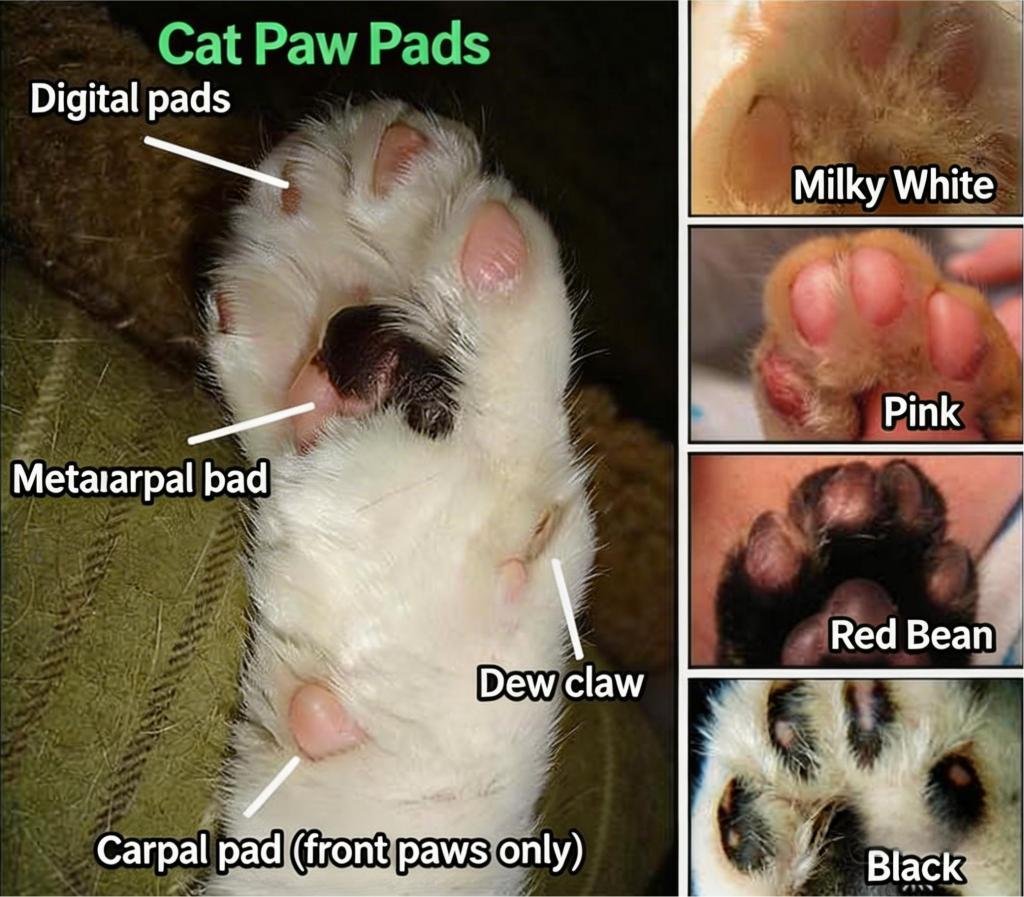
Cat paw pads usually include several different parts. Their colors can vary from black to pink to cream, depending on the cat.
Digital Pads
These are the small pads at the base of each toe.
Front paws usually have 5, while back paws usually have 4.
Metacarpal / Metatarsal Pad
This is the large central pad on the palm or sole area.
It is the biggest pad and provides most of the shock absorption when the cat walks or jumps.
Carpal Pad
This pad only appears on the front paws.
It helps protect a small bone called the pisiform bone. When a cat jumps down from high places or suddenly stops running, this pad helps absorb impact.
Dewclaw
This is similar to a human thumb and is also called the first toe.
It is usually found only on the front paws, unless the cat is a polydactyl cat.
Structure of Paw Pads
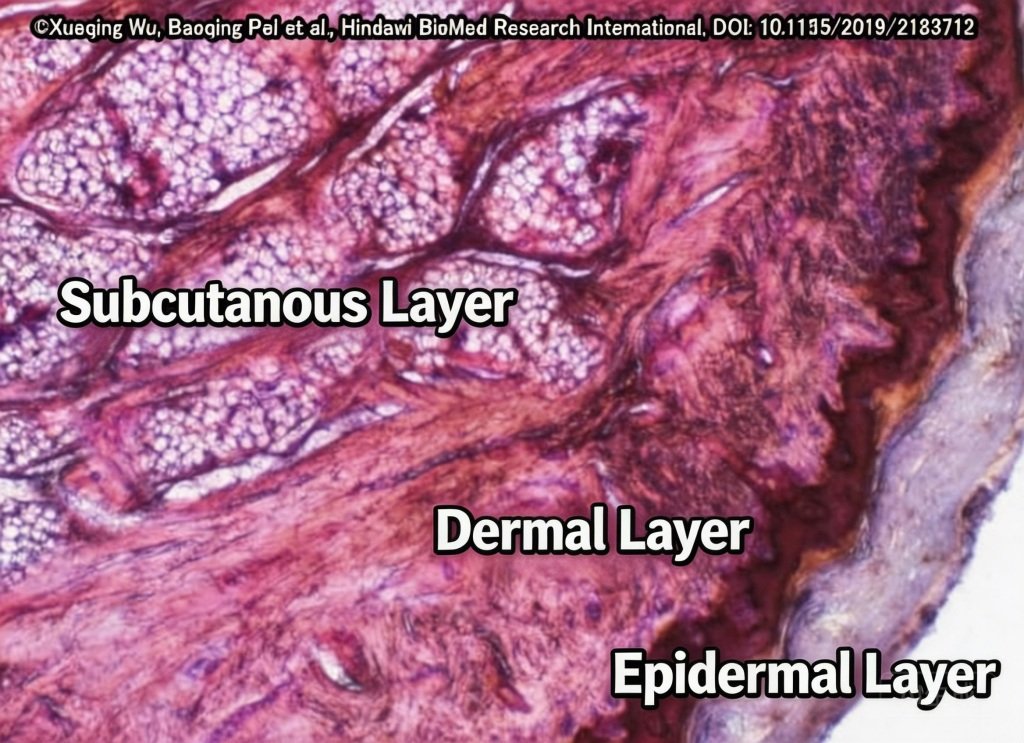
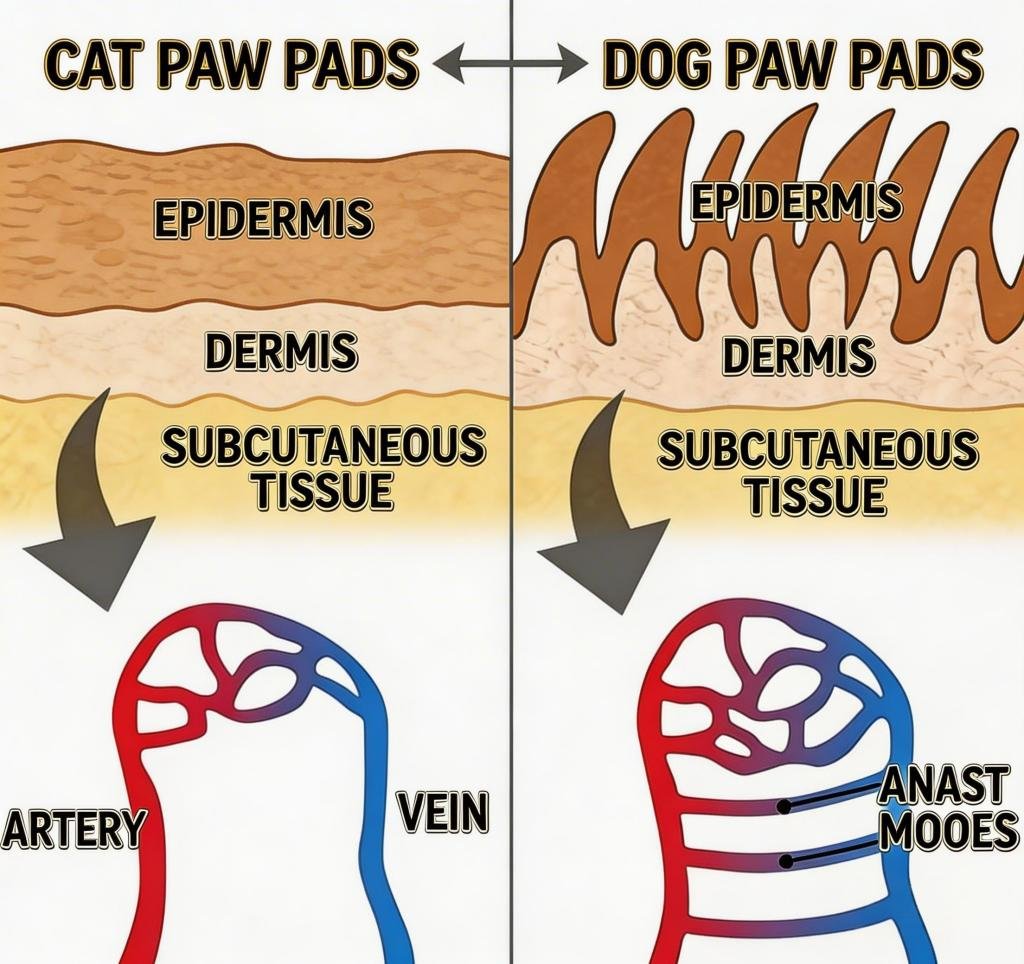
If you look at a paw pad under a microscope, you can see three main layers: the epidermis, dermis, and subcutaneous tissue.
Epidermis Layer
The outer layer contains a lot of Type I collagen fibers, which are very strong and resistant to pulling forces.
Because paw pads directly touch the ground, they are designed to be durable and wear-resistant. The outermost surface keeps building layers of hardened skin, similar to how calluses form on human feet. This helps protect the paw from damage during daily movement.
Dermis Layer
The dermis contains small upward structures called dermal papillae, which are arranged in a honeycomb-like pattern.
This layer contains nerves and blood vessels:
- Nerves send signals about touch, vibration, and pressure
- Blood vessels provide nutrients to surrounding tissues
There are also sweat gland ducts here. Sweat slightly moistens the surface of the paw pad, which increases friction and helps prevent slipping.
Subcutaneous Tissue Layer
The subcutaneous layer contains many small fat compartments surrounded by Type III collagen fibers.
From a 3D perspective, this layer looks like it is filled with many oval-shaped cushions. This structure helps absorb shock when the cat runs, jumps, or lands from heights, reducing damage to bones and joints.
Shock-Absorbing Function of Paw Pads
Researchers studied paw pads from both microscopic and biomechanical perspectives to understand how they work as natural shock absorbers.
They discovered that the oval-shaped fat compartments inside the subcutaneous layer play a key role.
Scientists compared two simulation models:
- Oval-shaped model
- Cylindrical model
When pressure was applied from top to bottom, the oval-shaped model performed better. As pressure increased, its deformation actually became more controlled rather than more severe.
Simply put:
When a cat steps on the ground:
- Pressure is transferred into the subcutaneous tissue
- The oval fat structure is compressed
- The structure gradually changes toward a more stable shape
- The deformation stays controlled
- Muscle force is efficiently transferred to the ground
This is why paw pads feel soft but are actually highly engineered biological shock absorbers. They help cats run, jump, and land safely while maintaining balance and agility.
Paw Pad Colors
Paw pad color mainly depends on melanin levels in the skin. In many cases, paw pad color matches nose color.
Black Paw Pads
Usually seen in cats with more black pigment, such as:
- Black cats
- Gray (blue) cats
- Color-point cats (like Siamese-style cats with darker extremities)
- Black-and-white cats
- Tortoiseshell cats
- Tabby cats
Tortoiseshell cats may have mixed pink and black pads instead of pure black ones.
Pink Paw Pads
More common in cats with more white or orange fur, including:
- White cats
- Albino cats
- Black-and-white cats
- Orange tabby cats
- Orange and white cats
- Some tortoiseshell cats
However, these cats often have mixed-colored pads rather than pure pink pads.
Reddish-Brown (Red Bean Color) Pads
When melanin levels are moderate, paw pads may look dark red-brown, similar to red beans. This is common in:
- Black cats
- Blue cats
- Color-point cats
- Brown or chocolate-colored cats
Mixed Pattern Pads
Some cats have pink and black mixed patterns that look like chocolate candy patterns.
Color Changes to Watch
If a cat’s paw pads gradually change from black to pink, it may be worth paying attention.
Although rare, cats can develop vitiligo, a skin condition that causes loss of pigment. It is usually not life-threatening, but because of reduced melanin protection, the skin may become more sensitive to sunlight. If this happens, it is best to use sun protection measures and consult a veterinarian.
Cats Can Sweat Through Paw Pads
Cats have eccrine sweat glands in their paw pads. These glands release sweat through tiny openings on the surface, keeping paw pads slightly moist.
A simple comparison is that it is like humans breathing lightly into their hands to improve grip. When cats feel nervous at a veterinary clinic, their paw pads may become wet because they are trying to improve traction so they can escape quickly.
Why Paw Pads Sometimes Smell Like Popcorn
Many owners think cat paw pads smell like popcorn or beans. This may come from:
- Sweat gland secretions
- Floor surface odors
- Saliva residues
- Bacterial fermentation on the paw surface
There is no definitive scientific proof, but people with sensitive noses often associate the smell with popcorn or roasted beans.
Paw Pad Sensory Function
Cat paw pads contain myelinated sensory nerve fibers that can transmit mechanical signals such as pressure and vibration at speeds over 40 meters per second (W. Janig, 1968). This allows cats to react quickly to changes in terrain.
Differences Between Cats and Dogs
People often say dogs enjoy running in the snow while cats prefer staying curled up indoors. This difference may relate to paw pad structure.
Compared to cats, dog paw pads are usually rougher. Dogs evolved from wolves living in cold regions, while cats’ ancestors lived in desert environments. These different evolutionary pressures led to differences in paw pad structure and behavior in cold weather.
Cat Claw Structure
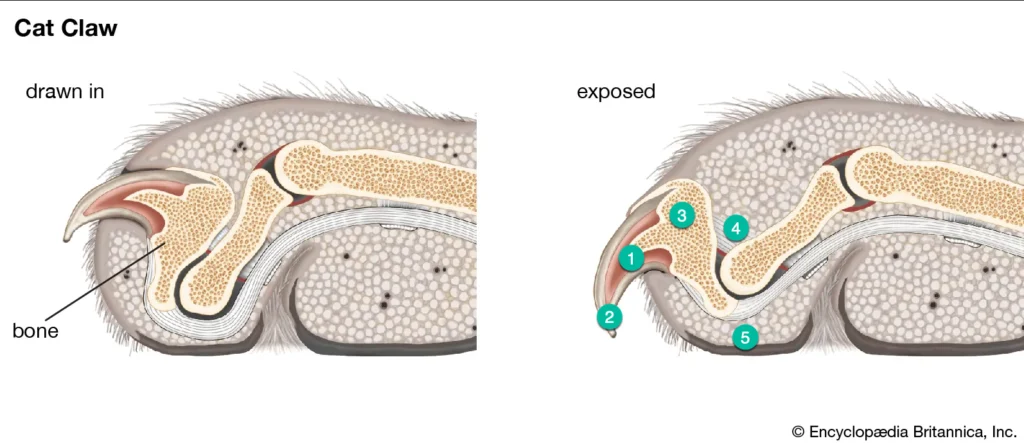
Cats and other felines can retract their claws. Claws have two layers:
- The inner layer is called the quick, which contains nerves and blood vessels
- The outer layer is a hard keratin shell
Cats sharpen their claws to remove old outer layers so new claws stay sharp.
Claw growth is similar to stacking layers of pencil caps:
- New claws grow inside
- Old outer layers peel away
Cats mainly use their front paws for activity, so scratching behavior is more common on front paws.
How Cat Claws Extend
Normally, claws are retracted and held in place by ligaments. This helps:
- Reduce claw wear
- Make footsteps quieter when hunting
When a cat wants to extend its claws, the deep digital flexor tendon is pulled by muscles, working like a pulley system. Cats can extend claws when hunting, walking on slippery surfaces, or climbing trees.
Paw Preference (Left or Right Paw Dominance)
Cats exhibit distinct paw preferences, much like human handedness. According to a significant study involving 66 domestic cats (24 males and 42 females), researchers measured front paw usage frequency through a food-reaching test.
Population Distribution
The study revealed that while many cats have a dominant paw, there is a slight overall bias toward the right paw in the general population:
- Right-paw preference: ~51.5%
- Left-paw preference: ~36.4%
- Ambilateral (No clear preference): ~12.1%
Overall, paw dominance varies greatly between individual cats.